
Test marina services
A second test advert so the classified page can be checked with the standard four advert layout.
+44 0000 000000 / info@1uk.com / 24boatbuilders.gold@24group.uk

 Subscribe
Approved articles for this 24MarinePorts issue.
Approved articles for this 24MarinePorts issue.
Approved articles for this 24MarinePorts issue.
Approved articles for this 24MarinePorts issue.
Approved articles for this 24MarinePorts issue.
Approved articles for this 24MarinePorts issue.
Approved articles for this 24MarinePorts issue.
Approved articles for this 24MarinePorts issue.
Approved articles for this 24MarinePorts issue.
Approved articles for this 24MarinePorts issue.
Approved articles for this 24MarinePorts issue.
Editor's comments for this issue will be added shortly.
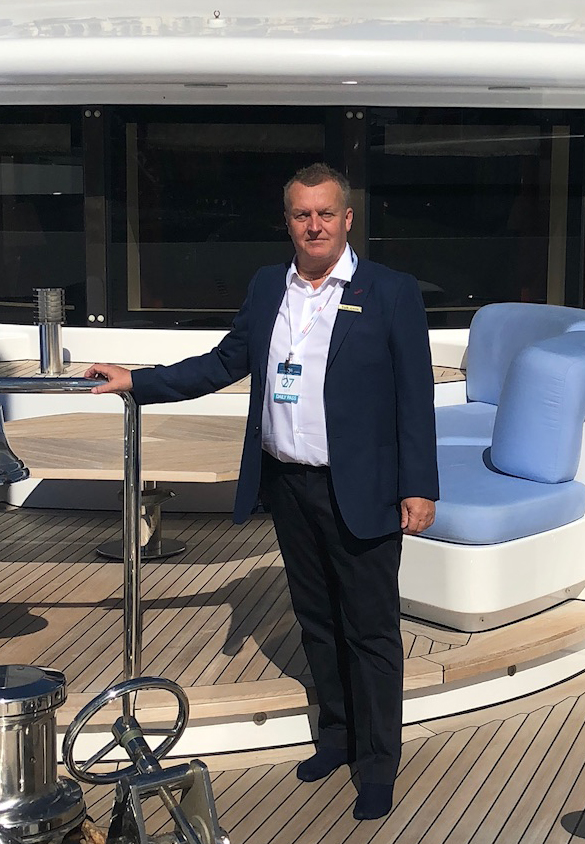
Why We Built 24Synergy — and Why the Magazines Matter

When we started developing 24Synergy, the objective was never simply to build another business directory, advertising website or collection of industry portals. There are already plenty of those, and creating another one would have achieved very little.
The question I kept coming back to was much simpler: **what should 24Synergy actually do for the businesses that use it?**
For me, the answer has always been about creating opportunity through collaboration.
We are constantly told that competition is healthy, and of course it is. Competition drives standards, innovation and better service. But I became interested in a slightly different question. What happens if competitors can also work together?
I don't mean sharing commercially sensitive information or pretending that companies aren't competing for the same customers. I mean recognising that every business already has its own clients, contacts, audience, knowledge and reach. If those individual networks can be connected intelligently, everybody potentially reaches considerably further than they could alone.
That principle became the foundation of 24Synergy.
The network is designed to grow through the businesses using it. Companies introduce their clients and contacts, other businesses do the same, and gradually those separate audiences become part of something much larger. Everybody contributes something to the network and everybody has the opportunity to benefit from the network that results.
There is also a perfectly sensible commercial reason for getting involved early. Your customers are already doing business with other companies and receiving marketing from other suppliers. It therefore makes sense to introduce them to a useful industry network yourself rather than waiting for somebody else to do it first.
That is why I think the early-adopter stage is particularly interesting. I am not going to pretend that a network during its launch period can offer the same volume of activity it should offer when thousands of companies and industry professionals are using it. Networks need people. They need participation and they need time to develop.
But eventually there is a tipping point. More companies join, more buyers arrive, more enquiries circulate, more RFQs are submitted, more people read the newsletters and magazines and more conversations take place through 24live. At that point, the companies that supported the network early aren't arriving and trying to establish themselves in an already busy marketplace. They are already there, with their accounts, listings, content, contacts and presence established.
Some of the mechanisms we have built become much more significant at that stage. Priority access to an RFQ, for example, might seem relatively unimportant when there are only a handful moving through the system. When substantial numbers of genuine opportunities are being generated, seeing something 48 hours before other users can make a considerable difference. The value of the network should therefore increase as the network itself grows.
That same thinking is ultimately what led us to create the magazines.
As 24Synergy developed, I increasingly felt that something was missing. We had created ways for businesses to list themselves, communicate, publish information, distribute newsletters, generate enquiries, respond to opportunities and reach audiences across different specialist sectors, but if we were genuinely trying to build a comprehensive marketing network, those businesses also needed somewhere to advertise.
So we built it.
The 24 Magazines aren't intended to sit separately from 24Synergy. They are another part of the same ecosystem, giving companies another route to market while giving readers useful specialist information in an accessible format. They are global publications, but with regional editions and regional editorial because the businesses and people using 24Synergy are global too.
A company shouldn't be disadvantaged because it happens to be based in Britain, France, the United States, Dubai, Singapore, Spain or somewhere else entirely. Nor should a reader have to wade through endless irrelevant information before finding something applicable to where they live, work, sail, charter, fly or conduct business.
That brings me to something else that is probably worth addressing openly.
Some readers will look through these magazines and ask: **“Have they used AI to produce some of this?”**
The answer is yes.
We have.
There are thousands of pieces of editorial involved across these publications and their regional editions, and it would be rather ridiculous for me to pretend that artificial intelligence hasn't helped us create them. AI exists, it is an extraordinarily useful tool when used properly, and I don't see any reason to hide the fact that we have used it.
What matters to me is **how** we have used it.
We haven't simply asked a machine to fill hundreds of pages with words so that the magazines look busy. We have chosen the subjects we believe are worth covering, identified the questions we think readers actually want answered and, in many cases, started the articles ourselves before using AI to help develop the research, structure and additional information around them.
The objective has always been usefulness.
If you're reading one of our sailing magazines, I want you to discover something that helps you sail, plan a passage, choose equipment, understand a destination or avoid a problem. If you're involved with private aviation, I want the information to answer questions relevant to flying, ownership, charter or operations. If you're in commercial shipping, brokerage, boat building, property, charter or another sector, the same principle applies.
I don't want pages of disposable editorial written simply because a magazine needs another article.
We have tried to identify subjects where somebody would otherwise have to spend time searching around the internet, opening numerous websites and piecing the information together themselves. We can do some of that background work instead, ask the questions and bring the useful information together in one place.
There is an environmental argument for that approach too. Endless searching, loading websites, serving adverts and repeatedly retrieving information all require digital infrastructure and energy. A magazine can be downloaded once, kept and read offline.
I wouldn't pretend that this somehow makes digital publishing impact-free, because it doesn't, but if we can save readers unnecessary searching while creating something useful enough to keep and refer back to, I think that is a better use of the technology available to us.
So yes, some of what you are reading has involved AI, and some of it has involved people. Increasingly it will involve more people as well.
As early adopters, journalists, specialists and other contributors become involved, their voices will naturally become part of these pages. We are also inviting other magazines and media organisations to contribute, which should introduce completely different editorial voices and areas of expertise. They may use AI themselves, of course, and I have no intention of telling another publisher or journalist which tools they are permitted to use.
The test is much simpler than that: **does the article give the reader something worthwhile?**
If it doesn't, it shouldn't be here.
That philosophy also explains something rather unusual we are now introducing. We are going to allow other independent magazines to promote themselves through our magazines.
At first that might sound counter-intuitive. Why would one magazine deliberately introduce its readers to another magazine?
My answer is: why wouldn't we?
If another specialist publication produces good material that our readers would appreciate, discovering it doesn't make our own magazine less useful. Quite the opposite. If we can become somewhere readers come to discover worthwhile information, including information and publications produced by other people, then I think we become more useful.
A participating publication will be able to contribute a genuine editorial article, tell readers where they can find more of its work and promote its magazine within our pages. We can potentially take that relationship considerably further as well. There may be opportunities to work with other publishers commercially, including arrangements where advertising from their own clients can reach our publications and both parties share in the resulting revenue.
Again, it comes back to the original idea behind 24Synergy. Competition doesn't have to prevent collaboration.
The scale of the network comes from the same philosophy. Historically, the industries we have worked with have never existed neatly inside individual boxes. A superyacht depends upon builders, suppliers, engineering companies, crew, brokers, charter businesses, marinas and countless specialist services. Those same owners and clients may use private aviation and own international property. Boat builders need suppliers. Charter companies need customers. Brokers need buyers and sellers. Employers need crew.
Exhibitors need boat shows, and boat shows need exhibitors and visitors.
Commercial ships and cruise ships sit alongside superyachts, motor yachts and sailing yachts. There are crew and employment services, boat and ship builders, ports, yacht services and suppliers, aviation, empty legs, property and specialist luxury markets. Each sector has its own identity, but there are countless points where they intersect.
That is why 24Synergy has become such a large collection of connected websites. It is deliberately not centred on one country or one type of business. A company with branches in several countries can bring those offices together through the same network, while a small specialist supplier can concentrate on the particular market that matters to it. Everything can still be managed centrally through the same account and dashboard.
24live takes that idea in another direction again. I sometimes describe it as sitting somewhere between the professional nature of LinkedIn and the immediacy of a social network such as Facebook, although I don't really want it to become either of those things. The purpose is business.
Members can publish their own material, interact with other users, promote their businesses and place appropriate content across relevant parts of the 24 Network. If somebody wants to be proactive, there is considerable freedom to put themselves in front of the industries they want to reach rather than simply creating a listing and waiting for somebody to find them.
That is an important distinction for me. **24Synergy isn't designed to do your marketing while you sit and watch. It is designed to give you the tools to do considerably more with your marketing yourself.**
There is another, deliberately different part of the ecosystem too.
Within the superyacht sector, 1UK.com is being developed around recognition rather than conventional paid placement. Companies cannot simply buy their way into recognition. They can request consideration, but that request can be declined. As the concept develops, I want appropriate industry leaders themselves to help determine the standards that businesses should achieve to be recognised at different levels.
That connects directly with where I would like 24Synergy itself eventually to go.
The intention is for 24Synergy to develop into a cooperative structure with industry leaders and board members helping to determine its future direction. The industry changes constantly, and the technology serving it needs to change with it. Electric propulsion is an obvious example today, but tomorrow there will be something else. The people actually working within these sectors will often identify what is needed long before a software developer sitting outside the industry ever could.
We have built the infrastructure, but I don't believe that means we should dictate indefinitely what it becomes. I would much rather create a structure where the people using the network have a meaningful voice in deciding which features should be developed next and where the network should go as their industries evolve.
There is a personal reason behind all of this as well.
I've always enjoyed helping businesses develop. I enjoy looking at a new company, understanding what it is trying to achieve and asking what could be done differently. Sometimes it is marketing, sometimes positioning, sometimes making an introduction or simply giving somebody the confidence and advice they need when they're trying to get something started.
I suppose 24Synergy is my attempt to do that on a much larger scale.
Rather than helping one company find another route to market, we have tried to build the infrastructure through which thousands of businesses can create those routes for themselves and for each other. It gives a small specialist company access to many of the same marketing mechanisms available to a much larger international organisation, while allowing a multinational business to connect offices, people and sectors through one global hub.
And that is probably the simplest answer to the question I started with: **what is 24Synergy actually for?**
It is there to create connections and opportunities that would otherwise be harder to create individually. The websites, magazines, newsletters, RFQs, publishing tools, 24live and everything else we develop are simply different ways of achieving that.
We've done the difficult part of bringing that infrastructure together. Now I want businesses to use it, challenge it and help us improve it. I want people to tell us what works, what doesn't and what their particular part of the industry needs next. As more businesses participate, the network should become more useful to everybody already inside it.
We have built 24Synergy, but I don't want it to feel as though it belongs to a small team sitting somewhere deciding what everybody else needs.
**We've built it for you. Now make use of it, make it work for your business, and help us decide what it becomes next.**
**Paul Thompson** *Editor*
Contributor: Paul Thompson / 24Synergy
Be the first reader to react to this article.

There is nothing particularly complicated about marina and port operations: buying used: the checks that matter before money changes hands, but there are several ways to make it unnecessarily expensive.

There is nothing particularly complicated about marina and port operations: buying used: the checks that matter before money changes hands, but there are several ways to make it unnecessarily expensive.
Cost also needs to be separated into purchase cost and ownership cost. The second figure is usually less visible. Consumables, routine servicing, insurance, finance, berthing or storage, professional fees, software subscriptions, inspections and eventual replacement items can materially change the economics. A useful quotation is therefore one that makes exclusions obvious.
If a supplier cannot explain what normally falls outside the quoted figure, ask for that clarification before treating two prices as comparable.
After-sales support can be more important than the original specification. A component that is excellent on paper is less attractive if parts take months to arrive or there is no competent service agent where the equipment will be used. The same applies to software-led products: ownership now includes updates, access rights, data and sometimes recurring subscriptions. Find out who supports the system, for how long, and what happens if the original supplier changes hands.
The regulatory backdrop is also moving. IMO work in 2026 has continued to focus on the infrastructure needed for renewable fuels and on the different levels of regulatory readiness for methanol, ammonia, hydrogen and other alternatives. That does not create one obvious fuel choice. It reinforces the need to match vessel type, route, bunkering availability, safety case and expected operating life before committing capital.
Timing matters. Buying or commissioning under deadline pressure weakens the buyer's position because there is less time to inspect, compare and walk away. Where possible, build the timetable backwards from the date the asset or service is genuinely required. Include survey or inspection time, corrections, training, delivery and a contingency. A realistic programme often reveals that the cheapest-looking option is not the one with the lowest overall cost.
The starting point is use. In marinas, commercial ports, shore power and port services, two apparently similar products or services can be right for completely different owners because their operating pattern is different. Frequency of use, geography, crew or staffing, storage, servicing access and the length of time you expect to keep the asset all change the answer. Before comparing brands or quotations, write down those constraints.

It sounds basic, but it prevents a specification being chosen for a lifestyle that exists only in the sales material.
Technical claims deserve context. Range, output, capacity, speed, efficiency and performance figures are normally produced under stated conditions. Real use adds weather, load, temperature, fouling, route, operator behaviour and reserve margins. Rather than arguing over a headline number, ask what assumptions sit behind it and what happens when those assumptions change. That produces a much more useful comparison.
Sustainability claims are increasingly part of the decision as well. The useful question is not whether a product is described as green, but what has actually changed: energy use, fuel consumption, material choice, repairability, service life, emissions, waste or end-of-life handling. Improvements in one area can create compromises in another. Evidence and measured performance are more valuable than broad environmental language.
Finally, insist on a proper handover. Familiarisation, emergency procedures, maintenance intervals, passwords, spare parts, warranty contacts and operating limitations should all be understood before the supplier disappears over the horizon. A surprising number of early problems are not failures at all but gaps in handover. Thirty minutes spent recording the right information can save days later.


My own shorthand for marina and port operations: buying used: the checks that matter before money changes hands is simple: verify the condition, verify the paperwork, understand the support network and calculate the cost on a realistic pattern of use. If any one of those four is unclear, there is still work to do before committing.
When money is about to change hands, the sequence matters. Establish identity and authority to sell, agree exactly what is included, record known defects and make any deposit terms clear. Where a survey, valuation or finance approval is part of the transaction, the contract should reflect that process rather than relying on a verbal understanding. Buyers should also know when risk and title transfer, particularly if the asset is moving between jurisdictions.
Market value is evidence, not aspiration. Advertised prices show what sellers hope to achieve; completed transactions, condition, specification, location and time on market give a better picture. A well-presented example can deserve a premium, but a premium still needs a reason. The strongest negotiating position comes from knowing which defects are merely cosmetic, which affect usability and which could lead to immediate capital expenditure.
The practical test for marinas, commercial ports, shore power and port services is whether the decision still makes sense when circumstances are less than ideal. Weather changes, schedules move, components fail and people use equipment differently from the designer's neat assumptions. Building a little resilience into the choice usually costs less than trying to recover it afterwards.
For most readers, that is enough to narrow the field considerably before serious money or time is committed.
Contributor: Paul Thompson / Editorial / 24MarinePorts
Be the first reader to react to this article.

A good decision in marinas, commercial ports, shore power and port services rarely comes from one impressive specification.
A good decision in marinas, commercial ports, shore power and port services rarely comes from one impressive specification. It comes from understanding how the whole package will be used.
Documentation is another practical test. Service records, manuals, certificates, invoices, warranties, software licences and evidence of previous work are not administrative clutter; they are part of the asset. Good records make troubleshooting easier and can support resale. Missing records do not automatically mean there is a problem, but they increase uncertainty, and uncertainty should be reflected in the questions asked, the inspection undertaken and sometimes the price.
Risk is best dealt with before commitment. That means independent inspection where appropriate, clear written scope, confirmation of insurance implications and an agreed process for defects or incomplete work. In higher-value transactions, legal, tax and regulatory advice should come from qualified advisers in the relevant jurisdiction. The purpose is not to make every transaction defensive; it is to stop assumptions becoming expensive surprises.
The regulatory backdrop is also moving. IMO work in 2026 has continued to focus on the infrastructure needed for renewable fuels and on the different levels of regulatory readiness for methanol, ammonia, hydrogen and other alternatives. That does not create one obvious fuel choice. It reinforces the need to match vessel type, route, bunkering availability, safety case and expected operating life before committing capital.
Resale should be considered even by people who intend to keep something for years. Highly personal specifications can be perfectly sensible, but buyers should understand the trade-off. Widely supported equipment, sensible layouts, complete records and recognised maintenance tend to be easier for the next owner to understand. The objective is not to design everything for an unknown future buyer; it is simply to avoid destroying flexibility without a good reason.
Cost also needs to be separated into purchase cost and ownership cost. The second figure is usually less visible. Consumables, routine servicing, insurance, finance, berthing or storage, professional fees, software subscriptions, inspections and eventual replacement items can materially change the economics. A useful quotation is therefore one that makes exclusions obvious.
If a supplier cannot explain what normally falls outside the quoted figure, ask for that clarification before treating two prices as comparable.
After-sales support can be more important than the original specification. A component that is excellent on paper is less attractive if parts take months to arrive or there is no competent service agent where the equipment will be used. The same applies to software-led products: ownership now includes updates, access rights, data and sometimes recurring subscriptions. Find out who supports the system, for how long, and what happens if the original supplier changes hands.
Timing matters. Buying or commissioning under deadline pressure weakens the buyer's position because there is less time to inspect, compare and walk away. Where possible, build the timetable backwards from the date the asset or service is genuinely required. Include survey or inspection time, corrections, training, delivery and a contingency. A realistic programme often reveals that the cheapest-looking option is not the one with the lowest overall cost.
The starting point is use. In marinas, commercial ports, shore power and port services, two apparently similar products or services can be right for completely different owners because their operating pattern is different. Frequency of use, geography, crew or staffing, storage, servicing access and the length of time you expect to keep the asset all change the answer. Before comparing brands or quotations, write down those constraints.
It sounds basic, but it prevents a specification being chosen for a lifestyle that exists only in the sales material.

When money is about to change hands, the sequence matters. Establish identity and authority to sell, agree exactly what is included, record known defects and make any deposit terms clear. Where a survey, valuation or finance approval is part of the transaction, the contract should reflect that process rather than relying on a verbal understanding. Buyers should also know when risk and title transfer, particularly if the asset is moving between jurisdictions.
Market value is evidence, not aspiration. Advertised prices show what sellers hope to achieve; completed transactions, condition, specification, location and time on market give a better picture. A well-presented example can deserve a premium, but a premium still needs a reason. The strongest negotiating position comes from knowing which defects are merely cosmetic, which affect usability and which could lead to immediate capital expenditure.
The practical test for marinas, commercial ports, shore power and port services is whether the decision still makes sense when circumstances are less than ideal. Weather changes, schedules move, components fail and people use equipment differently from the designer's neat assumptions. Building a little resilience into the choice usually costs less than trying to recover it afterwards.
The sensible approach is therefore quite conventional: define the job, verify the evidence, price the whole commitment and keep enough margin for the things that never appear in the brochure.
Contributor: Paul Thompson / Editorial / 24MarinePorts
Be the first reader to react to this article.

A good decision in marinas, commercial ports, shore power and port services rarely comes from one impressive specification.
A good decision in marinas, commercial ports, shore power and port services rarely comes from one impressive specification. It comes from understanding how the whole package will be used.
Finally, insist on a proper handover. Familiarisation, emergency procedures, maintenance intervals, passwords, spare parts, warranty contacts and operating limitations should all be understood before the supplier disappears over the horizon. A surprising number of early problems are not failures at all but gaps in handover. Thirty minutes spent recording the right information can save days later.
Documentation is another practical test. Service records, manuals, certificates, invoices, warranties, software licences and evidence of previous work are not administrative clutter; they are part of the asset. Good records make troubleshooting easier and can support resale. Missing records do not automatically mean there is a problem, but they increase uncertainty, and uncertainty should be reflected in the questions asked, the inspection undertaken and sometimes the price.
The regulatory backdrop is also moving. IMO work in 2026 has continued to focus on the infrastructure needed for renewable fuels and on the different levels of regulatory readiness for methanol, ammonia, hydrogen and other alternatives. That does not create one obvious fuel choice. It reinforces the need to match vessel type, route, bunkering availability, safety case and expected operating life before committing capital.
Risk is best dealt with before commitment. That means independent inspection where appropriate, clear written scope, confirmation of insurance implications and an agreed process for defects or incomplete work. In higher-value transactions, legal, tax and regulatory advice should come from qualified advisers in the relevant jurisdiction. The purpose is not to make every transaction defensive; it is to stop assumptions becoming expensive surprises.
Resale should be considered even by people who intend to keep something for years. Highly personal specifications can be perfectly sensible, but buyers should understand the trade-off. Widely supported equipment, sensible layouts, complete records and recognised maintenance tend to be easier for the next owner to understand. The objective is not to design everything for an unknown future buyer; it is simply to avoid destroying flexibility without a good reason.
Cost also needs to be separated into purchase cost and ownership cost. The second figure is usually less visible. Consumables, routine servicing, insurance, finance, berthing or storage, professional fees, software subscriptions, inspections and eventual replacement items can materially change the economics. A useful quotation is therefore one that makes exclusions obvious.
If a supplier cannot explain what normally falls outside the quoted figure, ask for that clarification before treating two prices as comparable.
After-sales support can be more important than the original specification. A component that is excellent on paper is less attractive if parts take months to arrive or there is no competent service agent where the equipment will be used. The same applies to software-led products: ownership now includes updates, access rights, data and sometimes recurring subscriptions. Find out who supports the system, for how long, and what happens if the original supplier changes hands.
Timing matters. Buying or commissioning under deadline pressure weakens the buyer's position because there is less time to inspect, compare and walk away. Where possible, build the timetable backwards from the date the asset or service is genuinely required. Include survey or inspection time, corrections, training, delivery and a contingency. A realistic programme often reveals that the cheapest-looking option is not the one with the lowest overall cost.

My own shorthand for choosing marina and port operations suppliers: why response time can matter as much as price is simple: verify the condition, verify the paperwork, understand the support network and calculate the cost on a realistic pattern of use. If any one of those four is unclear, there is still work to do before committing.
When money is about to change hands, the sequence matters. Establish identity and authority to sell, agree exactly what is included, record known defects and make any deposit terms clear. Where a survey, valuation or finance approval is part of the transaction, the contract should reflect that process rather than relying on a verbal understanding. Buyers should also know when risk and title transfer, particularly if the asset is moving between jurisdictions.
Market value is evidence, not aspiration. Advertised prices show what sellers hope to achieve; completed transactions, condition, specification, location and time on market give a better picture. A well-presented example can deserve a premium, but a premium still needs a reason. The strongest negotiating position comes from knowing which defects are merely cosmetic, which affect usability and which could lead to immediate capital expenditure.
The practical test for marinas, commercial ports, shore power and port services is whether the decision still makes sense when circumstances are less than ideal. Weather changes, schedules move, components fail and people use equipment differently from the designer's neat assumptions. Building a little resilience into the choice usually costs less than trying to recover it afterwards.
For most readers, that is enough to narrow the field considerably before serious money or time is committed.
Contributor: Paul Thompson / Editorial / 24MarinePorts
Be the first reader to react to this article.
I have always found that the useful part of marinas, commercial ports, shore power and port services starts once the brochure language has been stripped away.
I have always found that the useful part of marinas, commercial ports, shore power and port services starts once the brochure language has been stripped away.
Technical claims deserve context. Range, output, capacity, speed, efficiency and performance figures are normally produced under stated conditions. Real use adds weather, load, temperature, fouling, route, operator behaviour and reserve margins. Rather than arguing over a headline number, ask what assumptions sit behind it and what happens when those assumptions change. That produces a much more useful comparison.
Sustainability claims are increasingly part of the decision as well. The useful question is not whether a product is described as green, but what has actually changed: energy use, fuel consumption, material choice, repairability, service life, emissions, waste or end-of-life handling. Improvements in one area can create compromises in another. Evidence and measured performance are more valuable than broad environmental language.
The regulatory backdrop is also moving. IMO work in 2026 has continued to focus on the infrastructure needed for renewable fuels and on the different levels of regulatory readiness for methanol, ammonia, hydrogen and other alternatives. That does not create one obvious fuel choice. It reinforces the need to match vessel type, route, bunkering availability, safety case and expected operating life before committing capital.
Finally, insist on a proper handover. Familiarisation, emergency procedures, maintenance intervals, passwords, spare parts, warranty contacts and operating limitations should all be understood before the supplier disappears over the horizon. A surprising number of early problems are not failures at all but gaps in handover. Thirty minutes spent recording the right information can save days later.
Documentation is another practical test. Service records, manuals, certificates, invoices, warranties, software licences and evidence of previous work are not administrative clutter; they are part of the asset. Good records make troubleshooting easier and can support resale. Missing records do not automatically mean there is a problem, but they increase uncertainty, and uncertainty should be reflected in the questions asked, the inspection undertaken and sometimes the price.
Risk is best dealt with before commitment. That means independent inspection where appropriate, clear written scope, confirmation of insurance implications and an agreed process for defects or incomplete work. In higher-value transactions, legal, tax and regulatory advice should come from qualified advisers in the relevant jurisdiction. The purpose is not to make every transaction defensive; it is to stop assumptions becoming expensive surprises.
Resale should be considered even by people who intend to keep something for years. Highly personal specifications can be perfectly sensible, but buyers should understand the trade-off. Widely supported equipment, sensible layouts, complete records and recognised maintenance tend to be easier for the next owner to understand. The objective is not to design everything for an unknown future buyer; it is simply to avoid destroying flexibility without a good reason.
Cost also needs to be separated into purchase cost and ownership cost. The second figure is usually less visible. Consumables, routine servicing, insurance, finance, berthing or storage, professional fees, software subscriptions, inspections and eventual replacement items can materially change the economics. A useful quotation is therefore one that makes exclusions obvious.
If a supplier cannot explain what normally falls outside the quoted figure, ask for that clarification before treating two prices as comparable.


Comparison becomes easier if every contender is put through the same questions. Ask for the same operating assumptions, the same delivery point, the same warranty period and the same list of included equipment or services. That turns a collection of sales conversations into something closer to a procurement exercise and exposes the areas where one quotation has quietly omitted an expensive item.
References are useful when they are relevant. A supplier's biggest or most prestigious project may tell you very little about how it handles an ordinary job in your region. Ask instead for examples with a similar scale, operating pattern and timetable. The most useful reference is often the customer who has lived with the product for two or three years and has already needed after-sales support.
The practical test for marinas, commercial ports, shore power and port services is whether the decision still makes sense when circumstances are less than ideal. Weather changes, schedules move, components fail and people use equipment differently from the designer's neat assumptions. Building a little resilience into the choice usually costs less than trying to recover it afterwards.
None of this makes the decision difficult. It simply moves attention from presentation to evidence, which is usually where the better value sits.
Contributor: Paul Thompson / Editorial / 24MarinePorts
Be the first reader to react to this article.
This is one of those subjects where a little preparation is worth far more than a long list of features.
This is one of those subjects where a little preparation is worth far more than a long list of features.
After-sales support can be more important than the original specification. A component that is excellent on paper is less attractive if parts take months to arrive or there is no competent service agent where the equipment will be used. The same applies to software-led products: ownership now includes updates, access rights, data and sometimes recurring subscriptions. Find out who supports the system, for how long, and what happens if the original supplier changes hands.
Timing matters. Buying or commissioning under deadline pressure weakens the buyer's position because there is less time to inspect, compare and walk away. Where possible, build the timetable backwards from the date the asset or service is genuinely required. Include survey or inspection time, corrections, training, delivery and a contingency. A realistic programme often reveals that the cheapest-looking option is not the one with the lowest overall cost.
The regulatory backdrop is also moving. IMO work in 2026 has continued to focus on the infrastructure needed for renewable fuels and on the different levels of regulatory readiness for methanol, ammonia, hydrogen and other alternatives. That does not create one obvious fuel choice. It reinforces the need to match vessel type, route, bunkering availability, safety case and expected operating life before committing capital.
The starting point is use. In marinas, commercial ports, shore power and port services, two apparently similar products or services can be right for completely different owners because their operating pattern is different. Frequency of use, geography, crew or staffing, storage, servicing access and the length of time you expect to keep the asset all change the answer. Before comparing brands or quotations, write down those constraints.
It sounds basic, but it prevents a specification being chosen for a lifestyle that exists only in the sales material.
Technical claims deserve context. Range, output, capacity, speed, efficiency and performance figures are normally produced under stated conditions. Real use adds weather, load, temperature, fouling, route, operator behaviour and reserve margins. Rather than arguing over a headline number, ask what assumptions sit behind it and what happens when those assumptions change. That produces a much more useful comparison.
Sustainability claims are increasingly part of the decision as well. The useful question is not whether a product is described as green, but what has actually changed: energy use, fuel consumption, material choice, repairability, service life, emissions, waste or end-of-life handling. Improvements in one area can create compromises in another. Evidence and measured performance are more valuable than broad environmental language.
Finally, insist on a proper handover. Familiarisation, emergency procedures, maintenance intervals, passwords, spare parts, warranty contacts and operating limitations should all be understood before the supplier disappears over the horizon. A surprising number of early problems are not failures at all but gaps in handover. Thirty minutes spent recording the right information can save days later.
Documentation is another practical test. Service records, manuals, certificates, invoices, warranties, software licences and evidence of previous work are not administrative clutter; they are part of the asset. Good records make troubleshooting easier and can support resale. Missing records do not automatically mean there is a problem, but they increase uncertainty, and uncertainty should be reflected in the questions asked, the inspection undertaken and sometimes the price.
When money is about to change hands, the sequence matters. Establish identity and authority to sell, agree exactly what is included, record known defects and make any deposit terms clear. Where a survey, valuation or finance approval is part of the transaction, the contract should reflect that process rather than relying on a verbal understanding. Buyers should also know when risk and title transfer, particularly if the asset is moving between jurisdictions.
Market value is evidence, not aspiration. Advertised prices show what sellers hope to achieve; completed transactions, condition, specification, location and time on market give a better picture. A well-presented example can deserve a premium, but a premium still needs a reason. The strongest negotiating position comes from knowing which defects are merely cosmetic, which affect usability and which could lead to immediate capital expenditure.
The practical test for marinas, commercial ports, shore power and port services is whether the decision still makes sense when circumstances are less than ideal. Weather changes, schedules move, components fail and people use equipment differently from the designer's neat assumptions. Building a little resilience into the choice usually costs less than trying to recover it afterwards.
A measured decision now generally costs less than correcting an enthusiastic one later.
Contributor: Paul Thompson / Editorial / 24MarinePorts
Be the first reader to react to this article.
The market has become very good at presenting insurance questions worth answering before you commit as simple.
The market has become very good at presenting insurance questions worth answering before you commit as simple. In practice, the details still determine whether it works.
Risk is best dealt with before commitment. That means independent inspection where appropriate, clear written scope, confirmation of insurance implications and an agreed process for defects or incomplete work. In higher-value transactions, legal, tax and regulatory advice should come from qualified advisers in the relevant jurisdiction. The purpose is not to make every transaction defensive; it is to stop assumptions becoming expensive surprises.
Resale should be considered even by people who intend to keep something for years. Highly personal specifications can be perfectly sensible, but buyers should understand the trade-off. Widely supported equipment, sensible layouts, complete records and recognised maintenance tend to be easier for the next owner to understand. The objective is not to design everything for an unknown future buyer; it is simply to avoid destroying flexibility without a good reason.
The regulatory backdrop is also moving. IMO work in 2026 has continued to focus on the infrastructure needed for renewable fuels and on the different levels of regulatory readiness for methanol, ammonia, hydrogen and other alternatives. That does not create one obvious fuel choice. It reinforces the need to match vessel type, route, bunkering availability, safety case and expected operating life before committing capital.
Cost also needs to be separated into purchase cost and ownership cost. The second figure is usually less visible. Consumables, routine servicing, insurance, finance, berthing or storage, professional fees, software subscriptions, inspections and eventual replacement items can materially change the economics. A useful quotation is therefore one that makes exclusions obvious.
If a supplier cannot explain what normally falls outside the quoted figure, ask for that clarification before treating two prices as comparable.
After-sales support can be more important than the original specification. A component that is excellent on paper is less attractive if parts take months to arrive or there is no competent service agent where the equipment will be used. The same applies to software-led products: ownership now includes updates, access rights, data and sometimes recurring subscriptions. Find out who supports the system, for how long, and what happens if the original supplier changes hands.
Timing matters. Buying or commissioning under deadline pressure weakens the buyer's position because there is less time to inspect, compare and walk away. Where possible, build the timetable backwards from the date the asset or service is genuinely required. Include survey or inspection time, corrections, training, delivery and a contingency. A realistic programme often reveals that the cheapest-looking option is not the one with the lowest overall cost.
The starting point is use. In marinas, commercial ports, shore power and port services, two apparently similar products or services can be right for completely different owners because their operating pattern is different. Frequency of use, geography, crew or staffing, storage, servicing access and the length of time you expect to keep the asset all change the answer. Before comparing brands or quotations, write down those constraints.
It sounds basic, but it prevents a specification being chosen for a lifestyle that exists only in the sales material.
Technical claims deserve context. Range, output, capacity, speed, efficiency and performance figures are normally produced under stated conditions. Real use adds weather, load, temperature, fouling, route, operator behaviour and reserve margins. Rather than arguing over a headline number, ask what assumptions sit behind it and what happens when those assumptions change. That produces a much more useful comparison.

My own shorthand for insurance questions worth answering before you commit is simple: verify the condition, verify the paperwork, understand the support network and calculate the cost on a realistic pattern of use. If any one of those four is unclear, there is still work to do before committing.
Comparison becomes easier if every contender is put through the same questions. Ask for the same operating assumptions, the same delivery point, the same warranty period and the same list of included equipment or services. That turns a collection of sales conversations into something closer to a procurement exercise and exposes the areas where one quotation has quietly omitted an expensive item.
References are useful when they are relevant. A supplier's biggest or most prestigious project may tell you very little about how it handles an ordinary job in your region. Ask instead for examples with a similar scale, operating pattern and timetable. The most useful reference is often the customer who has lived with the product for two or three years and has already needed after-sales support.
The practical test for marinas, commercial ports, shore power and port services is whether the decision still makes sense when circumstances are less than ideal. Weather changes, schedules move, components fail and people use equipment differently from the designer's neat assumptions. Building a little resilience into the choice usually costs less than trying to recover it afterwards.
For most readers, that is enough to narrow the field considerably before serious money or time is committed.
Contributor: Paul Thompson / Editorial / 24MarinePorts
Be the first reader to react to this article.
This is one of those subjects where a little preparation is worth far more than a long list of features.
This is one of those subjects where a little preparation is worth far more than a long list of features.
Sustainability claims are increasingly part of the decision as well. The useful question is not whether a product is described as green, but what has actually changed: energy use, fuel consumption, material choice, repairability, service life, emissions, waste or end-of-life handling. Improvements in one area can create compromises in another. Evidence and measured performance are more valuable than broad environmental language.
Finally, insist on a proper handover. Familiarisation, emergency procedures, maintenance intervals, passwords, spare parts, warranty contacts and operating limitations should all be understood before the supplier disappears over the horizon. A surprising number of early problems are not failures at all but gaps in handover. Thirty minutes spent recording the right information can save days later.
The regulatory backdrop is also moving. IMO work in 2026 has continued to focus on the infrastructure needed for renewable fuels and on the different levels of regulatory readiness for methanol, ammonia, hydrogen and other alternatives. That does not create one obvious fuel choice. It reinforces the need to match vessel type, route, bunkering availability, safety case and expected operating life before committing capital.
Documentation is another practical test. Service records, manuals, certificates, invoices, warranties, software licences and evidence of previous work are not administrative clutter; they are part of the asset. Good records make troubleshooting easier and can support resale. Missing records do not automatically mean there is a problem, but they increase uncertainty, and uncertainty should be reflected in the questions asked, the inspection undertaken and sometimes the price.
Risk is best dealt with before commitment. That means independent inspection where appropriate, clear written scope, confirmation of insurance implications and an agreed process for defects or incomplete work. In higher-value transactions, legal, tax and regulatory advice should come from qualified advisers in the relevant jurisdiction. The purpose is not to make every transaction defensive; it is to stop assumptions becoming expensive surprises.
Resale should be considered even by people who intend to keep something for years. Highly personal specifications can be perfectly sensible, but buyers should understand the trade-off. Widely supported equipment, sensible layouts, complete records and recognised maintenance tend to be easier for the next owner to understand. The objective is not to design everything for an unknown future buyer; it is simply to avoid destroying flexibility without a good reason.
Cost also needs to be separated into purchase cost and ownership cost. The second figure is usually less visible. Consumables, routine servicing, insurance, finance, berthing or storage, professional fees, software subscriptions, inspections and eventual replacement items can materially change the economics. A useful quotation is therefore one that makes exclusions obvious.
If a supplier cannot explain what normally falls outside the quoted figure, ask for that clarification before treating two prices as comparable.
After-sales support can be more important than the original specification. A component that is excellent on paper is less attractive if parts take months to arrive or there is no competent service agent where the equipment will be used. The same applies to software-led products: ownership now includes updates, access rights, data and sometimes recurring subscriptions. Find out who supports the system, for how long, and what happens if the original supplier changes hands.

Preventive work is most effective when it is recorded rather than remembered. A simple calendar of hours, dates, consumables, inspections and recurring tasks gives owners and managers an early warning before maintenance becomes urgent. It also allows jobs to be grouped sensibly, reducing repeated access costs and downtime. The discipline is not glamorous, but it is one of the clearest ways to protect reliability.
Scope control matters on any refit or repair. Once equipment is opened up, additional work is common, so the original quotation should distinguish fixed items, provisional sums and work that requires further authorisation. Photographing condition before and after the job and retaining replaced-part details can prevent disputes and gives the next technician a useful history.
The practical test for marinas, commercial ports, shore power and port services is whether the decision still makes sense when circumstances are less than ideal. Weather changes, schedules move, components fail and people use equipment differently from the designer's neat assumptions. Building a little resilience into the choice usually costs less than trying to recover it afterwards.
That is the point worth carrying into the next conversation with a broker, builder, supplier or adviser: ask what the choice will be like to own and operate, not merely what it is like to buy.
Contributor: Paul Thompson / Editorial / 24MarinePorts
Be the first reader to react to this article.
A good decision in marinas, commercial ports, shore power and port services rarely comes from one impressive specification.
A good decision in marinas, commercial ports, shore power and port services rarely comes from one impressive specification. It comes from understanding how the whole package will be used.
Timing matters. Buying or commissioning under deadline pressure weakens the buyer's position because there is less time to inspect, compare and walk away. Where possible, build the timetable backwards from the date the asset or service is genuinely required. Include survey or inspection time, corrections, training, delivery and a contingency. A realistic programme often reveals that the cheapest-looking option is not the one with the lowest overall cost.
The starting point is use. In marinas, commercial ports, shore power and port services, two apparently similar products or services can be right for completely different owners because their operating pattern is different. Frequency of use, geography, crew or staffing, storage, servicing access and the length of time you expect to keep the asset all change the answer. Before comparing brands or quotations, write down those constraints.
It sounds basic, but it prevents a specification being chosen for a lifestyle that exists only in the sales material.
The regulatory backdrop is also moving. IMO work in 2026 has continued to focus on the infrastructure needed for renewable fuels and on the different levels of regulatory readiness for methanol, ammonia, hydrogen and other alternatives. That does not create one obvious fuel choice. It reinforces the need to match vessel type, route, bunkering availability, safety case and expected operating life before committing capital.
Technical claims deserve context. Range, output, capacity, speed, efficiency and performance figures are normally produced under stated conditions. Real use adds weather, load, temperature, fouling, route, operator behaviour and reserve margins. Rather than arguing over a headline number, ask what assumptions sit behind it and what happens when those assumptions change. That produces a much more useful comparison.
Sustainability claims are increasingly part of the decision as well. The useful question is not whether a product is described as green, but what has actually changed: energy use, fuel consumption, material choice, repairability, service life, emissions, waste or end-of-life handling. Improvements in one area can create compromises in another. Evidence and measured performance are more valuable than broad environmental language.
Finally, insist on a proper handover. Familiarisation, emergency procedures, maintenance intervals, passwords, spare parts, warranty contacts and operating limitations should all be understood before the supplier disappears over the horizon. A surprising number of early problems are not failures at all but gaps in handover. Thirty minutes spent recording the right information can save days later.
Documentation is another practical test. Service records, manuals, certificates, invoices, warranties, software licences and evidence of previous work are not administrative clutter; they are part of the asset. Good records make troubleshooting easier and can support resale. Missing records do not automatically mean there is a problem, but they increase uncertainty, and uncertainty should be reflected in the questions asked, the inspection undertaken and sometimes the price.
Risk is best dealt with before commitment. That means independent inspection where appropriate, clear written scope, confirmation of insurance implications and an agreed process for defects or incomplete work. In higher-value transactions, legal, tax and regulatory advice should come from qualified advisers in the relevant jurisdiction. The purpose is not to make every transaction defensive; it is to stop assumptions becoming expensive surprises.

Connected equipment creates a second maintenance schedule: passwords, access permissions, firmware, backups and subscriptions. Owners should know which systems can be updated remotely, which data leaves the asset and whether loss of an online service affects core operation. A paper or offline record of critical settings is still useful when the problem being diagnosed is the network itself.
Cybersecurity does not need to become a specialist exercise for every user. Basic separation of guest and operational networks, unique credentials, prompt updates and controlled administrator access remove a large proportion of avoidable risk. The more important question for a supplier is whether security has been designed into the product and whether updates will continue throughout its realistic service life.
The practical test for marinas, commercial ports, shore power and port services is whether the decision still makes sense when circumstances are less than ideal. Weather changes, schedules move, components fail and people use equipment differently from the designer's neat assumptions. Building a little resilience into the choice usually costs less than trying to recover it afterwards.
The best outcome is not necessarily the newest or most sophisticated option. It is the one that remains practical after the first season, the first service bill and the first change of plan.
Contributor: Paul Thompson / Editorial / 24MarinePorts
Be the first reader to react to this article.
The market has become very good at presenting where energy efficiency now makes a practical difference as simple.
The market has become very good at presenting where energy efficiency now makes a practical difference as simple. In practice, the details still determine whether it works.
Resale should be considered even by people who intend to keep something for years. Highly personal specifications can be perfectly sensible, but buyers should understand the trade-off. Widely supported equipment, sensible layouts, complete records and recognised maintenance tend to be easier for the next owner to understand. The objective is not to design everything for an unknown future buyer; it is simply to avoid destroying flexibility without a good reason.
Cost also needs to be separated into purchase cost and ownership cost. The second figure is usually less visible. Consumables, routine servicing, insurance, finance, berthing or storage, professional fees, software subscriptions, inspections and eventual replacement items can materially change the economics. A useful quotation is therefore one that makes exclusions obvious.
If a supplier cannot explain what normally falls outside the quoted figure, ask for that clarification before treating two prices as comparable.
The regulatory backdrop is also moving. IMO work in 2026 has continued to focus on the infrastructure needed for renewable fuels and on the different levels of regulatory readiness for methanol, ammonia, hydrogen and other alternatives. That does not create one obvious fuel choice. It reinforces the need to match vessel type, route, bunkering availability, safety case and expected operating life before committing capital.
After-sales support can be more important than the original specification. A component that is excellent on paper is less attractive if parts take months to arrive or there is no competent service agent where the equipment will be used. The same applies to software-led products: ownership now includes updates, access rights, data and sometimes recurring subscriptions. Find out who supports the system, for how long, and what happens if the original supplier changes hands.
Timing matters. Buying or commissioning under deadline pressure weakens the buyer's position because there is less time to inspect, compare and walk away. Where possible, build the timetable backwards from the date the asset or service is genuinely required. Include survey or inspection time, corrections, training, delivery and a contingency. A realistic programme often reveals that the cheapest-looking option is not the one with the lowest overall cost.
The starting point is use. In marinas, commercial ports, shore power and port services, two apparently similar products or services can be right for completely different owners because their operating pattern is different. Frequency of use, geography, crew or staffing, storage, servicing access and the length of time you expect to keep the asset all change the answer. Before comparing brands or quotations, write down those constraints.
It sounds basic, but it prevents a specification being chosen for a lifestyle that exists only in the sales material.
Technical claims deserve context. Range, output, capacity, speed, efficiency and performance figures are normally produced under stated conditions. Real use adds weather, load, temperature, fouling, route, operator behaviour and reserve margins. Rather than arguing over a headline number, ask what assumptions sit behind it and what happens when those assumptions change. That produces a much more useful comparison.
Sustainability claims are increasingly part of the decision as well. The useful question is not whether a product is described as green, but what has actually changed: energy use, fuel consumption, material choice, repairability, service life, emissions, waste or end-of-life handling. Improvements in one area can create compromises in another. Evidence and measured performance are more valuable than broad environmental language.
Energy decisions need a duty-cycle calculation. Average use is less important than the difficult day: the longest passage, the coldest morning, the heaviest load, the remote berth or the turnaround with the least charging time. Design around that case with a sensible reserve and the everyday operation normally becomes straightforward. Design around the brochure average and the owner may spend years managing around the system.
Infrastructure should be checked before hardware is ordered. Available electrical supply, connector type, grid capacity, bunkering arrangements, ventilation, fire protection and local operating rules can all dictate what is practical. In many projects the limiting factor is not the motor, battery or fuel technology; it is the place where the asset has to recharge, refuel or be maintained.
The practical test for marinas, commercial ports, shore power and port services is whether the decision still makes sense when circumstances are less than ideal. Weather changes, schedules move, components fail and people use equipment differently from the designer's neat assumptions. Building a little resilience into the choice usually costs less than trying to recover it afterwards.
For most readers, that is enough to narrow the field considerably before serious money or time is committed.
Contributor: Paul Thompson / Editorial / 24MarinePorts
Be the first reader to react to this article.
One of the easiest mistakes in marinas, commercial ports, shore power and port services is to concentrate on the headline and leave the awkward questions until later.
One of the easiest mistakes in marinas, commercial ports, shore power and port services is to concentrate on the headline and leave the awkward questions until later.
The starting point is use. In marinas, commercial ports, shore power and port services, two apparently similar products or services can be right for completely different owners because their operating pattern is different. Frequency of use, geography, crew or staffing, storage, servicing access and the length of time you expect to keep the asset all change the answer. Before comparing brands or quotations, write down those constraints.
It sounds basic, but it prevents a specification being chosen for a lifestyle that exists only in the sales material.
Technical claims deserve context. Range, output, capacity, speed, efficiency and performance figures are normally produced under stated conditions. Real use adds weather, load, temperature, fouling, route, operator behaviour and reserve margins. Rather than arguing over a headline number, ask what assumptions sit behind it and what happens when those assumptions change. That produces a much more useful comparison.
The regulatory backdrop is also moving. IMO work in 2026 has continued to focus on the infrastructure needed for renewable fuels and on the different levels of regulatory readiness for methanol, ammonia, hydrogen and other alternatives. That does not create one obvious fuel choice. It reinforces the need to match vessel type, route, bunkering availability, safety case and expected operating life before committing capital.
Sustainability claims are increasingly part of the decision as well. The useful question is not whether a product is described as green, but what has actually changed: energy use, fuel consumption, material choice, repairability, service life, emissions, waste or end-of-life handling. Improvements in one area can create compromises in another. Evidence and measured performance are more valuable than broad environmental language.
Finally, insist on a proper handover. Familiarisation, emergency procedures, maintenance intervals, passwords, spare parts, warranty contacts and operating limitations should all be understood before the supplier disappears over the horizon. A surprising number of early problems are not failures at all but gaps in handover. Thirty minutes spent recording the right information can save days later.
Documentation is another practical test. Service records, manuals, certificates, invoices, warranties, software licences and evidence of previous work are not administrative clutter; they are part of the asset. Good records make troubleshooting easier and can support resale. Missing records do not automatically mean there is a problem, but they increase uncertainty, and uncertainty should be reflected in the questions asked, the inspection undertaken and sometimes the price.
Risk is best dealt with before commitment. That means independent inspection where appropriate, clear written scope, confirmation of insurance implications and an agreed process for defects or incomplete work. In higher-value transactions, legal, tax and regulatory advice should come from qualified advisers in the relevant jurisdiction. The purpose is not to make every transaction defensive; it is to stop assumptions becoming expensive surprises.
Resale should be considered even by people who intend to keep something for years. Highly personal specifications can be perfectly sensible, but buyers should understand the trade-off. Widely supported equipment, sensible layouts, complete records and recognised maintenance tend to be easier for the next owner to understand. The objective is not to design everything for an unknown future buyer; it is simply to avoid destroying flexibility without a good reason.

When money is about to change hands, the sequence matters. Establish identity and authority to sell, agree exactly what is included, record known defects and make any deposit terms clear. Where a survey, valuation or finance approval is part of the transaction, the contract should reflect that process rather than relying on a verbal understanding. Buyers should also know when risk and title transfer, particularly if the asset is moving between jurisdictions.
Market value is evidence, not aspiration. Advertised prices show what sellers hope to achieve; completed transactions, condition, specification, location and time on market give a better picture. A well-presented example can deserve a premium, but a premium still needs a reason. The strongest negotiating position comes from knowing which defects are merely cosmetic, which affect usability and which could lead to immediate capital expenditure.
The practical test for marinas, commercial ports, shore power and port services is whether the decision still makes sense when circumstances are less than ideal. Weather changes, schedules move, components fail and people use equipment differently from the designer's neat assumptions. Building a little resilience into the choice usually costs less than trying to recover it afterwards.
The sensible approach is therefore quite conventional: define the job, verify the evidence, price the whole commitment and keep enough margin for the things that never appear in the brochure.
Contributor: Paul Thompson / Editorial / 24MarinePorts
Be the first reader to react to this article.
For anyone looking at planning for winter: the work that prevents expensive spring surprises, the first job is not to decide what looks best.
For anyone looking at planning for winter: the work that prevents expensive spring surprises, the first job is not to decide what looks best. It is to establish what problem actually needs solving.
Cost also needs to be separated into purchase cost and ownership cost. The second figure is usually less visible. Consumables, routine servicing, insurance, finance, berthing or storage, professional fees, software subscriptions, inspections and eventual replacement items can materially change the economics. A useful quotation is therefore one that makes exclusions obvious.
If a supplier cannot explain what normally falls outside the quoted figure, ask for that clarification before treating two prices as comparable.
After-sales support can be more important than the original specification. A component that is excellent on paper is less attractive if parts take months to arrive or there is no competent service agent where the equipment will be used. The same applies to software-led products: ownership now includes updates, access rights, data and sometimes recurring subscriptions. Find out who supports the system, for how long, and what happens if the original supplier changes hands.
The regulatory backdrop is also moving. IMO work in 2026 has continued to focus on the infrastructure needed for renewable fuels and on the different levels of regulatory readiness for methanol, ammonia, hydrogen and other alternatives. That does not create one obvious fuel choice. It reinforces the need to match vessel type, route, bunkering availability, safety case and expected operating life before committing capital.
Timing matters. Buying or commissioning under deadline pressure weakens the buyer's position because there is less time to inspect, compare and walk away. Where possible, build the timetable backwards from the date the asset or service is genuinely required. Include survey or inspection time, corrections, training, delivery and a contingency. A realistic programme often reveals that the cheapest-looking option is not the one with the lowest overall cost.
The starting point is use. In marinas, commercial ports, shore power and port services, two apparently similar products or services can be right for completely different owners because their operating pattern is different. Frequency of use, geography, crew or staffing, storage, servicing access and the length of time you expect to keep the asset all change the answer. Before comparing brands or quotations, write down those constraints.
It sounds basic, but it prevents a specification being chosen for a lifestyle that exists only in the sales material.
Technical claims deserve context. Range, output, capacity, speed, efficiency and performance figures are normally produced under stated conditions. Real use adds weather, load, temperature, fouling, route, operator behaviour and reserve margins. Rather than arguing over a headline number, ask what assumptions sit behind it and what happens when those assumptions change. That produces a much more useful comparison.
Sustainability claims are increasingly part of the decision as well. The useful question is not whether a product is described as green, but what has actually changed: energy use, fuel consumption, material choice, repairability, service life, emissions, waste or end-of-life handling. Improvements in one area can create compromises in another. Evidence and measured performance are more valuable than broad environmental language.
Finally, insist on a proper handover. Familiarisation, emergency procedures, maintenance intervals, passwords, spare parts, warranty contacts and operating limitations should all be understood before the supplier disappears over the horizon. A surprising number of early problems are not failures at all but gaps in handover. Thirty minutes spent recording the right information can save days later.
Preventive work is most effective when it is recorded rather than remembered. A simple calendar of hours, dates, consumables, inspections and recurring tasks gives owners and managers an early warning before maintenance becomes urgent. It also allows jobs to be grouped sensibly, reducing repeated access costs and downtime. The discipline is not glamorous, but it is one of the clearest ways to protect reliability.
Scope control matters on any refit or repair. Once equipment is opened up, additional work is common, so the original quotation should distinguish fixed items, provisional sums and work that requires further authorisation. Photographing condition before and after the job and retaining replaced-part details can prevent disputes and gives the next technician a useful history.
The practical test for marinas, commercial ports, shore power and port services is whether the decision still makes sense when circumstances are less than ideal. Weather changes, schedules move, components fail and people use equipment differently from the designer's neat assumptions. Building a little resilience into the choice usually costs less than trying to recover it afterwards.
The best outcome is not necessarily the newest or most sophisticated option. It is the one that remains practical after the first season, the first service bill and the first change of plan.
Contributor: Paul Thompson / Editorial / 24MarinePorts
Be the first reader to react to this article.
I have always found that the useful part of marinas, commercial ports, shore power and port services starts once the brochure language has been stripped away.
I have always found that the useful part of marinas, commercial ports, shore power and port services starts once the brochure language has been stripped away.
Documentation is another practical test. Service records, manuals, certificates, invoices, warranties, software licences and evidence of previous work are not administrative clutter; they are part of the asset. Good records make troubleshooting easier and can support resale. Missing records do not automatically mean there is a problem, but they increase uncertainty, and uncertainty should be reflected in the questions asked, the inspection undertaken and sometimes the price.
Risk is best dealt with before commitment. That means independent inspection where appropriate, clear written scope, confirmation of insurance implications and an agreed process for defects or incomplete work. In higher-value transactions, legal, tax and regulatory advice should come from qualified advisers in the relevant jurisdiction. The purpose is not to make every transaction defensive; it is to stop assumptions becoming expensive surprises.
The regulatory backdrop is also moving. IMO work in 2026 has continued to focus on the infrastructure needed for renewable fuels and on the different levels of regulatory readiness for methanol, ammonia, hydrogen and other alternatives. That does not create one obvious fuel choice. It reinforces the need to match vessel type, route, bunkering availability, safety case and expected operating life before committing capital.
Resale should be considered even by people who intend to keep something for years. Highly personal specifications can be perfectly sensible, but buyers should understand the trade-off. Widely supported equipment, sensible layouts, complete records and recognised maintenance tend to be easier for the next owner to understand. The objective is not to design everything for an unknown future buyer; it is simply to avoid destroying flexibility without a good reason.
Cost also needs to be separated into purchase cost and ownership cost. The second figure is usually less visible. Consumables, routine servicing, insurance, finance, berthing or storage, professional fees, software subscriptions, inspections and eventual replacement items can materially change the economics. A useful quotation is therefore one that makes exclusions obvious.
If a supplier cannot explain what normally falls outside the quoted figure, ask for that clarification before treating two prices as comparable.
After-sales support can be more important than the original specification. A component that is excellent on paper is less attractive if parts take months to arrive or there is no competent service agent where the equipment will be used. The same applies to software-led products: ownership now includes updates, access rights, data and sometimes recurring subscriptions. Find out who supports the system, for how long, and what happens if the original supplier changes hands.
Timing matters. Buying or commissioning under deadline pressure weakens the buyer's position because there is less time to inspect, compare and walk away. Where possible, build the timetable backwards from the date the asset or service is genuinely required. Include survey or inspection time, corrections, training, delivery and a contingency. A realistic programme often reveals that the cheapest-looking option is not the one with the lowest overall cost.
The starting point is use. In marinas, commercial ports, shore power and port services, two apparently similar products or services can be right for completely different owners because their operating pattern is different. Frequency of use, geography, crew or staffing, storage, servicing access and the length of time you expect to keep the asset all change the answer. Before comparing brands or quotations, write down those constraints.
It sounds basic, but it prevents a specification being chosen for a lifestyle that exists only in the sales material.

Comparison becomes easier if every contender is put through the same questions. Ask for the same operating assumptions, the same delivery point, the same warranty period and the same list of included equipment or services. That turns a collection of sales conversations into something closer to a procurement exercise and exposes the areas where one quotation has quietly omitted an expensive item.
References are useful when they are relevant. A supplier's biggest or most prestigious project may tell you very little about how it handles an ordinary job in your region. Ask instead for examples with a similar scale, operating pattern and timetable. The most useful reference is often the customer who has lived with the product for two or three years and has already needed after-sales support.
The practical test for marinas, commercial ports, shore power and port services is whether the decision still makes sense when circumstances are less than ideal. Weather changes, schedules move, components fail and people use equipment differently from the designer's neat assumptions. Building a little resilience into the choice usually costs less than trying to recover it afterwards.
That is the point worth carrying into the next conversation with a broker, builder, supplier or adviser: ask what the choice will be like to own and operate, not merely what it is like to buy.
Contributor: Paul Thompson / Editorial / 24MarinePorts
Be the first reader to react to this article.
One of the easiest mistakes in marinas, commercial ports, shore power and port services is to concentrate on the headline and leave the awkward questions until later.
One of the easiest mistakes in marinas, commercial ports, shore power and port services is to concentrate on the headline and leave the awkward questions until later.
Technical claims deserve context. Range, output, capacity, speed, efficiency and performance figures are normally produced under stated conditions. Real use adds weather, load, temperature, fouling, route, operator behaviour and reserve margins. Rather than arguing over a headline number, ask what assumptions sit behind it and what happens when those assumptions change. That produces a much more useful comparison.
Sustainability claims are increasingly part of the decision as well. The useful question is not whether a product is described as green, but what has actually changed: energy use, fuel consumption, material choice, repairability, service life, emissions, waste or end-of-life handling. Improvements in one area can create compromises in another. Evidence and measured performance are more valuable than broad environmental language.
The regulatory backdrop is also moving. IMO work in 2026 has continued to focus on the infrastructure needed for renewable fuels and on the different levels of regulatory readiness for methanol, ammonia, hydrogen and other alternatives. That does not create one obvious fuel choice. It reinforces the need to match vessel type, route, bunkering availability, safety case and expected operating life before committing capital.
Finally, insist on a proper handover. Familiarisation, emergency procedures, maintenance intervals, passwords, spare parts, warranty contacts and operating limitations should all be understood before the supplier disappears over the horizon. A surprising number of early problems are not failures at all but gaps in handover. Thirty minutes spent recording the right information can save days later.
Documentation is another practical test. Service records, manuals, certificates, invoices, warranties, software licences and evidence of previous work are not administrative clutter; they are part of the asset. Good records make troubleshooting easier and can support resale. Missing records do not automatically mean there is a problem, but they increase uncertainty, and uncertainty should be reflected in the questions asked, the inspection undertaken and sometimes the price.
Risk is best dealt with before commitment. That means independent inspection where appropriate, clear written scope, confirmation of insurance implications and an agreed process for defects or incomplete work. In higher-value transactions, legal, tax and regulatory advice should come from qualified advisers in the relevant jurisdiction. The purpose is not to make every transaction defensive; it is to stop assumptions becoming expensive surprises.
Resale should be considered even by people who intend to keep something for years. Highly personal specifications can be perfectly sensible, but buyers should understand the trade-off. Widely supported equipment, sensible layouts, complete records and recognised maintenance tend to be easier for the next owner to understand. The objective is not to design everything for an unknown future buyer; it is simply to avoid destroying flexibility without a good reason.
Cost also needs to be separated into purchase cost and ownership cost. The second figure is usually less visible. Consumables, routine servicing, insurance, finance, berthing or storage, professional fees, software subscriptions, inspections and eventual replacement items can materially change the economics. A useful quotation is therefore one that makes exclusions obvious.
If a supplier cannot explain what normally falls outside the quoted figure, ask for that clarification before treating two prices as comparable.
My own shorthand for marina and port operations: refit or replace? a practical way to make the decision is simple: verify the condition, verify the paperwork, understand the support network and calculate the cost on a realistic pattern of use. If any one of those four is unclear, there is still work to do before committing.
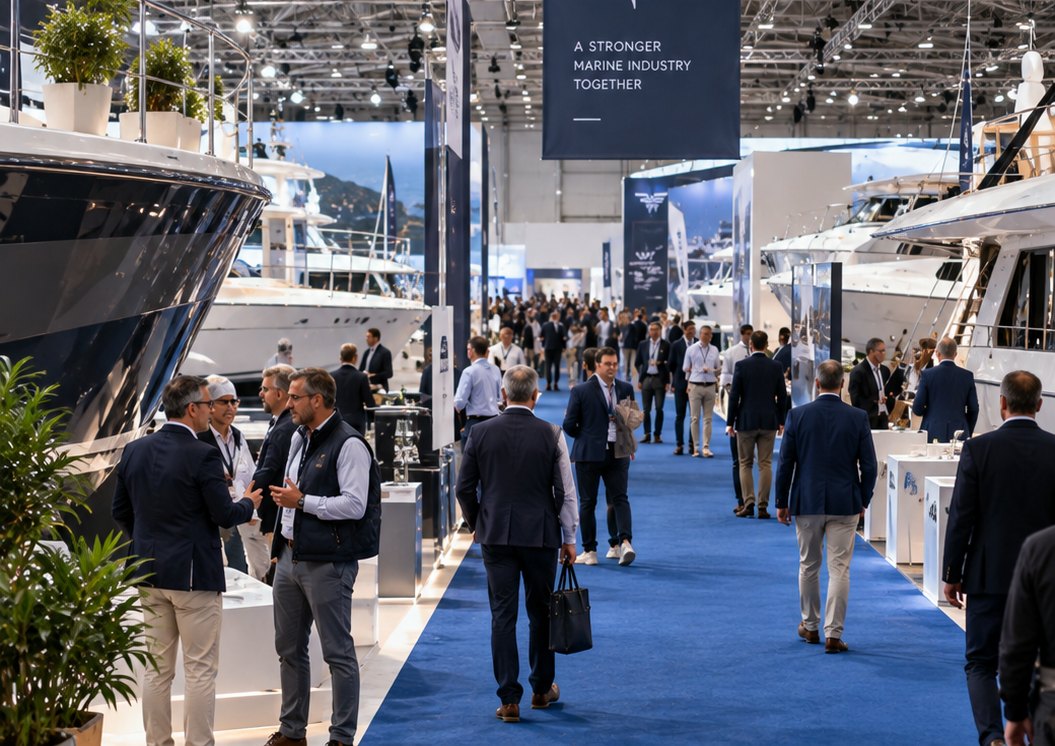
Preventive work is most effective when it is recorded rather than remembered. A simple calendar of hours, dates, consumables, inspections and recurring tasks gives owners and managers an early warning before maintenance becomes urgent. It also allows jobs to be grouped sensibly, reducing repeated access costs and downtime. The discipline is not glamorous, but it is one of the clearest ways to protect reliability.
Scope control matters on any refit or repair. Once equipment is opened up, additional work is common, so the original quotation should distinguish fixed items, provisional sums and work that requires further authorisation. Photographing condition before and after the job and retaining replaced-part details can prevent disputes and gives the next technician a useful history.
The practical test for marinas, commercial ports, shore power and port services is whether the decision still makes sense when circumstances are less than ideal. Weather changes, schedules move, components fail and people use equipment differently from the designer's neat assumptions. Building a little resilience into the choice usually costs less than trying to recover it afterwards.
None of this makes the decision difficult. It simply moves attention from presentation to evidence, which is usually where the better value sits.
Contributor: Paul Thompson / Editorial / 24MarinePorts
Be the first reader to react to this article.
This is one of those subjects where a little preparation is worth far more than a long list of features.
This is one of those subjects where a little preparation is worth far more than a long list of features.
After-sales support can be more important than the original specification. A component that is excellent on paper is less attractive if parts take months to arrive or there is no competent service agent where the equipment will be used. The same applies to software-led products: ownership now includes updates, access rights, data and sometimes recurring subscriptions. Find out who supports the system, for how long, and what happens if the original supplier changes hands.
Timing matters. Buying or commissioning under deadline pressure weakens the buyer's position because there is less time to inspect, compare and walk away. Where possible, build the timetable backwards from the date the asset or service is genuinely required. Include survey or inspection time, corrections, training, delivery and a contingency. A realistic programme often reveals that the cheapest-looking option is not the one with the lowest overall cost.
The regulatory backdrop is also moving. IMO work in 2026 has continued to focus on the infrastructure needed for renewable fuels and on the different levels of regulatory readiness for methanol, ammonia, hydrogen and other alternatives. That does not create one obvious fuel choice. It reinforces the need to match vessel type, route, bunkering availability, safety case and expected operating life before committing capital.
The starting point is use. In marinas, commercial ports, shore power and port services, two apparently similar products or services can be right for completely different owners because their operating pattern is different. Frequency of use, geography, crew or staffing, storage, servicing access and the length of time you expect to keep the asset all change the answer. Before comparing brands or quotations, write down those constraints.
It sounds basic, but it prevents a specification being chosen for a lifestyle that exists only in the sales material.
Technical claims deserve context. Range, output, capacity, speed, efficiency and performance figures are normally produced under stated conditions. Real use adds weather, load, temperature, fouling, route, operator behaviour and reserve margins. Rather than arguing over a headline number, ask what assumptions sit behind it and what happens when those assumptions change. That produces a much more useful comparison.
Sustainability claims are increasingly part of the decision as well. The useful question is not whether a product is described as green, but what has actually changed: energy use, fuel consumption, material choice, repairability, service life, emissions, waste or end-of-life handling. Improvements in one area can create compromises in another. Evidence and measured performance are more valuable than broad environmental language.
Finally, insist on a proper handover. Familiarisation, emergency procedures, maintenance intervals, passwords, spare parts, warranty contacts and operating limitations should all be understood before the supplier disappears over the horizon. A surprising number of early problems are not failures at all but gaps in handover. Thirty minutes spent recording the right information can save days later.
Documentation is another practical test. Service records, manuals, certificates, invoices, warranties, software licences and evidence of previous work are not administrative clutter; they are part of the asset. Good records make troubleshooting easier and can support resale. Missing records do not automatically mean there is a problem, but they increase uncertainty, and uncertainty should be reflected in the questions asked, the inspection undertaken and sometimes the price.
Comparison becomes easier if every contender is put through the same questions. Ask for the same operating assumptions, the same delivery point, the same warranty period and the same list of included equipment or services. That turns a collection of sales conversations into something closer to a procurement exercise and exposes the areas where one quotation has quietly omitted an expensive item.
References are useful when they are relevant. A supplier's biggest or most prestigious project may tell you very little about how it handles an ordinary job in your region. Ask instead for examples with a similar scale, operating pattern and timetable. The most useful reference is often the customer who has lived with the product for two or three years and has already needed after-sales support.
The practical test for marinas, commercial ports, shore power and port services is whether the decision still makes sense when circumstances are less than ideal. Weather changes, schedules move, components fail and people use equipment differently from the designer's neat assumptions. Building a little resilience into the choice usually costs less than trying to recover it afterwards.
For most readers, that is enough to narrow the field considerably before serious money or time is committed.
Contributor: Paul Thompson / Editorial / 24MarinePorts
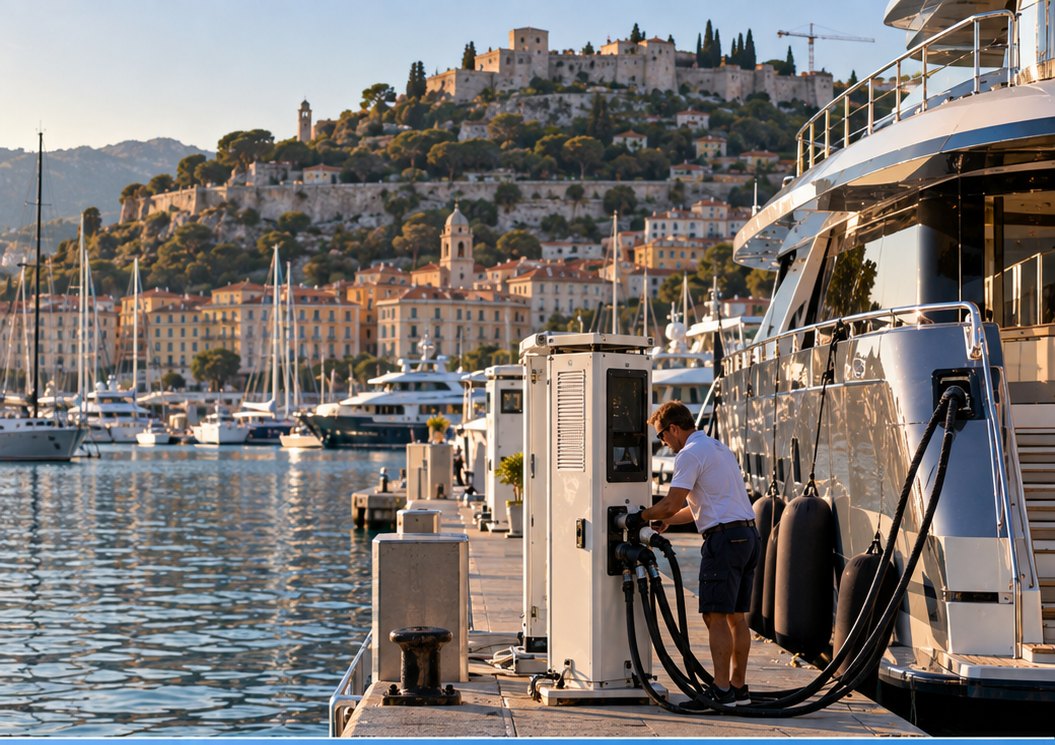
Be the first reader to react to this article.
For anyone looking at common specification upgrades that solve real problems, the first job is not to decide what looks best.
For anyone looking at common specification upgrades that solve real problems, the first job is not to decide what looks best. It is to establish what problem actually needs solving.
Risk is best dealt with before commitment. That means independent inspection where appropriate, clear written scope, confirmation of insurance implications and an agreed process for defects or incomplete work. In higher-value transactions, legal, tax and regulatory advice should come from qualified advisers in the relevant jurisdiction. The purpose is not to make every transaction defensive; it is to stop assumptions becoming expensive surprises.
Resale should be considered even by people who intend to keep something for years. Highly personal specifications can be perfectly sensible, but buyers should understand the trade-off. Widely supported equipment, sensible layouts, complete records and recognised maintenance tend to be easier for the next owner to understand. The objective is not to design everything for an unknown future buyer; it is simply to avoid destroying flexibility without a good reason.
The regulatory backdrop is also moving. IMO work in 2026 has continued to focus on the infrastructure needed for renewable fuels and on the different levels of regulatory readiness for methanol, ammonia, hydrogen and other alternatives. That does not create one obvious fuel choice. It reinforces the need to match vessel type, route, bunkering availability, safety case and expected operating life before committing capital.
Cost also needs to be separated into purchase cost and ownership cost. The second figure is usually less visible. Consumables, routine servicing, insurance, finance, berthing or storage, professional fees, software subscriptions, inspections and eventual replacement items can materially change the economics. A useful quotation is therefore one that makes exclusions obvious.
If a supplier cannot explain what normally falls outside the quoted figure, ask for that clarification before treating two prices as comparable.
After-sales support can be more important than the original specification. A component that is excellent on paper is less attractive if parts take months to arrive or there is no competent service agent where the equipment will be used. The same applies to software-led products: ownership now includes updates, access rights, data and sometimes recurring subscriptions. Find out who supports the system, for how long, and what happens if the original supplier changes hands.
Timing matters. Buying or commissioning under deadline pressure weakens the buyer's position because there is less time to inspect, compare and walk away. Where possible, build the timetable backwards from the date the asset or service is genuinely required. Include survey or inspection time, corrections, training, delivery and a contingency. A realistic programme often reveals that the cheapest-looking option is not the one with the lowest overall cost.
The starting point is use. In marinas, commercial ports, shore power and port services, two apparently similar products or services can be right for completely different owners because their operating pattern is different. Frequency of use, geography, crew or staffing, storage, servicing access and the length of time you expect to keep the asset all change the answer. Before comparing brands or quotations, write down those constraints.
It sounds basic, but it prevents a specification being chosen for a lifestyle that exists only in the sales material.
Technical claims deserve context. Range, output, capacity, speed, efficiency and performance figures are normally produced under stated conditions. Real use adds weather, load, temperature, fouling, route, operator behaviour and reserve margins. Rather than arguing over a headline number, ask what assumptions sit behind it and what happens when those assumptions change. That produces a much more useful comparison.

Comparison becomes easier if every contender is put through the same questions. Ask for the same operating assumptions, the same delivery point, the same warranty period and the same list of included equipment or services. That turns a collection of sales conversations into something closer to a procurement exercise and exposes the areas where one quotation has quietly omitted an expensive item.
References are useful when they are relevant. A supplier's biggest or most prestigious project may tell you very little about how it handles an ordinary job in your region. Ask instead for examples with a similar scale, operating pattern and timetable. The most useful reference is often the customer who has lived with the product for two or three years and has already needed after-sales support.
The practical test for marinas, commercial ports, shore power and port services is whether the decision still makes sense when circumstances are less than ideal. Weather changes, schedules move, components fail and people use equipment differently from the designer's neat assumptions. Building a little resilience into the choice usually costs less than trying to recover it afterwards.
That is the point worth carrying into the next conversation with a broker, builder, supplier or adviser: ask what the choice will be like to own and operate, not merely what it is like to buy.
Contributor: Paul Thompson / Editorial / 24MarinePorts
Be the first reader to react to this article.
A good decision in marinas, commercial ports, shore power and port services rarely comes from one impressive specification.
A good decision in marinas, commercial ports, shore power and port services rarely comes from one impressive specification. It comes from understanding how the whole package will be used.
Sustainability claims are increasingly part of the decision as well. The useful question is not whether a product is described as green, but what has actually changed: energy use, fuel consumption, material choice, repairability, service life, emissions, waste or end-of-life handling. Improvements in one area can create compromises in another. Evidence and measured performance are more valuable than broad environmental language.
Finally, insist on a proper handover. Familiarisation, emergency procedures, maintenance intervals, passwords, spare parts, warranty contacts and operating limitations should all be understood before the supplier disappears over the horizon. A surprising number of early problems are not failures at all but gaps in handover. Thirty minutes spent recording the right information can save days later.
The regulatory backdrop is also moving. IMO work in 2026 has continued to focus on the infrastructure needed for renewable fuels and on the different levels of regulatory readiness for methanol, ammonia, hydrogen and other alternatives. That does not create one obvious fuel choice. It reinforces the need to match vessel type, route, bunkering availability, safety case and expected operating life before committing capital.
Documentation is another practical test. Service records, manuals, certificates, invoices, warranties, software licences and evidence of previous work are not administrative clutter; they are part of the asset. Good records make troubleshooting easier and can support resale. Missing records do not automatically mean there is a problem, but they increase uncertainty, and uncertainty should be reflected in the questions asked, the inspection undertaken and sometimes the price.
Risk is best dealt with before commitment. That means independent inspection where appropriate, clear written scope, confirmation of insurance implications and an agreed process for defects or incomplete work. In higher-value transactions, legal, tax and regulatory advice should come from qualified advisers in the relevant jurisdiction. The purpose is not to make every transaction defensive; it is to stop assumptions becoming expensive surprises.
Resale should be considered even by people who intend to keep something for years. Highly personal specifications can be perfectly sensible, but buyers should understand the trade-off. Widely supported equipment, sensible layouts, complete records and recognised maintenance tend to be easier for the next owner to understand. The objective is not to design everything for an unknown future buyer; it is simply to avoid destroying flexibility without a good reason.
Cost also needs to be separated into purchase cost and ownership cost. The second figure is usually less visible. Consumables, routine servicing, insurance, finance, berthing or storage, professional fees, software subscriptions, inspections and eventual replacement items can materially change the economics. A useful quotation is therefore one that makes exclusions obvious.
If a supplier cannot explain what normally falls outside the quoted figure, ask for that clarification before treating two prices as comparable.
After-sales support can be more important than the original specification. A component that is excellent on paper is less attractive if parts take months to arrive or there is no competent service agent where the equipment will be used. The same applies to software-led products: ownership now includes updates, access rights, data and sometimes recurring subscriptions. Find out who supports the system, for how long, and what happens if the original supplier changes hands.

When money is about to change hands, the sequence matters. Establish identity and authority to sell, agree exactly what is included, record known defects and make any deposit terms clear. Where a survey, valuation or finance approval is part of the transaction, the contract should reflect that process rather than relying on a verbal understanding. Buyers should also know when risk and title transfer, particularly if the asset is moving between jurisdictions.
Market value is evidence, not aspiration. Advertised prices show what sellers hope to achieve; completed transactions, condition, specification, location and time on market give a better picture. A well-presented example can deserve a premium, but a premium still needs a reason. The strongest negotiating position comes from knowing which defects are merely cosmetic, which affect usability and which could lead to immediate capital expenditure.
The practical test for marinas, commercial ports, shore power and port services is whether the decision still makes sense when circumstances are less than ideal. Weather changes, schedules move, components fail and people use equipment differently from the designer's neat assumptions. Building a little resilience into the choice usually costs less than trying to recover it afterwards.
A measured decision now generally costs less than correcting an enthusiastic one later.
Contributor: Paul Thompson / Editorial / 24MarinePorts
Be the first reader to react to this article.
For anyone looking at how to judge claims about sustainability without accepting the marketing, the first job is not to decide what looks best.
For anyone looking at how to judge claims about sustainability without accepting the marketing, the first job is not to decide what looks best. It is to establish what problem actually needs solving.
Timing matters. Buying or commissioning under deadline pressure weakens the buyer's position because there is less time to inspect, compare and walk away. Where possible, build the timetable backwards from the date the asset or service is genuinely required. Include survey or inspection time, corrections, training, delivery and a contingency. A realistic programme often reveals that the cheapest-looking option is not the one with the lowest overall cost.
The starting point is use. In marinas, commercial ports, shore power and port services, two apparently similar products or services can be right for completely different owners because their operating pattern is different. Frequency of use, geography, crew or staffing, storage, servicing access and the length of time you expect to keep the asset all change the answer. Before comparing brands or quotations, write down those constraints.
It sounds basic, but it prevents a specification being chosen for a lifestyle that exists only in the sales material.
The regulatory backdrop is also moving. IMO work in 2026 has continued to focus on the infrastructure needed for renewable fuels and on the different levels of regulatory readiness for methanol, ammonia, hydrogen and other alternatives. That does not create one obvious fuel choice. It reinforces the need to match vessel type, route, bunkering availability, safety case and expected operating life before committing capital.
Technical claims deserve context. Range, output, capacity, speed, efficiency and performance figures are normally produced under stated conditions. Real use adds weather, load, temperature, fouling, route, operator behaviour and reserve margins. Rather than arguing over a headline number, ask what assumptions sit behind it and what happens when those assumptions change. That produces a much more useful comparison.
Sustainability claims are increasingly part of the decision as well. The useful question is not whether a product is described as green, but what has actually changed: energy use, fuel consumption, material choice, repairability, service life, emissions, waste or end-of-life handling. Improvements in one area can create compromises in another. Evidence and measured performance are more valuable than broad environmental language.
Finally, insist on a proper handover. Familiarisation, emergency procedures, maintenance intervals, passwords, spare parts, warranty contacts and operating limitations should all be understood before the supplier disappears over the horizon. A surprising number of early problems are not failures at all but gaps in handover. Thirty minutes spent recording the right information can save days later.
Documentation is another practical test. Service records, manuals, certificates, invoices, warranties, software licences and evidence of previous work are not administrative clutter; they are part of the asset. Good records make troubleshooting easier and can support resale. Missing records do not automatically mean there is a problem, but they increase uncertainty, and uncertainty should be reflected in the questions asked, the inspection undertaken and sometimes the price.
Risk is best dealt with before commitment. That means independent inspection where appropriate, clear written scope, confirmation of insurance implications and an agreed process for defects or incomplete work. In higher-value transactions, legal, tax and regulatory advice should come from qualified advisers in the relevant jurisdiction. The purpose is not to make every transaction defensive; it is to stop assumptions becoming expensive surprises.

My own shorthand for how to judge claims about sustainability without accepting the marketing is simple: verify the condition, verify the paperwork, understand the support network and calculate the cost on a realistic pattern of use. If any one of those four is unclear, there is still work to do before committing.
Energy decisions need a duty-cycle calculation. Average use is less important than the difficult day: the longest passage, the coldest morning, the heaviest load, the remote berth or the turnaround with the least charging time. Design around that case with a sensible reserve and the everyday operation normally becomes straightforward. Design around the brochure average and the owner may spend years managing around the system.
Infrastructure should be checked before hardware is ordered. Available electrical supply, connector type, grid capacity, bunkering arrangements, ventilation, fire protection and local operating rules can all dictate what is practical. In many projects the limiting factor is not the motor, battery or fuel technology; it is the place where the asset has to recharge, refuel or be maintained.
The practical test for marinas, commercial ports, shore power and port services is whether the decision still makes sense when circumstances are less than ideal. Weather changes, schedules move, components fail and people use equipment differently from the designer's neat assumptions. Building a little resilience into the choice usually costs less than trying to recover it afterwards.
That is the point worth carrying into the next conversation with a broker, builder, supplier or adviser: ask what the choice will be like to own and operate, not merely what it is like to buy.
Contributor: Paul Thompson / Editorial / 24MarinePorts
Be the first reader to react to this article.
This is one of those subjects where a little preparation is worth far more than a long list of features.
This is one of those subjects where a little preparation is worth far more than a long list of features.
Resale should be considered even by people who intend to keep something for years. Highly personal specifications can be perfectly sensible, but buyers should understand the trade-off. Widely supported equipment, sensible layouts, complete records and recognised maintenance tend to be easier for the next owner to understand. The objective is not to design everything for an unknown future buyer; it is simply to avoid destroying flexibility without a good reason.
Cost also needs to be separated into purchase cost and ownership cost. The second figure is usually less visible. Consumables, routine servicing, insurance, finance, berthing or storage, professional fees, software subscriptions, inspections and eventual replacement items can materially change the economics. A useful quotation is therefore one that makes exclusions obvious.
If a supplier cannot explain what normally falls outside the quoted figure, ask for that clarification before treating two prices as comparable.
The regulatory backdrop is also moving. IMO work in 2026 has continued to focus on the infrastructure needed for renewable fuels and on the different levels of regulatory readiness for methanol, ammonia, hydrogen and other alternatives. That does not create one obvious fuel choice. It reinforces the need to match vessel type, route, bunkering availability, safety case and expected operating life before committing capital.
After-sales support can be more important than the original specification. A component that is excellent on paper is less attractive if parts take months to arrive or there is no competent service agent where the equipment will be used. The same applies to software-led products: ownership now includes updates, access rights, data and sometimes recurring subscriptions. Find out who supports the system, for how long, and what happens if the original supplier changes hands.
Timing matters. Buying or commissioning under deadline pressure weakens the buyer's position because there is less time to inspect, compare and walk away. Where possible, build the timetable backwards from the date the asset or service is genuinely required. Include survey or inspection time, corrections, training, delivery and a contingency. A realistic programme often reveals that the cheapest-looking option is not the one with the lowest overall cost.
The starting point is use. In marinas, commercial ports, shore power and port services, two apparently similar products or services can be right for completely different owners because their operating pattern is different. Frequency of use, geography, crew or staffing, storage, servicing access and the length of time you expect to keep the asset all change the answer. Before comparing brands or quotations, write down those constraints.
It sounds basic, but it prevents a specification being chosen for a lifestyle that exists only in the sales material.
Technical claims deserve context. Range, output, capacity, speed, efficiency and performance figures are normally produced under stated conditions. Real use adds weather, load, temperature, fouling, route, operator behaviour and reserve margins. Rather than arguing over a headline number, ask what assumptions sit behind it and what happens when those assumptions change. That produces a much more useful comparison.
Sustainability claims are increasingly part of the decision as well. The useful question is not whether a product is described as green, but what has actually changed: energy use, fuel consumption, material choice, repairability, service life, emissions, waste or end-of-life handling. Improvements in one area can create compromises in another. Evidence and measured performance are more valuable than broad environmental language.
Connected equipment creates a second maintenance schedule: passwords, access permissions, firmware, backups and subscriptions. Owners should know which systems can be updated remotely, which data leaves the asset and whether loss of an online service affects core operation. A paper or offline record of critical settings is still useful when the problem being diagnosed is the network itself.
Cybersecurity does not need to become a specialist exercise for every user. Basic separation of guest and operational networks, unique credentials, prompt updates and controlled administrator access remove a large proportion of avoidable risk. The more important question for a supplier is whether security has been designed into the product and whether updates will continue throughout its realistic service life.
The practical test for marinas, commercial ports, shore power and port services is whether the decision still makes sense when circumstances are less than ideal. Weather changes, schedules move, components fail and people use equipment differently from the designer's neat assumptions. Building a little resilience into the choice usually costs less than trying to recover it afterwards.
For most readers, that is enough to narrow the field considerably before serious money or time is committed.
Contributor: Paul Thompson / Editorial / 24MarinePorts
Be the first reader to react to this article.
I have always found that the useful part of marinas, commercial ports, shore power and port services starts once the brochure language has been stripped away.
I have always found that the useful part of marinas, commercial ports, shore power and port services starts once the brochure language has been stripped away.
Finally, insist on a proper handover. Familiarisation, emergency procedures, maintenance intervals, passwords, spare parts, warranty contacts and operating limitations should all be understood before the supplier disappears over the horizon. A surprising number of early problems are not failures at all but gaps in handover. Thirty minutes spent recording the right information can save days later.
Documentation is another practical test. Service records, manuals, certificates, invoices, warranties, software licences and evidence of previous work are not administrative clutter; they are part of the asset. Good records make troubleshooting easier and can support resale. Missing records do not automatically mean there is a problem, but they increase uncertainty, and uncertainty should be reflected in the questions asked, the inspection undertaken and sometimes the price.
The regulatory backdrop is also moving. IMO work in 2026 has continued to focus on the infrastructure needed for renewable fuels and on the different levels of regulatory readiness for methanol, ammonia, hydrogen and other alternatives. That does not create one obvious fuel choice. It reinforces the need to match vessel type, route, bunkering availability, safety case and expected operating life before committing capital.
Risk is best dealt with before commitment. That means independent inspection where appropriate, clear written scope, confirmation of insurance implications and an agreed process for defects or incomplete work. In higher-value transactions, legal, tax and regulatory advice should come from qualified advisers in the relevant jurisdiction. The purpose is not to make every transaction defensive; it is to stop assumptions becoming expensive surprises.
Resale should be considered even by people who intend to keep something for years. Highly personal specifications can be perfectly sensible, but buyers should understand the trade-off. Widely supported equipment, sensible layouts, complete records and recognised maintenance tend to be easier for the next owner to understand. The objective is not to design everything for an unknown future buyer; it is simply to avoid destroying flexibility without a good reason.
Cost also needs to be separated into purchase cost and ownership cost. The second figure is usually less visible. Consumables, routine servicing, insurance, finance, berthing or storage, professional fees, software subscriptions, inspections and eventual replacement items can materially change the economics. A useful quotation is therefore one that makes exclusions obvious.
If a supplier cannot explain what normally falls outside the quoted figure, ask for that clarification before treating two prices as comparable.
After-sales support can be more important than the original specification. A component that is excellent on paper is less attractive if parts take months to arrive or there is no competent service agent where the equipment will be used. The same applies to software-led products: ownership now includes updates, access rights, data and sometimes recurring subscriptions. Find out who supports the system, for how long, and what happens if the original supplier changes hands.
Timing matters. Buying or commissioning under deadline pressure weakens the buyer's position because there is less time to inspect, compare and walk away. Where possible, build the timetable backwards from the date the asset or service is genuinely required. Include survey or inspection time, corrections, training, delivery and a contingency. A realistic programme often reveals that the cheapest-looking option is not the one with the lowest overall cost.
Connected equipment creates a second maintenance schedule: passwords, access permissions, firmware, backups and subscriptions. Owners should know which systems can be updated remotely, which data leaves the asset and whether loss of an online service affects core operation. A paper or offline record of critical settings is still useful when the problem being diagnosed is the network itself.
Cybersecurity does not need to become a specialist exercise for every user. Basic separation of guest and operational networks, unique credentials, prompt updates and controlled administrator access remove a large proportion of avoidable risk. The more important question for a supplier is whether security has been designed into the product and whether updates will continue throughout its realistic service life.
The practical test for marinas, commercial ports, shore power and port services is whether the decision still makes sense when circumstances are less than ideal. Weather changes, schedules move, components fail and people use equipment differently from the designer's neat assumptions. Building a little resilience into the choice usually costs less than trying to recover it afterwards.
A measured decision now generally costs less than correcting an enthusiastic one later.
Contributor: Paul Thompson / Editorial / 24MarinePorts
Be the first reader to react to this article.
I have always found that the useful part of marinas, commercial ports, shore power and port services starts once the brochure language has been stripped away.
I have always found that the useful part of marinas, commercial ports, shore power and port services starts once the brochure language has been stripped away.
The starting point is use. In marinas, commercial ports, shore power and port services, two apparently similar products or services can be right for completely different owners because their operating pattern is different. Frequency of use, geography, crew or staffing, storage, servicing access and the length of time you expect to keep the asset all change the answer. Before comparing brands or quotations, write down those constraints.
It sounds basic, but it prevents a specification being chosen for a lifestyle that exists only in the sales material.
Technical claims deserve context. Range, output, capacity, speed, efficiency and performance figures are normally produced under stated conditions. Real use adds weather, load, temperature, fouling, route, operator behaviour and reserve margins. Rather than arguing over a headline number, ask what assumptions sit behind it and what happens when those assumptions change. That produces a much more useful comparison.
The regulatory backdrop is also moving. IMO work in 2026 has continued to focus on the infrastructure needed for renewable fuels and on the different levels of regulatory readiness for methanol, ammonia, hydrogen and other alternatives. That does not create one obvious fuel choice. It reinforces the need to match vessel type, route, bunkering availability, safety case and expected operating life before committing capital.
Sustainability claims are increasingly part of the decision as well. The useful question is not whether a product is described as green, but what has actually changed: energy use, fuel consumption, material choice, repairability, service life, emissions, waste or end-of-life handling. Improvements in one area can create compromises in another. Evidence and measured performance are more valuable than broad environmental language.
Finally, insist on a proper handover. Familiarisation, emergency procedures, maintenance intervals, passwords, spare parts, warranty contacts and operating limitations should all be understood before the supplier disappears over the horizon. A surprising number of early problems are not failures at all but gaps in handover. Thirty minutes spent recording the right information can save days later.
Documentation is another practical test. Service records, manuals, certificates, invoices, warranties, software licences and evidence of previous work are not administrative clutter; they are part of the asset. Good records make troubleshooting easier and can support resale. Missing records do not automatically mean there is a problem, but they increase uncertainty, and uncertainty should be reflected in the questions asked, the inspection undertaken and sometimes the price.
Risk is best dealt with before commitment. That means independent inspection where appropriate, clear written scope, confirmation of insurance implications and an agreed process for defects or incomplete work. In higher-value transactions, legal, tax and regulatory advice should come from qualified advisers in the relevant jurisdiction. The purpose is not to make every transaction defensive; it is to stop assumptions becoming expensive surprises.
Resale should be considered even by people who intend to keep something for years. Highly personal specifications can be perfectly sensible, but buyers should understand the trade-off. Widely supported equipment, sensible layouts, complete records and recognised maintenance tend to be easier for the next owner to understand. The objective is not to design everything for an unknown future buyer; it is simply to avoid destroying flexibility without a good reason.
Comparison becomes easier if every contender is put through the same questions. Ask for the same operating assumptions, the same delivery point, the same warranty period and the same list of included equipment or services. That turns a collection of sales conversations into something closer to a procurement exercise and exposes the areas where one quotation has quietly omitted an expensive item.
References are useful when they are relevant. A supplier's biggest or most prestigious project may tell you very little about how it handles an ordinary job in your region. Ask instead for examples with a similar scale, operating pattern and timetable. The most useful reference is often the customer who has lived with the product for two or three years and has already needed after-sales support.
The practical test for marinas, commercial ports, shore power and port services is whether the decision still makes sense when circumstances are less than ideal. Weather changes, schedules move, components fail and people use equipment differently from the designer's neat assumptions. Building a little resilience into the choice usually costs less than trying to recover it afterwards.
A measured decision now generally costs less than correcting an enthusiastic one later.
Contributor: Paul Thompson / Editorial / 24MarinePorts
Be the first reader to react to this article.
Every quarter produces plenty of announcements in marinas, ports, harbours, berthing, shore services and waterfront infrastructure, but the useful story is usually not the loudest one. I am more interested in the changes that alter what somebody buys, what it costs to operate, how quickly support arrives and whether the decision still makes sense several years later.
Every quarter produces plenty of announcements in marinas, ports, harbours, berthing, shore services and waterfront infrastructure, but the useful story is usually not the loudest one. I am more interested in the changes that alter what somebody buys, what it costs to operate, how quickly support arrives and whether the decision still makes sense several years later.
What is changing
Start by defining the job in plain language. What does the buyer, owner, operator or guest actually need to achieve, and under what conditions? That immediately makes comparison easier. A specification that is excellent for one use can be unnecessarily expensive or actively inconvenient for another. I would write down the non-negotiables, the desirable extras and the things that merely look attractive in a sales presentation.
Then verify the basics. Ask for documents, dimensions, service intervals, exclusions, lead times, warranties, references or operating data where they are relevant. If a claim materially affects the decision, it should be capable of being explained without resorting to vague phrases. This is particularly important where two offers appear similar but include different levels of preparation, support or responsibility.
Why it matters in practice
Price needs context. The cheapest quotation can become the expensive option once delivery, installation, travel, consumables, finance, insurance, maintenance, downtime or replacement are included. Equally, paying more is not evidence of quality. The useful comparison is total cost against the benefit that will actually be used.
Support deserves the same scrutiny as the initial product or service. Who answers the telephone when something goes wrong? Is technical knowledge held in-house or passed elsewhere? Are parts, people or replacements readily available? A realistic response time can be more valuable than an impressive feature that becomes unusable for weeks when a minor component fails.
There is also a human factor. Complicated systems and elaborate processes are often sold on capability, but somebody has to live with them. Training, handover, documentation and ease of use should therefore be part of the buying decision, not an afterthought.
What readers should watch next
Before committing, I would reduce the decision to a short written comparison. What problem does each option solve, what evidence supports the claims, what is excluded, what are the likely running costs, and what happens if circumstances change? That final question is important because resale, upgrade, relocation, regulation and changing patterns of use can alter the economics surprisingly quickly.
The strongest decisions in marinas, ports, harbours, berthing, shore services and waterfront infrastructure are rarely the ones with the longest specification or the most fashionable name attached. They are the ones where the requirement was understood at the beginning, the evidence was checked, the inconvenient questions were asked and the owner or customer knew exactly what would happen after the deal was done.
That is also the standard I would apply to this category in the magazine. It should help a reader make a better decision, not simply give another supplier somewhere to repeat a brochure.
Contributor: Paul Thompson / Editorial / 24MarinePorts
Be the first reader to react to this article.
The expensive mistakes in marinas, ports, harbours, berthing, shore services and waterfront infrastructure are rarely caused by one spectacular failure. More often they begin with a small assumption that nobody checked. That is why I would start with the detail that sits behind the brochure, quotation or listing rather than the headline promise.
The expensive mistakes in marinas, ports, harbours, berthing, shore services and waterfront infrastructure are rarely caused by one spectacular failure. More often they begin with a small assumption that nobody checked. That is why I would start with the detail that sits behind the brochure, quotation or listing rather than the headline promise.
The overlooked detail
Start by defining the job in plain language. What does the buyer, owner, operator or guest actually need to achieve, and under what conditions? That immediately makes comparison easier. A specification that is excellent for one use can be unnecessarily expensive or actively inconvenient for another. I would write down the non-negotiables, the desirable extras and the things that merely look attractive in a sales presentation.
Then verify the basics. Ask for documents, dimensions, service intervals, exclusions, lead times, warranties, references or operating data where they are relevant. If a claim materially affects the decision, it should be capable of being explained without resorting to vague phrases. This is particularly important where two offers appear similar but include different levels of preparation, support or responsibility.
Where cost and risk appear
Price needs context. The cheapest quotation can become the expensive option once delivery, installation, travel, consumables, finance, insurance, maintenance, downtime or replacement are included. Equally, paying more is not evidence of quality. The useful comparison is total cost against the benefit that will actually be used.
Support deserves the same scrutiny as the initial product or service. Who answers the telephone when something goes wrong? Is technical knowledge held in-house or passed elsewhere? Are parts, people or replacements readily available? A realistic response time can be more valuable than an impressive feature that becomes unusable for weeks when a minor component fails.
There is also a human factor. Complicated systems and elaborate processes are often sold on capability, but somebody has to live with them. Training, handover, documentation and ease of use should therefore be part of the buying decision, not an afterthought.
Questions to ask before committing
Before committing, I would reduce the decision to a short written comparison. What problem does each option solve, what evidence supports the claims, what is excluded, what are the likely running costs, and what happens if circumstances change? That final question is important because resale, upgrade, relocation, regulation and changing patterns of use can alter the economics surprisingly quickly.
The strongest decisions in marinas, ports, harbours, berthing, shore services and waterfront infrastructure are rarely the ones with the longest specification or the most fashionable name attached. They are the ones where the requirement was understood at the beginning, the evidence was checked, the inconvenient questions were asked and the owner or customer knew exactly what would happen after the deal was done.
That is also the standard I would apply to this category in the magazine. It should help a reader make a better decision, not simply give another supplier somewhere to repeat a brochure.
Contributor: Paul Thompson / Editorial / 24MarinePorts
Be the first reader to react to this article.
New does not automatically mean better. In marinas, ports, harbours, berthing, shore services and waterfront infrastructure, a launch is worth attention when it removes a genuine inconvenience, reduces operating burden, improves safety or gives the buyer more useful choice. Everything else can wait until the excitement has settled.
New does not automatically mean better. In marinas, ports, harbours, berthing, shore services and waterfront infrastructure, a launch is worth attention when it removes a genuine inconvenience, reduces operating burden, improves safety or gives the buyer more useful choice. Everything else can wait until the excitement has settled.
What is actually new
Start by defining the job in plain language. What does the buyer, owner, operator or guest actually need to achieve, and under what conditions? That immediately makes comparison easier. A specification that is excellent for one use can be unnecessarily expensive or actively inconvenient for another. I would write down the non-negotiables, the desirable extras and the things that merely look attractive in a sales presentation.
Then verify the basics. Ask for documents, dimensions, service intervals, exclusions, lead times, warranties, references or operating data where they are relevant. If a claim materially affects the decision, it should be capable of being explained without resorting to vague phrases. This is particularly important where two offers appear similar but include different levels of preparation, support or responsibility.
Separating substance from launch noise
Price needs context. The cheapest quotation can become the expensive option once delivery, installation, travel, consumables, finance, insurance, maintenance, downtime or replacement are included. Equally, paying more is not evidence of quality. The useful comparison is total cost against the benefit that will actually be used.
Support deserves the same scrutiny as the initial product or service. Who answers the telephone when something goes wrong? Is technical knowledge held in-house or passed elsewhere? Are parts, people or replacements readily available? A realistic response time can be more valuable than an impressive feature that becomes unusable for weeks when a minor component fails.
There is also a human factor. Complicated systems and elaborate processes are often sold on capability, but somebody has to live with them. Training, handover, documentation and ease of use should therefore be part of the buying decision, not an afterthought.
Where it could prove useful
Before committing, I would reduce the decision to a short written comparison. What problem does each option solve, what evidence supports the claims, what is excluded, what are the likely running costs, and what happens if circumstances change? That final question is important because resale, upgrade, relocation, regulation and changing patterns of use can alter the economics surprisingly quickly.
The strongest decisions in marinas, ports, harbours, berthing, shore services and waterfront infrastructure are rarely the ones with the longest specification or the most fashionable name attached. They are the ones where the requirement was understood at the beginning, the evidence was checked, the inconvenient questions were asked and the owner or customer knew exactly what would happen after the deal was done.
That is also the standard I would apply to this category in the magazine. It should help a reader make a better decision, not simply give another supplier somewhere to repeat a brochure.
Contributor: Paul Thompson / Editorial / 24MarinePorts
Be the first reader to react to this article.
A useful professional contribution should leave the reader with something they can apply. For marinas, ports, harbours, berthing, shore services and waterfront infrastructure, that means concentrating on the requirement, the evidence and the consequences of the decision rather than turning the page into a sales pitch.
A useful professional contribution should leave the reader with something they can apply. For marinas, ports, harbours, berthing, shore services and waterfront infrastructure, that means concentrating on the requirement, the evidence and the consequences of the decision rather than turning the page into a sales pitch.
Start with the requirement
Start by defining the job in plain language. What does the buyer, owner, operator or guest actually need to achieve, and under what conditions? That immediately makes comparison easier. A specification that is excellent for one use can be unnecessarily expensive or actively inconvenient for another. I would write down the non-negotiables, the desirable extras and the things that merely look attractive in a sales presentation.
Then verify the basics. Ask for documents, dimensions, service intervals, exclusions, lead times, warranties, references or operating data where they are relevant. If a claim materially affects the decision, it should be capable of being explained without resorting to vague phrases. This is particularly important where two offers appear similar but include different levels of preparation, support or responsibility.
Check the evidence
Price needs context. The cheapest quotation can become the expensive option once delivery, installation, travel, consumables, finance, insurance, maintenance, downtime or replacement are included. Equally, paying more is not evidence of quality. The useful comparison is total cost against the benefit that will actually be used.
Support deserves the same scrutiny as the initial product or service. Who answers the telephone when something goes wrong? Is technical knowledge held in-house or passed elsewhere? Are parts, people or replacements readily available? A realistic response time can be more valuable than an impressive feature that becomes unusable for weeks when a minor component fails.
There is also a human factor. Complicated systems and elaborate processes are often sold on capability, but somebody has to live with them. Training, handover, documentation and ease of use should therefore be part of the buying decision, not an afterthought.
Keep the decision commercially grounded
Before committing, I would reduce the decision to a short written comparison. What problem does each option solve, what evidence supports the claims, what is excluded, what are the likely running costs, and what happens if circumstances change? That final question is important because resale, upgrade, relocation, regulation and changing patterns of use can alter the economics surprisingly quickly.
The strongest decisions in marinas, ports, harbours, berthing, shore services and waterfront infrastructure are rarely the ones with the longest specification or the most fashionable name attached. They are the ones where the requirement was understood at the beginning, the evidence was checked, the inconvenient questions were asked and the owner or customer knew exactly what would happen after the deal was done.
That is also the standard I would apply to this category in the magazine. It should help a reader make a better decision, not simply give another supplier somewhere to repeat a brochure.
Contributor: Editorial Desk / Guest Contributor Brief / 24MarinePorts
Be the first reader to react to this article.
If I had an hour with a specialist in marinas, ports, harbours, berthing, shore services and waterfront infrastructure, I would spend surprisingly little of it asking what they sell. The more revealing questions concern what they refuse to recommend, what commonly goes wrong, how they deal with delays and what happens after the invoice has been paid.
If I had an hour with a specialist in marinas, ports, harbours, berthing, shore services and waterfront infrastructure, I would spend surprisingly little of it asking what they sell. The more revealing questions concern what they refuse to recommend, what commonly goes wrong, how they deal with delays and what happens after the invoice has been paid.
Questions about capability
Start by defining the job in plain language. What does the buyer, owner, operator or guest actually need to achieve, and under what conditions? That immediately makes comparison easier. A specification that is excellent for one use can be unnecessarily expensive or actively inconvenient for another. I would write down the non-negotiables, the desirable extras and the things that merely look attractive in a sales presentation.
Then verify the basics. Ask for documents, dimensions, service intervals, exclusions, lead times, warranties, references or operating data where they are relevant. If a claim materially affects the decision, it should be capable of being explained without resorting to vague phrases. This is particularly important where two offers appear similar but include different levels of preparation, support or responsibility.
Questions about delivery
Price needs context. The cheapest quotation can become the expensive option once delivery, installation, travel, consumables, finance, insurance, maintenance, downtime or replacement are included. Equally, paying more is not evidence of quality. The useful comparison is total cost against the benefit that will actually be used.
Support deserves the same scrutiny as the initial product or service. Who answers the telephone when something goes wrong? Is technical knowledge held in-house or passed elsewhere? Are parts, people or replacements readily available? A realistic response time can be more valuable than an impressive feature that becomes unusable for weeks when a minor component fails.
There is also a human factor. Complicated systems and elaborate processes are often sold on capability, but somebody has to live with them. Training, handover, documentation and ease of use should therefore be part of the buying decision, not an afterthought.
Questions about support after the sale
Before committing, I would reduce the decision to a short written comparison. What problem does each option solve, what evidence supports the claims, what is excluded, what are the likely running costs, and what happens if circumstances change? That final question is important because resale, upgrade, relocation, regulation and changing patterns of use can alter the economics surprisingly quickly.
The strongest decisions in marinas, ports, harbours, berthing, shore services and waterfront infrastructure are rarely the ones with the longest specification or the most fashionable name attached. They are the ones where the requirement was understood at the beginning, the evidence was checked, the inconvenient questions were asked and the owner or customer knew exactly what would happen after the deal was done.
That is also the standard I would apply to this category in the magazine. It should help a reader make a better decision, not simply give another supplier somewhere to repeat a brochure.
Contributor: Paul Thompson / Editorial / 24MarinePorts
Be the first reader to react to this article.
There is no shortage of confident language around marinas, ports, harbours, berthing, shore services and waterfront infrastructure. The difficulty is that confidence is not evidence. Buyers and operators are better served by information that can be checked: specifications, service commitments, operating limits, references, documentation and a clear explanation of cost.
There is no shortage of confident language around marinas, ports, harbours, berthing, shore services and waterfront infrastructure. The difficulty is that confidence is not evidence. Buyers and operators are better served by information that can be checked: specifications, service commitments, operating limits, references, documentation and a clear explanation of cost.
The problem with easy claims
Start by defining the job in plain language. What does the buyer, owner, operator or guest actually need to achieve, and under what conditions? That immediately makes comparison easier. A specification that is excellent for one use can be unnecessarily expensive or actively inconvenient for another. I would write down the non-negotiables, the desirable extras and the things that merely look attractive in a sales presentation.
Then verify the basics. Ask for documents, dimensions, service intervals, exclusions, lead times, warranties, references or operating data where they are relevant. If a claim materially affects the decision, it should be capable of being explained without resorting to vague phrases. This is particularly important where two offers appear similar but include different levels of preparation, support or responsibility.
What better evidence looks like
Price needs context. The cheapest quotation can become the expensive option once delivery, installation, travel, consumables, finance, insurance, maintenance, downtime or replacement are included. Equally, paying more is not evidence of quality. The useful comparison is total cost against the benefit that will actually be used.
Support deserves the same scrutiny as the initial product or service. Who answers the telephone when something goes wrong? Is technical knowledge held in-house or passed elsewhere? Are parts, people or replacements readily available? A realistic response time can be more valuable than an impressive feature that becomes unusable for weeks when a minor component fails.
There is also a human factor. Complicated systems and elaborate processes are often sold on capability, but somebody has to live with them. Training, handover, documentation and ease of use should therefore be part of the buying decision, not an afterthought.
A more useful way to decide
Before committing, I would reduce the decision to a short written comparison. What problem does each option solve, what evidence supports the claims, what is excluded, what are the likely running costs, and what happens if circumstances change? That final question is important because resale, upgrade, relocation, regulation and changing patterns of use can alter the economics surprisingly quickly.
The strongest decisions in marinas, ports, harbours, berthing, shore services and waterfront infrastructure are rarely the ones with the longest specification or the most fashionable name attached. They are the ones where the requirement was understood at the beginning, the evidence was checked, the inconvenient questions were asked and the owner or customer knew exactly what would happen after the deal was done.
That is also the standard I would apply to this category in the magazine. It should help a reader make a better decision, not simply give another supplier somewhere to repeat a brochure.
Contributor: Paul Thompson / Editorial / 24MarinePorts
Be the first reader to react to this article.
One recurring argument in marinas, ports, harbours, berthing, shore services and waterfront infrastructure is whether the safest route is a proven standard package or a solution tailored closely to the individual user. Both approaches can be right, and both can become expensive when chosen for the wrong reason.
One recurring argument in marinas, ports, harbours, berthing, shore services and waterfront infrastructure is whether the safest route is a proven standard package or a solution tailored closely to the individual user. Both approaches can be right, and both can become expensive when chosen for the wrong reason.
The case for standardisation
Start by defining the job in plain language. What does the buyer, owner, operator or guest actually need to achieve, and under what conditions? That immediately makes comparison easier. A specification that is excellent for one use can be unnecessarily expensive or actively inconvenient for another. I would write down the non-negotiables, the desirable extras and the things that merely look attractive in a sales presentation.
Then verify the basics. Ask for documents, dimensions, service intervals, exclusions, lead times, warranties, references or operating data where they are relevant. If a claim materially affects the decision, it should be capable of being explained without resorting to vague phrases. This is particularly important where two offers appear similar but include different levels of preparation, support or responsibility.
The case for customisation
Price needs context. The cheapest quotation can become the expensive option once delivery, installation, travel, consumables, finance, insurance, maintenance, downtime or replacement are included. Equally, paying more is not evidence of quality. The useful comparison is total cost against the benefit that will actually be used.
Support deserves the same scrutiny as the initial product or service. Who answers the telephone when something goes wrong? Is technical knowledge held in-house or passed elsewhere? Are parts, people or replacements readily available? A realistic response time can be more valuable than an impressive feature that becomes unusable for weeks when a minor component fails.
There is also a human factor. Complicated systems and elaborate processes are often sold on capability, but somebody has to live with them. Training, handover, documentation and ease of use should therefore be part of the buying decision, not an afterthought.
Where the sensible middle ground sits
Before committing, I would reduce the decision to a short written comparison. What problem does each option solve, what evidence supports the claims, what is excluded, what are the likely running costs, and what happens if circumstances change? That final question is important because resale, upgrade, relocation, regulation and changing patterns of use can alter the economics surprisingly quickly.
The strongest decisions in marinas, ports, harbours, berthing, shore services and waterfront infrastructure are rarely the ones with the longest specification or the most fashionable name attached. They are the ones where the requirement was understood at the beginning, the evidence was checked, the inconvenient questions were asked and the owner or customer knew exactly what would happen after the deal was done.
That is also the standard I would apply to this category in the magazine. It should help a reader make a better decision, not simply give another supplier somewhere to repeat a brochure.
Contributor: Paul Thompson / Editorial / 24MarinePorts
Be the first reader to react to this article.
People who work around marinas, ports, harbours, berthing, shore services and waterfront infrastructure every day tend to notice different things from a first-time buyer. They look past presentation and start with the awkward details: access, records, response times, condition, exclusions, compatibility and who is actually responsible when something stops working.
People who work around marinas, ports, harbours, berthing, shore services and waterfront infrastructure every day tend to notice different things from a first-time buyer. They look past presentation and start with the awkward details: access, records, response times, condition, exclusions, compatibility and who is actually responsible when something stops working.
The first five minutes
Start by defining the job in plain language. What does the buyer, owner, operator or guest actually need to achieve, and under what conditions? That immediately makes comparison easier. A specification that is excellent for one use can be unnecessarily expensive or actively inconvenient for another. I would write down the non-negotiables, the desirable extras and the things that merely look attractive in a sales presentation.
Then verify the basics. Ask for documents, dimensions, service intervals, exclusions, lead times, warranties, references or operating data where they are relevant. If a claim materially affects the decision, it should be capable of being explained without resorting to vague phrases. This is particularly important where two offers appear similar but include different levels of preparation, support or responsibility.
The paperwork and detail
Price needs context. The cheapest quotation can become the expensive option once delivery, installation, travel, consumables, finance, insurance, maintenance, downtime or replacement are included. Equally, paying more is not evidence of quality. The useful comparison is total cost against the benefit that will actually be used.
Support deserves the same scrutiny as the initial product or service. Who answers the telephone when something goes wrong? Is technical knowledge held in-house or passed elsewhere? Are parts, people or replacements readily available? A realistic response time can be more valuable than an impressive feature that becomes unusable for weeks when a minor component fails.
There is also a human factor. Complicated systems and elaborate processes are often sold on capability, but somebody has to live with them. Training, handover, documentation and ease of use should therefore be part of the buying decision, not an afterthought.
The clues that justify a second look
Before committing, I would reduce the decision to a short written comparison. What problem does each option solve, what evidence supports the claims, what is excluded, what are the likely running costs, and what happens if circumstances change? That final question is important because resale, upgrade, relocation, regulation and changing patterns of use can alter the economics surprisingly quickly.
The strongest decisions in marinas, ports, harbours, berthing, shore services and waterfront infrastructure are rarely the ones with the longest specification or the most fashionable name attached. They are the ones where the requirement was understood at the beginning, the evidence was checked, the inconvenient questions were asked and the owner or customer knew exactly what would happen after the deal was done.
That is also the standard I would apply to this category in the magazine. It should help a reader make a better decision, not simply give another supplier somewhere to repeat a brochure.
Contributor: Paul Thompson / Editorial / 24MarinePorts
Be the first reader to react to this article.
The best way to understand marinas, ports, harbours, berthing, shore services and waterfront infrastructure is to experience it under conditions that resemble real use. A polished demonstration can be useful, but it should not prevent straightforward questions about inconvenience, noise, waiting time, staffing, storage, maintenance or the parts of the experience that happen after the photograph.
The best way to understand marinas, ports, harbours, berthing, shore services and waterfront infrastructure is to experience it under conditions that resemble real use. A polished demonstration can be useful, but it should not prevent straightforward questions about inconvenience, noise, waiting time, staffing, storage, maintenance or the parts of the experience that happen after the photograph.
Before you arrive
Start by defining the job in plain language. What does the buyer, owner, operator or guest actually need to achieve, and under what conditions? That immediately makes comparison easier. A specification that is excellent for one use can be unnecessarily expensive or actively inconvenient for another. I would write down the non-negotiables, the desirable extras and the things that merely look attractive in a sales presentation.
Then verify the basics. Ask for documents, dimensions, service intervals, exclusions, lead times, warranties, references or operating data where they are relevant. If a claim materially affects the decision, it should be capable of being explained without resorting to vague phrases. This is particularly important where two offers appear similar but include different levels of preparation, support or responsibility.
During the experience
Price needs context. The cheapest quotation can become the expensive option once delivery, installation, travel, consumables, finance, insurance, maintenance, downtime or replacement are included. Equally, paying more is not evidence of quality. The useful comparison is total cost against the benefit that will actually be used.
Support deserves the same scrutiny as the initial product or service. Who answers the telephone when something goes wrong? Is technical knowledge held in-house or passed elsewhere? Are parts, people or replacements readily available? A realistic response time can be more valuable than an impressive feature that becomes unusable for weeks when a minor component fails.
There is also a human factor. Complicated systems and elaborate processes are often sold on capability, but somebody has to live with them. Training, handover, documentation and ease of use should therefore be part of the buying decision, not an afterthought.
What to assess afterwards
Before committing, I would reduce the decision to a short written comparison. What problem does each option solve, what evidence supports the claims, what is excluded, what are the likely running costs, and what happens if circumstances change? That final question is important because resale, upgrade, relocation, regulation and changing patterns of use can alter the economics surprisingly quickly.
The strongest decisions in marinas, ports, harbours, berthing, shore services and waterfront infrastructure are rarely the ones with the longest specification or the most fashionable name attached. They are the ones where the requirement was understood at the beginning, the evidence was checked, the inconvenient questions were asked and the owner or customer knew exactly what would happen after the deal was done.
That is also the standard I would apply to this category in the magazine. It should help a reader make a better decision, not simply give another supplier somewhere to repeat a brochure.
Contributor: Paul Thompson / Editorial / 24MarinePorts
Be the first reader to react to this article.
A review of anything connected with marinas, ports, harbours, berthing, shore services and waterfront infrastructure should begin before the reviewer sees the product. Decide what matters first. Otherwise the most impressive feature in the room has a habit of becoming the most important feature in the review, whether it deserves to or not.
A review of anything connected with marinas, ports, harbours, berthing, shore services and waterfront infrastructure should begin before the reviewer sees the product. Decide what matters first. Otherwise the most impressive feature in the room has a habit of becoming the most important feature in the review, whether it deserves to or not.
Set the test before the product
Start by defining the job in plain language. What does the buyer, owner, operator or guest actually need to achieve, and under what conditions? That immediately makes comparison easier. A specification that is excellent for one use can be unnecessarily expensive or actively inconvenient for another. I would write down the non-negotiables, the desirable extras and the things that merely look attractive in a sales presentation.
Then verify the basics. Ask for documents, dimensions, service intervals, exclusions, lead times, warranties, references or operating data where they are relevant. If a claim materially affects the decision, it should be capable of being explained without resorting to vague phrases. This is particularly important where two offers appear similar but include different levels of preparation, support or responsibility.
Use realistic conditions
Price needs context. The cheapest quotation can become the expensive option once delivery, installation, travel, consumables, finance, insurance, maintenance, downtime or replacement are included. Equally, paying more is not evidence of quality. The useful comparison is total cost against the benefit that will actually be used.
Support deserves the same scrutiny as the initial product or service. Who answers the telephone when something goes wrong? Is technical knowledge held in-house or passed elsewhere? Are parts, people or replacements readily available? A realistic response time can be more valuable than an impressive feature that becomes unusable for weeks when a minor component fails.
There is also a human factor. Complicated systems and elaborate processes are often sold on capability, but somebody has to live with them. Training, handover, documentation and ease of use should therefore be part of the buying decision, not an afterthought.
Judge ownership as well as performance
Before committing, I would reduce the decision to a short written comparison. What problem does each option solve, what evidence supports the claims, what is excluded, what are the likely running costs, and what happens if circumstances change? That final question is important because resale, upgrade, relocation, regulation and changing patterns of use can alter the economics surprisingly quickly.
The strongest decisions in marinas, ports, harbours, berthing, shore services and waterfront infrastructure are rarely the ones with the longest specification or the most fashionable name attached. They are the ones where the requirement was understood at the beginning, the evidence was checked, the inconvenient questions were asked and the owner or customer knew exactly what would happen after the deal was done.
That is also the standard I would apply to this category in the magazine. It should help a reader make a better decision, not simply give another supplier somewhere to repeat a brochure.
Contributor: Paul Thompson / Editorial / 24MarinePorts
Be the first reader to react to this article.
A classified advertisement in marinas, ports, harbours, berthing, shore services and waterfront infrastructure is an invitation to investigate, not proof of condition or value. Good listings make that investigation easier; weak ones often reveal themselves through what they omit.
A classified advertisement in marinas, ports, harbours, berthing, shore services and waterfront infrastructure is an invitation to investigate, not proof of condition or value. Good listings make that investigation easier; weak ones often reveal themselves through what they omit.
Read between the lines
Start by defining the job in plain language. What does the buyer, owner, operator or guest actually need to achieve, and under what conditions? That immediately makes comparison easier. A specification that is excellent for one use can be unnecessarily expensive or actively inconvenient for another. I would write down the non-negotiables, the desirable extras and the things that merely look attractive in a sales presentation.
Then verify the basics. Ask for documents, dimensions, service intervals, exclusions, lead times, warranties, references or operating data where they are relevant. If a claim materially affects the decision, it should be capable of being explained without resorting to vague phrases. This is particularly important where two offers appear similar but include different levels of preparation, support or responsibility.
Verify before travelling or paying
Price needs context. The cheapest quotation can become the expensive option once delivery, installation, travel, consumables, finance, insurance, maintenance, downtime or replacement are included. Equally, paying more is not evidence of quality. The useful comparison is total cost against the benefit that will actually be used.
Support deserves the same scrutiny as the initial product or service. Who answers the telephone when something goes wrong? Is technical knowledge held in-house or passed elsewhere? Are parts, people or replacements readily available? A realistic response time can be more valuable than an impressive feature that becomes unusable for weeks when a minor component fails.
There is also a human factor. Complicated systems and elaborate processes are often sold on capability, but somebody has to live with them. Training, handover, documentation and ease of use should therefore be part of the buying decision, not an afterthought.
Compare total proposition, not asking price
Before committing, I would reduce the decision to a short written comparison. What problem does each option solve, what evidence supports the claims, what is excluded, what are the likely running costs, and what happens if circumstances change? That final question is important because resale, upgrade, relocation, regulation and changing patterns of use can alter the economics surprisingly quickly.
The strongest decisions in marinas, ports, harbours, berthing, shore services and waterfront infrastructure are rarely the ones with the longest specification or the most fashionable name attached. They are the ones where the requirement was understood at the beginning, the evidence was checked, the inconvenient questions were asked and the owner or customer knew exactly what would happen after the deal was done.
That is also the standard I would apply to this category in the magazine. It should help a reader make a better decision, not simply give another supplier somewhere to repeat a brochure.
Contributor: Paul Thompson / Editorial / 24MarinePorts
Be the first reader to react to this article.
The most useful reader questions about marinas, ports, harbours, berthing, shore services and waterfront infrastructure are usually practical rather than glamorous. What will it cost after purchase? Who supports it? What happens when plans change? Which claims can be verified? Those questions deserve more space than another page of adjectives.
The most useful reader questions about marinas, ports, harbours, berthing, shore services and waterfront infrastructure are usually practical rather than glamorous. What will it cost after purchase? Who supports it? What happens when plans change? Which claims can be verified? Those questions deserve more space than another page of adjectives.
Cost and value
Start by defining the job in plain language. What does the buyer, owner, operator or guest actually need to achieve, and under what conditions? That immediately makes comparison easier. A specification that is excellent for one use can be unnecessarily expensive or actively inconvenient for another. I would write down the non-negotiables, the desirable extras and the things that merely look attractive in a sales presentation.
Then verify the basics. Ask for documents, dimensions, service intervals, exclusions, lead times, warranties, references or operating data where they are relevant. If a claim materially affects the decision, it should be capable of being explained without resorting to vague phrases. This is particularly important where two offers appear similar but include different levels of preparation, support or responsibility.
Service and accountability
Price needs context. The cheapest quotation can become the expensive option once delivery, installation, travel, consumables, finance, insurance, maintenance, downtime or replacement are included. Equally, paying more is not evidence of quality. The useful comparison is total cost against the benefit that will actually be used.
Support deserves the same scrutiny as the initial product or service. Who answers the telephone when something goes wrong? Is technical knowledge held in-house or passed elsewhere? Are parts, people or replacements readily available? A realistic response time can be more valuable than an impressive feature that becomes unusable for weeks when a minor component fails.
There is also a human factor. Complicated systems and elaborate processes are often sold on capability, but somebody has to live with them. Training, handover, documentation and ease of use should therefore be part of the buying decision, not an afterthought.
The questions that deserve clearer answers
Before committing, I would reduce the decision to a short written comparison. What problem does each option solve, what evidence supports the claims, what is excluded, what are the likely running costs, and what happens if circumstances change? That final question is important because resale, upgrade, relocation, regulation and changing patterns of use can alter the economics surprisingly quickly.
The strongest decisions in marinas, ports, harbours, berthing, shore services and waterfront infrastructure are rarely the ones with the longest specification or the most fashionable name attached. They are the ones where the requirement was understood at the beginning, the evidence was checked, the inconvenient questions were asked and the owner or customer knew exactly what would happen after the deal was done.
That is also the standard I would apply to this category in the magazine. It should help a reader make a better decision, not simply give another supplier somewhere to repeat a brochure.
Contributor: Editorial Desk / Reader Questions / 24MarinePorts
Be the first reader to react to this article.
Forecasting marinas, ports, harbours, berthing, shore services and waterfront infrastructure is easy if the aim is to sound futuristic. It is harder, and more useful, to identify changes that have a realistic route into everyday use. Cost, infrastructure, regulation, skills and customer behaviour usually decide the pace long before technology reaches its theoretical limit.
Forecasting marinas, ports, harbours, berthing, shore services and waterfront infrastructure is easy if the aim is to sound futuristic. It is harder, and more useful, to identify changes that have a realistic route into everyday use. Cost, infrastructure, regulation, skills and customer behaviour usually decide the pace long before technology reaches its theoretical limit.
Technology with a purpose
Start by defining the job in plain language. What does the buyer, owner, operator or guest actually need to achieve, and under what conditions? That immediately makes comparison easier. A specification that is excellent for one use can be unnecessarily expensive or actively inconvenient for another. I would write down the non-negotiables, the desirable extras and the things that merely look attractive in a sales presentation.
Then verify the basics. Ask for documents, dimensions, service intervals, exclusions, lead times, warranties, references or operating data where they are relevant. If a claim materially affects the decision, it should be capable of being explained without resorting to vague phrases. This is particularly important where two offers appear similar but include different levels of preparation, support or responsibility.
Infrastructure and skills
Price needs context. The cheapest quotation can become the expensive option once delivery, installation, travel, consumables, finance, insurance, maintenance, downtime or replacement are included. Equally, paying more is not evidence of quality. The useful comparison is total cost against the benefit that will actually be used.
Support deserves the same scrutiny as the initial product or service. Who answers the telephone when something goes wrong? Is technical knowledge held in-house or passed elsewhere? Are parts, people or replacements readily available? A realistic response time can be more valuable than an impressive feature that becomes unusable for weeks when a minor component fails.
There is also a human factor. Complicated systems and elaborate processes are often sold on capability, but somebody has to live with them. Training, handover, documentation and ease of use should therefore be part of the buying decision, not an afterthought.
What is likely to remain stubbornly familiar
Before committing, I would reduce the decision to a short written comparison. What problem does each option solve, what evidence supports the claims, what is excluded, what are the likely running costs, and what happens if circumstances change? That final question is important because resale, upgrade, relocation, regulation and changing patterns of use can alter the economics surprisingly quickly.
The strongest decisions in marinas, ports, harbours, berthing, shore services and waterfront infrastructure are rarely the ones with the longest specification or the most fashionable name attached. They are the ones where the requirement was understood at the beginning, the evidence was checked, the inconvenient questions were asked and the owner or customer knew exactly what would happen after the deal was done.
That is also the standard I would apply to this category in the magazine. It should help a reader make a better decision, not simply give another supplier somewhere to repeat a brochure.
Contributor: Paul Thompson / Editorial / 24MarinePorts
Be the first reader to react to this article.
Some ideas in marinas, ports, harbours, berthing, shore services and waterfront infrastructure sound ridiculous until the problem they are trying to solve is understood. Others remain ridiculous after closer inspection. The useful exercise is working out which is which before paying to find out.
Some ideas in marinas, ports, harbours, berthing, shore services and waterfront infrastructure sound ridiculous until the problem they are trying to solve is understood. Others remain ridiculous after closer inspection. The useful exercise is working out which is which before paying to find out.
Why it sounds odd
Start by defining the job in plain language. What does the buyer, owner, operator or guest actually need to achieve, and under what conditions? That immediately makes comparison easier. A specification that is excellent for one use can be unnecessarily expensive or actively inconvenient for another. I would write down the non-negotiables, the desirable extras and the things that merely look attractive in a sales presentation.
Then verify the basics. Ask for documents, dimensions, service intervals, exclusions, lead times, warranties, references or operating data where they are relevant. If a claim materially affects the decision, it should be capable of being explained without resorting to vague phrases. This is particularly important where two offers appear similar but include different levels of preparation, support or responsibility.
Where it can actually work
Price needs context. The cheapest quotation can become the expensive option once delivery, installation, travel, consumables, finance, insurance, maintenance, downtime or replacement are included. Equally, paying more is not evidence of quality. The useful comparison is total cost against the benefit that will actually be used.
Support deserves the same scrutiny as the initial product or service. Who answers the telephone when something goes wrong? Is technical knowledge held in-house or passed elsewhere? Are parts, people or replacements readily available? A realistic response time can be more valuable than an impressive feature that becomes unusable for weeks when a minor component fails.
There is also a human factor. Complicated systems and elaborate processes are often sold on capability, but somebody has to live with them. Training, handover, documentation and ease of use should therefore be part of the buying decision, not an afterthought.
The limitations nobody should ignore
Before committing, I would reduce the decision to a short written comparison. What problem does each option solve, what evidence supports the claims, what is excluded, what are the likely running costs, and what happens if circumstances change? That final question is important because resale, upgrade, relocation, regulation and changing patterns of use can alter the economics surprisingly quickly.
The strongest decisions in marinas, ports, harbours, berthing, shore services and waterfront infrastructure are rarely the ones with the longest specification or the most fashionable name attached. They are the ones where the requirement was understood at the beginning, the evidence was checked, the inconvenient questions were asked and the owner or customer knew exactly what would happen after the deal was done.
That is also the standard I would apply to this category in the magazine. It should help a reader make a better decision, not simply give another supplier somewhere to repeat a brochure.
Contributor: Paul Thompson / Editorial / 24MarinePorts
Be the first reader to react to this article.
No single supplier, adviser or operator covers every part of marinas, ports, harbours, berthing, shore services and waterfront infrastructure. Outcomes improve when the right specialists can be found quickly, information moves cleanly between them and everybody understands where their responsibility starts and finishes.
No single supplier, adviser or operator covers every part of marinas, ports, harbours, berthing, shore services and waterfront infrastructure. Outcomes improve when the right specialists can be found quickly, information moves cleanly between them and everybody understands where their responsibility starts and finishes.
The information gap
Start by defining the job in plain language. What does the buyer, owner, operator or guest actually need to achieve, and under what conditions? That immediately makes comparison easier. A specification that is excellent for one use can be unnecessarily expensive or actively inconvenient for another. I would write down the non-negotiables, the desirable extras and the things that merely look attractive in a sales presentation.
Then verify the basics. Ask for documents, dimensions, service intervals, exclusions, lead times, warranties, references or operating data where they are relevant. If a claim materially affects the decision, it should be capable of being explained without resorting to vague phrases. This is particularly important where two offers appear similar but include different levels of preparation, support or responsibility.
Why trusted specialists matter
Price needs context. The cheapest quotation can become the expensive option once delivery, installation, travel, consumables, finance, insurance, maintenance, downtime or replacement are included. Equally, paying more is not evidence of quality. The useful comparison is total cost against the benefit that will actually be used.
Support deserves the same scrutiny as the initial product or service. Who answers the telephone when something goes wrong? Is technical knowledge held in-house or passed elsewhere? Are parts, people or replacements readily available? A realistic response time can be more valuable than an impressive feature that becomes unusable for weeks when a minor component fails.
There is also a human factor. Complicated systems and elaborate processes are often sold on capability, but somebody has to live with them. Training, handover, documentation and ease of use should therefore be part of the buying decision, not an afterthought.
Turning contacts into measurable value
Before committing, I would reduce the decision to a short written comparison. What problem does each option solve, what evidence supports the claims, what is excluded, what are the likely running costs, and what happens if circumstances change? That final question is important because resale, upgrade, relocation, regulation and changing patterns of use can alter the economics surprisingly quickly.
The strongest decisions in marinas, ports, harbours, berthing, shore services and waterfront infrastructure are rarely the ones with the longest specification or the most fashionable name attached. They are the ones where the requirement was understood at the beginning, the evidence was checked, the inconvenient questions were asked and the owner or customer knew exactly what would happen after the deal was done.
That is also the standard I would apply to this category in the magazine. It should help a reader make a better decision, not simply give another supplier somewhere to repeat a brochure.
Contributor: Paul Thompson / Editorial / 24MarinePorts
Be the first reader to react to this article.
Three ships connecting at once made the point more clearly than any engineering diagram. On 23 September 2026, Portsmouth International Port reported two Brittany Ferries vessels and Phoenix Reisen’s Amadea plugging into its new shore-power system. The port describes it as the UK’s first multi-berth, multi-frequency, high-voltage installation, delivered through five years of grid work, construction and commissioning while ferries continued to operate. The practical interest lies in the sequence: securing electricity, routing it to working berths, matching ship requirements and fitting the changeover into port calls. Portsmouth’s account offers a useful field guide for any harbour weighing a similar project.

A shore-power cable looks simple once it is connected. The difficult work is everything that makes the connection possible without stopping a port from being a port.
That is the value of Portsmouth International Port’s latest account of its installation. On 23 September 2026, the port said three ships were plugged in: two Brittany Ferries vessels and Phoenix Reisen’s Amadea. It described the facility as the UK’s first multi-berth, multi-frequency, high-voltage shore-power system and published a white paper with industry partners to explain the five-year project. The date matters. This is not an artist’s impression or a procurement announcement.
The equipment had reached use across several vessels at a working ferry and cruise port.
Portsmouth’s story begins upstream, at the electricity network. The port says the work involved securing extra power from the grid, then building out the route from supply to berth while port operations continued. That sequence is easy to underestimate.
A port cannot treat a new connection like a workshop extension: ferries have schedules, passenger movements and vehicle flows to protect; quay space is occupied; buried services and existing structures constrain construction; and the electrical supply must fit the demand profile that ships actually bring.
A project can have excellent equipment and still fail to deliver useful service if the connection arrives too late, the cable route is awkward, or a ship cannot be connected within its call. Portsmouth’s five-year journey makes clear that shore power is an infrastructure programme, not a plug-in accessory.
The phrase “multi-frequency” signals a particularly practical complication. The UK grid supplies electricity at 50 hertz, while many large ships are designed around 60-hertz systems. The DfT’s summary of responses to its shore-power call for evidence identified this mismatch as a recurring issue and noted the need for frequency conversion. The port has not published every technical detail in its launch announcement, so it is better not to infer the precise arrangement at each Portsmouth berth.
What is clear is the design requirement: a system serving different ships must be able to deliver power in a form compatible with the vessel alongside.

That compatibility question starts before a ship reaches the quay. Port engineers need reliable vessel information: connection voltage and frequency, maximum and typical demand, connector type, cable handling arrangement, the position of the ship’s connection point, and the power sequence specified by the vessel’s own systems. A ship’s nominal rating is not the whole story. The port has to understand how loads change during a call and what operational mode the ship will be in while connected.
Ferries, cruise ships and cargo vessels do not have identical patterns of demand, nor do they all present the same physical arrangements at the berth.
The most useful early action for a port considering shore power is therefore a call-pattern audit. Identify which vessels call regularly, how long they remain alongside, which berths they use, and which operators can provide credible electrical data. Put the expected power demand beside the existing site connection and the port’s other loads. That will show whether the initial project should serve one berth, several berths, a stable ferry pattern or a less predictable mix.
It also helps avoid the common trap of buying equipment around an attractive demonstration vessel that represents little of the port’s normal business.
Portsmouth has made the multi-berth question central to its claim. A single connection point may be a sensible start where a port serves one vessel class on one predictable berth. Multiple berths change the operational proposition. The system needs a clear way to allocate power, position cables and keep the quay usable, and its design must account for the possibility that vessels call in close succession or that several ships are alongside at once.
The port’s 23 September example demonstrates three vessels connected on the same day; its announcement does not say they were all drawing power simultaneously, and the distinction matters. “Three ships plugging in” is not the same as three ships at full load at the same moment. Capacity planning must be based on simultaneous demand, not a headline count.
A port should test that assumption with its intended users. Ask operators what they can commit to, what connection windows are workable and what conditions would lead a master to keep auxiliary engines running. Compare those answers with the port’s berth plan and electricity contract. Shore power that exists but is unavailable when a ship needs it will not change behaviour. Nor will a cable that adds a difficult manoeuvre to a tightly timed turn-around.
The construction phase has a different set of risks. Portsmouth says cables were laid while the port remained in operation. That demands a detailed work plan tied to berth availability, traffic movements and the safety arrangements that keep people and plant separated. Existing ports rarely offer a clean, empty corridor from a substation to a quay. Routes must be surveyed; buried services located; crossings and protection designed; and works sequenced around live operations.
A route that is easy to install can prove troublesome to inspect or repair later. Early access to accurate utility records and a physical survey is more valuable than a polished concept drawing.
The port’s partner list gives an indication of how broad the delivery task was. Portsmouth names Innovate UK, the University of Portsmouth, Swanbarton, Barter4Things, MSE International, Balfour Beatty, ABB, AtkinsRéalis, contractors and its in-house team, alongside the British Ports Association as a co-author of the white paper. That mixture spans funding and research, technical design, major construction, electrical equipment, specialist services and day-to-day port knowledge.
The operational team should be involved early, not brought in at handover. They know when a berth is truly available, where a cable will obstruct work, and which steps are realistic during a busy call.
The port’s own description credits its in-house team with becoming expert in shore power. That is more than a public-relations detail. High-voltage connections bring a new class of work into a port’s routine. The operators who plan and supervise connections need defined competence, clear authority and a shared understanding with the ship. Training should cover the actual installation and its failure modes, not only generic electrical awareness.
Each side needs to know who is permitted to make or verify a connection, who authorises energisation, how communication is maintained, and what happens if the planned sequence has to stop.
Before first use, the port and vessel should agree the working procedure in language that is unambiguous at the quay. Which party controls each step? How is the correct cable and connection confirmed? Who checks that the ship is ready to transfer load? How is the connection isolated if something unexpected happens? The master’s responsibility for the vessel does not disappear when shore power is used, while the port remains responsible for its own equipment and operating arrangements.
A safe interface depends on both sides treating the changeover as a joint operation.
The physical details matter. Cable reach must suit the range of ships expected at the berth, but excess length can create handling problems. The cable’s route must avoid vehicle movements and cargo work. Storage and protection need to suit weather, salt and repeated use. Clear markings and controlled access help prevent an apparently available socket becoming a hazard.
When a ship’s connection point is on the opposite side from the expected position, or a vessel is not aligned as planned, the operators need an approved alternative arrangement rather than improvising under time pressure.
Commissioning should test more than whether electricity reaches a ship. It should prove the operational sequence, communications, protection systems, metering and response to a fault. Dry tests and staged testing can find interface problems before a live connection. A port should record connection times, any delays, energy delivered, interruptions and reasons for non-use.
Those records answer the questions that determine whether the system is working: are ships actually connecting, can the port complete the changeover inside the available window, and are reliability or cost issues discouraging operators?
Portsmouth’s reported connection of two Brittany Ferries ships and Amadea illustrates the value of involving different operators and ship types in the first operational period. It does not, on its own, establish how often they will connect or what emissions savings have been achieved. Those are questions for measured data over time. The port’s announcement says the project is intended to support national maritime decarbonisation ambitions and that its white paper sets out lessons and calls to action.
An operator evaluating a similar scheme should look for the evidence behind each reported benefit: connection rates, energy drawn, vessel hours at berth, fuel that would otherwise have been burned, and the emissions factors applied to both sources of power.
The economics need the same discipline. Grid capacity, network works, conversion equipment, cables, civils, control systems and ongoing maintenance all carry costs. Electricity tariffs and standing charges may affect the ship’s choice, while port investment must be recovered in a market where vessel adoption is not guaranteed. The useful comparison is not simply the capital cost of a cable against the price of marine fuel.
It is the whole cost and use case: who pays for shore electricity, what charges apply, which vessels are likely to connect, how the asset will be maintained, and whether it can serve future demand without a second disruptive construction phase.
The grid question has become more pressing across the sector. In its published summary of responses on net-zero ports, the Department for Transport reported that some port companies described difficulty securing timely and affordable capacity upgrades; respondents cited long connection lead times, peak-demand complexity and uncertainty over future vessel uptake. These are respondents’ reported experiences, not a universal forecast for every port.
The same evidence says several ports operate near their available capacity at busy times. For a prospective project, the practical lesson is to begin the network conversation early and ask the distribution network operator for a view based on a properly described load profile.
Portsmouth’s experience also shows why that conversation needs to be specific. “We need more power” is not a useful application. A port should model berth demand, existing loads, plausible simultaneity and phasing. It should state what can be managed, what must be firm, and when the load will occur. Consider whether connection points should have individual limits, whether on-site generation or storage has a role, and what happens if a network upgrade is delayed.
Those options should be tested on engineering and commercial evidence, not treated as automatic solutions. Batteries can shift loads but do not create energy; generation can help but depends on site and resource; operational controls can reduce peaks only if they fit ships’ schedules.
There is a planning dimension as well. Substations and cable routes need space close to the users they serve, but available land in a port is valuable and often contested. The most direct route may cross a future development plot or an area needed for cargo. Shore-power assets should be placed within a long-term port plan, with room for maintenance access and additional connections. A cheap location that forces repeated cable crossings or later relocation can be expensive in practice.
For another harbour, Portsmouth’s strongest lesson is not to copy its equipment list. It is to follow the chain of dependencies. Start with vessels and berth use; quantify demand; confirm the grid path and timetable; design the civil route around live operations; agree a technical interface with operators; and prepare the workforce to run the system. Work backward from the day a ship is expected to connect, and identify every decision that must be settled before then.
If one party’s data, funding or permission is on the critical path, name the dependency and assign an owner.
The white paper is valuable because Portsmouth has chosen to share the process, not merely announce a finished installation. Other ports should read it alongside their own network and operating conditions. A ferry port with regular overnight calls faces a different business case from a container terminal with short, intense stays. A harbour with one dominant grid constraint needs a different route to delivery from one with berth-space limitations. No national template can remove those local facts.
The image to keep is the one Portsmouth supplied: three ships at the quay, each with a connection that has required years of preparation. The visible moment lasts minutes. The port’s challenge was to make those minutes possible, repeatable and compatible with a working schedule. That is what turns a shore-power project into a port service.
Contributor: Paul Thompson / 24MarinePorts
Be the first reader to react to this article.
The 2025 revision changed the name on the cover, but its operational significance is broader than a fresh title. The Ports and Marine Facilities Safety Code and its accompanying good-practice guide make clear that accountability rests with the duty holder, including where a port’s marine activity involves terminals, berths or third-party facilities. For a harbour authority, the useful response is not a ceremonial policy review. It is to test whether the safety management system still describes the real operation: current risks, competent people, clear responsibilities, effective contractor controls and evidence that decisions are acted upon. The Code is flexible, but the duty to manage risk is not optional.
A contractor’s workboat is approaching the berth. A terminal team is preparing a lift. The harbour master has a weather warning to consider, and a visiting master is asking whether the planned movement can go ahead. On paper, each decision may sit in a different procedure. In the harbour, they meet in the same stretch of water.
That is where the 2025 update to the Ports and Marine Facilities Safety Code becomes useful. The Department for Transport and Maritime and Coastguard Agency published the updated Code on 15 April 2025, changing its title from the Port Marine Safety Code. The Code sets a national standard for port marine safety and applies to harbour authorities and other marine facilities, berths and terminals in the UK. The accompanying guide to good practice was updated on the same date.
Its emphasis is practical: organisations should apply the guidance reasonably and proportionately to their circumstances, while ensuring that their marine operations are managed safely.
For a duty holder, the central task has not changed into a paperwork exercise. The Code’s ten key measures frame what an organisation must be able to demonstrate: it understands its legal duties and powers; it has an effective safety management system; it assesses and controls risk; it has competent people; it audits performance and learns. The duty holder is accountable for the organisation’s compliance and for performance in ensuring safe marine operations.
A delegated manager can carry out substantial work, but accountability cannot be delegated away.
The name change matters because the scope is explicit. The Code addresses not only conventional harbour authorities but also other marine facilities, including terminals, berths and jetties. The good-practice guide says the material is applicable to organisations that may not have statutory harbour powers. That is significant in a sector where a port authority, terminal operator, berth owner and vessel service provider can share a waterfront while holding different responsibilities.
Each needs to understand which duties attach to it and how its arrangements interact with others.
A sensible review begins with a map of the operation, not with a search-and-replace exercise in a manual. List the organisation’s marine activities and the places where they occur: navigation, pilotage if applicable, towage, berthing, cargo transfer, passenger movements, bunkering, dredging, construction, diving, small craft use and contractor activity. Then identify who controls each activity, who supplies advice, who can stop unsafe work and who receives the information needed to make a safe decision.
Where the map is incomplete, the safety management system may be too.
The updated Code and guide are built to accommodate ports of very different scale. A small harbour with modest traffic does not need the bureaucracy of a major container port. It still needs a proportionate way to identify hazards, control them and check whether controls work. Proportionate does not mean informal to the point that responsibility becomes unclear. In a small organisation, a short, current procedure with named owners and a review date may be stronger than a thick manual nobody uses.
In a complex port, a clear system may need to connect multiple departments, tenants and emergency arrangements.
The duty holder’s first practical question should be whether the safety management system reflects today’s port. Since its last substantive review, have new berths opened, vessels changed, traffic increased, works altered the channel, or responsibilities shifted between the authority and a terminal? Has a new contractor brought unfamiliar equipment or a different method? Does the current risk assessment take account of the actual tidal, visibility and weather limits at the site?
A document can be formally in date and still be operationally obsolete.
Risk assessment is not a one-off task that can be filed and forgotten. The Code requires a formal safety assessment basis for the organisation’s powers, policies, plans and procedures. In practice, the assessment should explain the hazards that matter, the likelihood and consequence considered, the controls chosen and why the remaining risk is acceptable. The assessment needs to be revisited when conditions change or when an incident, near miss, audit or user report suggests the assumptions no longer hold.
A useful harbour review looks for the link between assessment and action. If a hazard is identified, who is responsible for its control? How will they know the control is in place? What evidence will show it is effective? If the risk is accepted, who had authority to accept it and on what basis? These questions make risk management concrete. They also expose generic risk registers that mention familiar dangers without explaining what the harbour actually does about them.
The Designated Person is central to independent assurance. The Code expects the duty holder to appoint a suitable individual or individuals to provide independent assurance that the safety management system is working effectively and to audit compliance. The good-practice guide discusses the function in detail.
“Independent” is not a ceremonial label: the person must have sufficient distance from the day-to-day management of the system to give an honest view, and sufficient access and competence to understand what is happening. The role does not transfer the duty holder’s accountability to the Designated Person. It gives the duty holder a route to informed assurance.
The difference between assurance and administration is worth protecting. A Designated Person who simply checks that forms exist may miss that the procedure cannot be followed at night, that the contractor induction does not cover a specific hazard, or that a risk control depends on information arriving too late. Good assurance tests the system against real practice. It can include reviewing records, observing operations, speaking to those who use procedures and following corrective actions through to completion.
The result should be a clear account to the duty holder of what works, where confidence is weak and what needs attention.
The Code’s accountability principle also has consequences for contractors and marine users. A port cannot assume that issuing a document proves the user understands it. Contractor control should begin before work starts: define the scope, check competence, agree hazards and control measures, specify communication and permit requirements, and make clear who controls the interface with navigation. The arrangements should be monitored while work is under way.
A contractor may be responsible for its own safe system of work, but that does not absolve the port of managing risks arising from activity in its waters or from how the activity interacts with other port operations.
Harbour users need information that is usable. Directions, notices, local rules and vessel traffic instructions should be accessible and intelligible to the people who need them. If the port relies on a pilot, berth operator, tug master and vessel master to coordinate an unusual movement, the system needs to make sure each understands the plan and the limits. For routine traffic, familiarisation and clear reporting channels reduce the chance that a small discrepancy becomes a hazardous surprise.
For visiting crews, concise information about local conditions and expectations is more useful than an extensive document that arrives too late to read.
Training and competence should be tied to the tasks people actually perform. A harbour authority needs to know what competence is required for its roles, how that competence is assessed and maintained, and what happens when someone is not yet ready to act independently. Qualifications matter, but they are not a substitute for local knowledge. A pilot may hold the relevant certificate and still need familiarisation with a changed berth or a new vessel type.
A contractor’s safety passport may not demonstrate competence for a particular lifting operation. The port should be able to explain the difference.
Incident reporting is another test of whether the system works. Staff and users must know how to report a near miss, unsafe condition or failure of a control. The process should not depend on someone being certain that an event meets a formal threshold. Prompt reporting allows a harbour to spot patterns: the same berth repeatedly produces mooring concerns; a particular shift struggles with a procedure; a communication failure recurs when traffic is busy.
Investigations should aim to understand how the event became possible and whether controls were adequate, not simply identify the last person to act.
Corrective actions require ownership and closure. “Discuss at the next meeting” is not a control. Each action needs a responsible person, a due date and a way to verify completion. If an action is overdue, the system should show who can escalate it and whether interim controls are needed. The duty holder should receive enough information to judge whether significant safety issues are being resolved. This is an area where a concise dashboard can help, provided it does not reduce important context to a single score.
The 2025 guide’s application to third-party facilities makes interface management a practical priority. A terminal may own the berth infrastructure while the harbour authority retains navigation responsibilities. A private marine facility may conduct operations that affect other users of the water. The organisation should identify where control begins and ends, then agree how information, emergency response and changes are managed across that boundary.
Contracts can allocate tasks; they cannot make a physical interface disappear.
Start with a written responsibility matrix for activities that cross organisational boundaries. It should show who authorises work, who controls access, who communicates with vessel traffic services, who raises a stop-work concern, and who informs whom if conditions change. Test it against a real scenario: an unexpected vessel movement during a contractor operation, a pollution event near the berth, loss of communications, or a sudden weather deterioration.
If two parties both think the other is in charge, the arrangement needs repair before an emergency exposes the gap.
Emergency plans need the same practical test. They should be proportionate to the hazards and coordinated with those who would have to act: emergency services, terminal staff, pilots, tug providers, vessel crews and neighbouring facilities as relevant. Exercises should do more than confirm that phone numbers work. They should test decision-making, information flow and the transfer of control.
A well-written plan that has never been rehearsed may conceal unrealistic assumptions about access, equipment, time or authority.
The Code is not a substitute for applicable legislation, and the guide cannot provide a port with powers it does not hold. The DfT publication makes clear that the duty holder should understand and review the organisation’s legal powers, duties and responsibilities, based on relevant national and local legislation. Where gaps exist, the organisation may need to seek additional powers or alter its arrangements. A legal register is useful only if someone checks it and translates relevant changes into practice.
The best way to demonstrate compliance is to make the evidence easy to follow. A duty holder should be able to see how the organisation identifies risk, assigns responsibility, trains people, controls contractors, learns from events and verifies improvement. Evidence may include approved policies, current assessments, competence records, audit findings, minutes showing decisions, incident actions and exercise outcomes. The point is not volume.
It is a traceable relationship between the risk, the chosen control and the organisation’s assurance that the control works.
The Department for Transport’s guide includes discussion of enforcement and legal examples, including a case in which deficiencies included failure to provide a safety management system and failure to appoint a suitable Designated Person. That context reinforces a straightforward point: the Code’s principles are not aspirational decoration. Serious deficiencies can have consequences. A harbour authority should not wait for a formal challenge to discover that its assurance process has been mostly administrative.
A practical annual cycle gives the duty holder a structured way to maintain oversight. Confirm the scope and legal basis; review material changes in operations; examine the highest risks and their controls; ask the Designated Person for independent assurance; review competence, contractor performance, incidents and overdue actions; and decide what needs resources or escalation. The cycle need not replace continuous review. It ensures the big picture reaches the person who is accountable.
The Code gives organisations flexibility because a harbour is not a standardised machine. That flexibility increases the importance of judgement. A small port cannot copy a large port’s procedures wholesale and call the result compliant. A large port cannot argue that complexity makes clear accountability impossible. Each must design arrangements that fit its actual risk, make responsibilities visible and check whether the arrangements work in the water, on the quay and in the office.
The 2025 update is a good occasion to ask a searching question: if an experienced person who did not know the port picked up its safety management system, could they understand who is responsible for each material risk and how the organisation knows its controls are effective? If the answer depends on unwritten knowledge held by one manager, there is a resilience problem. If records show actions but no one can say whether they changed behaviour, there is an assurance problem.
And if contractors or marine users cannot explain their part in a shared operation, there is an interface problem.
The duty holder’s role is to ensure those weaknesses are visible and addressed. The Code provides the frame; the harbour must supply the evidence. A sound system does not promise that nothing will go wrong. It gives the organisation a disciplined way to recognise risk, make decisions, learn and improve before a preventable failure becomes the event that finally gets everyone’s attention.
Contributor: Paul Thompson / 24MarinePorts
Be the first reader to react to this article.
The ship may send its arrival information once, but the port call still runs through a crowded chain of systems and organisations. The IMO’s Maritime Single Window requirement has applied since 1 January 2024, and its 2026 digitalisation work has sharpened the emphasis on interoperability, standardised data and cyber resilience. For British ports, agents and public authorities, the practical test is whether the same trusted information can move between systems without being typed, corrected and submitted again. That depends on data standards, clear ownership and usable interfaces as much as on the software labelled “single window”.
A vessel’s arrival begins as a set of facts: identity, voyage, crew, cargo, dangerous goods, arrival time and the formalities required by authorities. The ambition behind the Maritime Single Window is straightforward: submit the required information through one digital point, then let authorised users access what they need. The working reality is less tidy.
The same voyage can touch a port community system, an agent’s platform, the Maritime and Coastguard Agency, border bodies, customs, terminals and local port systems. Each has a legitimate purpose; the friction appears when the same fact must be entered repeatedly or when two systems interpret it differently.
The international obligation is already in force. The IMO says Maritime Single Windows have been mandatory for its member states since 1 January 2024, following amendments to the Convention on Facilitation of International Maritime Traffic. An MSW is a one-stop digital platform for information exchange between ships and government agencies around arrival, stay and departure. The rule is not a direction that every country must buy the same software. It establishes a function and a point of exchange.
How a state implements the platform and connects it to existing systems is where much of the practical work lies.
For a British port call, that distinction matters. The concept of one submission does not necessarily mean one screen operated by every participant, or one database that contains every operational detail. The IMO’s purpose is to reduce administrative burden and facilitate the movement of information. A port’s local system may still handle berth allocation, pilotage, towage, cargo and invoicing. National authorities have their own clearance and reporting duties.
The operational question is whether the necessary information can flow between these systems in a controlled way, with fewer duplicate requests and fewer opportunities for a transcription error.
The first useful step is to draw the information route. Take a routine arrival and list every data item, who first supplies it, who receives it, where it is stored and whether it is re-entered. Do not begin with platform names; begin with fields and decisions. A ship’s estimated time of arrival, for instance, may be supplied by the agent, updated as the voyage progresses, used by the harbour to plan services and passed to agencies for clearance.
If each system holds a separate copy, the port needs to know which is authoritative and how an update reaches the other users. A single window that merely receives one form while downstream agencies still ask for the same data has not delivered the full operational benefit.
Agents often sit at the centre of this process. They gather information from vessel operators and masters, translate it into the formats required by different platforms, and correct inconsistencies under time pressure. Repeated data entry is not only tedious. It creates several versions of the same detail, each with the potential to be incomplete or stale. An error in a low-consequence field can cause a nuisance; an error in cargo or dangerous goods information can create a safety or clearance problem.
The agent’s experience can reveal where a supposedly digital process still depends on manual reconciliation.
A well-designed system should make the point of first entry clear and minimise re-keying, while giving the submitter a way to correct data without uncertainty about which version is being used. That requires a stable data model. The IMO Compendium on Facilitation and Electronic Business supports harmonised data elements and exchange standards.
At its 50th session in March 2026, the Facilitation Committee approved updates to the Compendium, including datasets for meteorological and oceanographic observations, mail delivery bills, ship sanitation certificates and seafarer information. The IMO says the updates support greater harmonisation and interoperability among MSWs, port community systems and other ship-port data exchange systems.
A field label alone does not ensure interoperability. “Arrival time” might mean the ship’s forecast at pilot station, time at berth, or actual arrival in port limits. “Crew list” might require different identifiers or update rules depending on the authority. A port, agent and government system need a shared meaning, format, validation rule and process for amendments. If one system accepts a value another rejects, a human still has to resolve the conflict.
That is why data governance is not an abstract IT concern: it determines whether the port call moves cleanly.
A port should establish a common data dictionary for the information it exchanges, using recognised IMO definitions where applicable. Map local fields to standard ones, document permitted formats and units, and set out who can amend a submission. Agree how the system handles missing or contradictory information, how it records the time and source of a change, and how users are told that action is required.
These rules should be agreed with users, not imposed by a software integrator who has never managed an arrival on a foggy morning.
The IMO’s strategy work has moved on since the mandatory MSW date. In March 2026, FAL 50 approved a global Strategy on Maritime Digitalization for further review across IMO committees and eventual consideration by the Assembly in 2027. The IMO describes the strategy as centred on interoperability, system standardisation, data sharing and governance. It aims to improve efficiency and reduce administrative burdens, while giving attention to resilience, cyber threats and the digital divide.
This is a policy direction in development, not a complete blueprint for every port’s software procurement.
The distinction helps avoid a familiar procurement mistake: treating a global strategy as a product specification. A British port should not wait for every element of IMO’s future strategy before fixing an obvious duplicate-entry problem. Nor should it assume that a new platform will automatically satisfy the evolving standards. Build for change: use well-documented interfaces, keep data definitions visible, and ask vendors how the system will accommodate revised IMO datasets and national requirements.
Avoid tying essential information to a proprietary structure that is difficult to export or map.
National arrangements are also important. The UK already has maritime reporting processes for particular purposes. The MCA’s guidance on mandatory vessel reporting describes the Consolidated European Reporting System, or CERS, as the system used by the agency to collect specified information and send it to the European Maritime Safety Agency; ports can provide information through a web interface or by linking their own traffic systems directly. CERS is not synonymous with the IMO Maritime Single Window.
It illustrates the landscape into which any broader single-window arrangement must fit. A UK port’s practical question is how the relevant systems and obligations align, not whether the port can replace every established channel with one login.
That makes the national picture more complex than an international slogan. An MSW is an exchange point for public formalities. A port community system may coordinate commercial and operational exchanges among terminals, agents, carriers and hauliers. A port’s vessel traffic or planning system has its own live operational purpose. These systems can share data, but they should not be confused.
The aim is a coherent chain in which each system receives the information it needs from an agreed source, rather than forcing a single application to become an all-purpose solution.
For an agent, the everyday test is simple: how many times must a vessel’s core data be keyed or amended for one call, and how many separate acknowledgements must be checked? For a port, measure the same process from the moment the pre-arrival submission arrives to the point when a vessel is authorised or ready to berth. Track missing fields, rejected submissions, late changes, manual interventions and calls delayed because information could not be matched.
The measurements need a baseline before a new system is introduced. Otherwise, a project may report that forms are online without proving that the workload has changed.
Interoperability has a human side. A captain or agent should receive clear confirmation that required information has been received, and a specific indication of what needs correction. A vague error message pushes the task back to a phone call or email. A notification sent to the wrong role creates delay.
Different users need different views: the agency may need a validated data field; the harbour operations team needs the information that affects safe movement; the terminal needs what it requires for berth and cargo planning. Good access control shares the right information with the right user without exposing unnecessary data.
There is also a question of responsibility. The system should make clear who is accountable for the accuracy of each submission, who validates it and who has authority to act on it. Automation does not remove the need for a named owner. If data is copied from one platform into another, the port needs to know whether the downstream copy is authoritative or merely a convenience. If a submission is amended after clearance, users need to understand whether they are seeing the new version.
The audit trail should record what changed and when, without making the operator search through a maze of technical logs.
Cybersecurity moves from a background IT concern to a direct operational issue when essential port-call information depends on connected systems. At FAL 50, the IMO approved draft amendments to the FAL Convention requiring member governments to implement mandatory cybersecurity measures for Maritime Single Windows, subject to national legislation. The amendments will be submitted for adoption at FAL 51 in 2027 and are expected to enter into force on 1 January 2029.
The IMO’s timetable is clear: the measures are not yet in force, but cyber resilience is already part of the design conversation.
A port should ask how the system behaves when it is unavailable. Is there a secure fallback process? How are duplicate submissions avoided when service resumes? Which information can be accessed offline? Who can authorise a workaround, and how are users notified? A paper or phone fallback should be rehearsed and reconciled afterwards. Without a planned recovery procedure, a cyber incident or ordinary network outage can turn a digital efficiency into a port-call bottleneck.
Data protection and commercial sensitivity need equal care. The single window does not justify giving every stakeholder unrestricted access to every field. Establish roles and permissions, retain information only as required, and make it possible to investigate inappropriate access. Ship, crew and cargo information can be sensitive. The platform should support lawful sharing without treating openness as the same thing as universal visibility.
A sensible implementation begins with the port call as a process, then prioritises the most repeated and consequential data exchanges. Bring agents, vessel operators, government users, terminals, port operations and IT specialists into the design discussion. Ask each group to show the current steps, including the spreadsheets, emails and workarounds that official diagrams often omit. Agree what “submitted once” will mean in measurable terms.
A pilot with a defined vessel group or route can expose issues before the system is expanded, provided it does not create an unmanageable parallel process.
Procurement documents should ask vendors to demonstrate, not merely assert, standards compliance. Which IMO Compendium datasets are supported? How are fields mapped to national systems? Can the port export its data in a usable format? How are version changes handled? What happens when the connection to an authority fails? Can a user see the status of a submission and the reason for rejection? How does the platform record amendments?
These questions are easier to answer before the contract is signed than after the port has built its process around a fixed interface.
The port should also look beyond the first deployment. Standards evolve, national requirements change and the IMO strategy is still moving through its governance process. Keep a named owner for data definitions and interfaces. Review error patterns with agents and authority users. Retire duplicate forms when it is safe and lawful to do so; otherwise staff will maintain two processes indefinitely. Record the cost of manual reconciliation, because that is the work a genuine improvement should reduce.
There is a risk in describing the single window as a switch that suddenly makes paperwork disappear. International shipping depends on governments, ports and commercial systems that have distinct legal and operational purposes. Some information must be submitted to more than one authority under different rules; the value lies in making those exchanges coherent and reusable where possible. Harmonisation does not mean all countries or ports operate identical systems.
It means that data can be understood, verified and passed on without each organisation inventing its own language.
The clearest sign of progress will be a port call that is less fragile. The agent should not have to guess which portal holds the current time. The harbour should not discover a late change through an email buried in an inbox. The authority should not have to ask for a field already submitted in a compatible form. And when something is missing, the system should identify it early and clearly.
Britain’s challenge is therefore less about putting another window on a screen than deciding what passes through it, who trusts it, and what happens when the information changes. The IMO has set the international obligation and is developing the interoperability agenda. The operational work belongs to the port-call community: standardise what can be standardised, preserve clear responsibility, and remove duplicate handling one field and one exchange at a time.
Contributor: Paul Thompson / 24MarinePorts
Be the first reader to react to this article.
At Aberdeen’s North Harbour, the striking number is eight: the count of berths covered by the new shore-power installation. The operational detail is more revealing. Port information lists 2.1 MVA of total capacity across five plug locations, with connections designed for a range of voltages and both 50- and 60-hertz vessels. The first ship connected in the demonstrator was OSM Thome’s NS Iona, one of five vessels retrofitted for the project. How does the cable become a routine part of a busy offshore port call? The answer lies in scheduling, ship readiness, clear authority and a changeover that crews can complete safely.
An offshore support vessel can be an unusually demanding customer for a quay-side power system. Its port call is not a quiet interval between voyages. The vessel may be alongside for crew changes, equipment, stores, maintenance or preparations for its next task, while other vessels and cargo operations continue nearby. The electricity connection has to fit that work, and the crew has to be confident enough in the process to shut down auxiliary generation and accept power from shore.
Port of Aberdeen’s North Harbour installation provides a useful view of how that can work. The port announced on 19 June 2025 that its shore-power project was live, supplying eight berths. Its marine information page gives the more operational figures: 2.1 MVA total capacity across eight berths at Albert Quay and Mearns Quay, with five plug locations. The same page lists 500 kVA across two berths at Regent Quay, served by one plug location.
These figures describe available infrastructure; they do not mean eight vessels can all draw maximum power simultaneously. The distinction between berths served and connection points, and between total capacity and concurrent demand, is essential to understanding the installation.
The port calls the North Harbour project its “Shore Power in Operation” demonstrator. It was delivered through a partnership led by Port of Aberdeen, with Connected Places Catapult, Tidewater Marine UK, OSM Offshore and the University of Manchester’s Tyndall Centre, alongside supporting organisations. The first vessel connected was OSM Thome’s NS Iona, one of five vessels retrofitted as part of the project. That pairing—shore equipment and vessel conversion—is the heart of the story.
A port can prepare the quay, but a ship must also have compatible equipment, trained crew and procedures that work with its own electrical system.
The physical operation begins before the vessel makes fast. The port needs to know which berth it will use, whether that berth has a connection point, what power the vessel needs and whether the connection is compatible. Aberdeen’s published specifications say each connection point has a maximum capacity of 350 amps and can provide between 230 and 690 volts at 50 or 60 hertz, according to the listed berth information. A vessel’s electrical team must confirm the values that apply to its installation.
The port asks vessels to schedule connections through its shore-power contact, a reminder that the process is planned service rather than a universal socket waiting at every bollard.
Scheduling is the first human factor. An offshore vessel may have an expected call plan, but actual arrival and departure times can change with weather, job completion, crew transfer or operational need. The port has to balance berth availability, cable access and vessel demand. The ship must be ready to connect during the window available, and the connection should not delay cargo work or a subsequent movement.
If the connection is treated as an afterthought, it can be left until the crew is tired and the quay is busy—the conditions in which a fiddly process is most likely to be bypassed.
A useful arrival brief should establish the connection point’s location on the ship, cable reach, power requirements, who will handle the shore equipment and the planned time for transfer. The berth plan should account for the direction the vessel is expected to lie and whether the cable can be routed without crossing a working area. If a vessel’s position changes, the team should know whether the cable arrangement remains acceptable.
A brief held only between the port and the ship’s agent may not reach the people who have to handle the cable; the operational plan needs to arrive with the deck and electrical teams as well.
The changeover itself is a controlled sequence, not simply a matter of joining connectors. A typical shore-power process requires the vessel to prepare its electrical system, establish the connection, verify key parameters and protections, then transfer load in accordance with agreed procedures. The exact steps depend on the equipment and vessel. A port should not publish or improvise a generic sequence in place of the system manufacturer’s instructions and vessel-specific procedure.
What it can do is ensure that both parties agree who leads each step, how readiness is confirmed, how communication is maintained and what conditions require a stop.
The words “shore side” and “vessel side” should not become a grey area of responsibility. The ship’s master remains responsible for the vessel. The port controls its own installation and the conditions under which it is made available. Connection and energisation are shared interface activities. A clear procedure names the person with authority at each stage and makes it obvious how either party can halt the process if a condition is not right.
That clarity is especially important when the port’s team and vessel crew have not worked together before.
The cable becomes a piece of moving equipment once it is in the hands of a team. It is heavy enough to require a planned handling method, but the precise weight and arrangement depend on the installed system. Its route should keep clear of traffic, lifting operations, mooring lines and access ways. A cable dragged across a busy quay can be damaged, trip a worker or obstruct a vehicle. Protecting it by routing it through an awkward space can create its own hazard.
The port should design the connection area so that the safest route is also the obvious one, with barriers or controls where other work could conflict.
Crew familiarity is another determinant of take-up. A retrofitted vessel has new equipment and procedures, and even experienced engineers may need training on the specific installation. The relevant questions are practical: who is trained to make the connection, who checks the system before transfer, who monitors it while alongside and who disconnects before departure? Do watchkeepers understand alarms and fault indications? Can the crew explain how to return safely to onboard generation if supply is interrupted?
A connection that works only when one particular engineer is on duty is not yet a resilient routine.
The port’s supporting information says it offers assistance from its operations team and describes the process as convenient. That support should be understood as a service function with defined competence and availability. A vessel should know whom to contact ahead of arrival and during the connection. The port should be able to explain the working window, the information it needs, any limits on use and the escalation route for a fault.
If the local team is the bridge between a ship’s electrical staff and port infrastructure, that role deserves formal training and a record of experience.
A port may have several nominally suitable vessels but only a subset equipped and prepared to connect. Aberdeen’s project reports five vessels retrofitted within its demonstrator. That is an important indicator of the two-sided investment required, although the source does not identify every vessel or describe its individual conversion. Retrofitting can involve shipboard electrical changes, protection, control and physical connection arrangements.
Port operators assessing demand should therefore ask owners for firm vessel-side plans, rather than treating technical compatibility as a future possibility.
The crew also needs a reason to use shore power. Electricity price, connection charges, time to connect, reliability and the vessel’s operating profile all affect the decision. If an offshore vessel is alongside briefly, the time and effort of connection may be difficult to justify unless the system is designed for rapid, repeatable use. If it remains in port for a longer maintenance period, the balance may be different.
The port’s project partners can measure actual use over time: connection frequency, duration, energy delivered, interruptions and the reasons a compatible vessel did not connect. Those records are more useful than counting installed sockets.
The port’s announcement says the system uses power from its renewable energy tariff and explains that shore power allows vessels to use port electricity instead of running auxiliary engines while alongside. It projects savings of more than 60,000 tonnes of carbon-dioxide equivalent over 20 years for the project, and states that the installation could cut emissions at berth by more than 80 per cent compared with burning marine fuel, in its innovation material.
These are project estimates, not measured totals for every vessel or call. Actual savings depend on energy use, the vessel’s alternative engine consumption, the carbon intensity of supplied electricity and how consistently ships connect.
A careful operator will ask for the methodology behind an emissions claim. Does the comparison use a vessel’s measured auxiliary-engine fuel burn or a generic factor? Are hotel loads and operational loads treated consistently? Does the calculation distinguish direct emissions from lifecycle emissions? Is the renewable tariff supported by the relevant contractual evidence?
Keeping these questions close to the data protects the project’s credibility and helps identify where improved operating practice can increase benefit.
The operational record should also capture the small interruptions that are easy to dismiss. A connector takes longer than expected; the planned vessel arrives at a different berth; a cable cannot be routed because another operation has occupied the space; a crew is uncertain about a step; a fault alarm leads to a return to onboard power. Each event offers information about the service design.
If the same issue repeats, training may not be enough: the port may need to change scheduling, markings, equipment location or the berth allocation process.
The distinction between a berth and a plug location creates a useful planning question. Aberdeen lists eight berths covered by the North Harbour system but five plug locations. That arrangement is not a deficiency; it may reflect how assets and vessel calls can be served. It does mean users should confirm the available connection point for the berth and call in question. Ports considering replication should model how many vessels may require power at once and whether the plug points match actual berth use.
A broader berth coverage figure alone does not tell the user how much simultaneous service exists.
Capacity also needs to be treated as an operating limit. The 2.1 MVA is total capacity, not necessarily a promise that every connection can draw 350 amps at every listed voltage concurrently. The port’s engineering and operating rules govern the allocation. Ship operators should share realistic demand profiles, including peak loads and start-up requirements. The port can then plan which vessels can be connected together and whether any load management is necessary.
This avoids a last-minute discovery that several individually compatible vessels exceed the system’s available capacity when berthed together.
Safety procedures should include what happens when the plan fails. A supply interruption, unexpected alarm, damaged cable or change in vessel status requires a known response. The ship needs to know how to isolate the supply and restore onboard generation without creating a second hazard. The port needs to know who is notified and whether its equipment should be taken out of service. After an event, a joint review can establish what happened and whether the process, the equipment or the communication failed.
A port should not rely on a crew member’s memory of an earlier connection to manage a new fault.
The wider North Harbour context makes shore power one element of a working maritime estate. The port supports offshore energy activity, towage and other vessel operations. Its news release also notes facilities for Bibby Marine’s electric service operation vessel project at Regent Quay and shore power arrangements for Serco NorthLink passenger ferries, funded by Caledonian Maritime Assets Limited.
These are separate installations and projects; their existence underlines that port electrification is arriving through more than one vessel class and funding route. Common staff understanding and clear equipment boundaries help prevent assumptions travelling from one system to another where they may not apply.
For another harbour, Aberdeen’s example argues for planning vessel-side and quay-side work together. Start with a list of vessels that have both a reason and a credible timetable to connect. Gather technical data directly from each operator. Map the expected calls against berth use, cable location, connection time and energy demand. Confirm what grid capacity can be made available and what existing loads compete for it.
Then design the connection procedure with the people who will carry it out, including the ship’s crew and the port’s operational staff.
The trial phase should focus on repeatability, not ceremony. The first connection proves the system can work under one set of conditions. A useful demonstrator tests different crews, call patterns, berth positions and operational pressures. Record the time from vessel readiness to load transfer, the support required, the energy drawn and any deviation from procedure. Ask crew and port staff where the job felt uncertain or needlessly complicated. Make revisions, then test again.
A process that can be completed consistently by trained teams is the real deliverable.
Training should be refreshed as people change roles and equipment evolves. Keep connection instructions at the point of use, in a format that works on the quay, and make sure the version is controlled. New crew should be briefed before a connection, not while the cable is being deployed. Contractors who may work in the connection area should understand the exclusion zones and who to contact if their own work conflicts with the cable route.
The port’s induction should explain the operational consequences of damaging or obstructing the system.
One useful measure is the proportion of eligible vessel-hours alongside during which shore power is used. That should be reported alongside the number of calls, total energy delivered and interruptions. It distinguishes equipment availability from actual adoption. Ports can then ask whether low use reflects vessel incompatibility, insufficient connection windows, electricity costs, missing crew training or limited berth coverage.
Without that analysis, a high-profile installation can look successful while the most important behaviour remains unchanged.
Aberdeen’s system is unusual in the combination of multiple offshore berths, varied electrical specifications and a port community built around demanding vessel work. Its published marine information gives prospective users more practical detail than a project announcement alone. The figures tell operators to ask about the specific berth and plug location, confirm voltage and frequency, and schedule support. They also remind other ports that capacity is not the same thing as universal availability.
At the quay, the human choreography is easy to overlook: a vessel arrives, the plan is confirmed, people handle the cable, checks are completed, power is transferred and the crew continues its work. Every step depends on a decision made earlier—by the designer who placed the connection point, the scheduler who reserved the berth, the operator who supplied the vessel data and the trainer who prepared the people. That is the real story inside a port that can power offshore vessels at the quay.
The equipment makes the connection possible; the routine makes it usable.
Contributor: Paul Thompson / 24MarinePorts
Be the first reader to react to this article.
Two live installations show what shore power can do; government evidence shows why reproducing them is not a matter of copying the hardware. Portsmouth describes a five-year project to secure additional electricity and build a multi-berth system while the port stayed open. Aberdeen’s North Harbour installation provides 2.1 MVA across eight berths, with five plug locations. Across the sector, ports have reported tight capacity, costly upgrades and long connection queues. The next investment decision should be guided by evidence about actual vessel demand, coincident loads, network lead times and the cost of delivered power—not by a national target or a berth count alone.
The shore-power cable is the most visible part of a problem that often begins kilometres away, in the network connection queue.
Portsmouth International Port’s September 2026 account is a useful reminder of the distance between those two points. The port says its first multi-berth, multi-frequency, high-voltage shore-power system took five years to deliver, including securing extra power from the grid and laying cables while the port remained in operation. On 23 September, Portsmouth reported three vessels plugging in: two Brittany Ferries ships and Phoenix Reisen’s Amadea.
The same month, it released a white paper with the British Ports Association and project partners to share the lessons.
At Port of Aberdeen, a different live installation offers another practical reference. The port announced in June 2025 that its North Harbour system was operational across eight berths. Its marine information page specifies 2.1 MVA total capacity across Albert Quay and Mearns Quay, served by five plug locations. The figures describe installed infrastructure, not eight simultaneous maximum-power connections. Together the Portsmouth and Aberdeen examples show that shore power is being delivered in working ports.
They do not show that every harbour can reproduce the result on the same timetable or at the same cost.
The grid question is not an excuse to defer all action. It is a reason to make the next project evidence-led. A port that starts with a generic request for “more capacity” may struggle to persuade a network company that its load is sufficiently defined, or may commit to an upgrade that does not match the vessels it serves. A port that knows its call patterns, peak loads and phasing can make a stronger case and choose the right scale of investment.
The Department for Transport’s published summary of responses to its Net Zero Ports call for evidence describes the range of constraints reported by port companies. Many respondents said they had difficulty obtaining timely and affordable upgrades. Some described lead times of up to 15 years; one account in the evidence said an initially phased offer was later pushed to 2039 after wider transmission impacts were assessed. These are reported experiences, not a universal connection forecast.
The department explicitly notes that the responses were a snapshot and did not account for reforms to the grid connection process that were ongoing at the time. They still show why a port should not treat a connection date as a minor detail in a shore-power business case.
The same government evidence reports that ports’ demand is not simply a question of total megawatts. Peak demand can coincide with vessel berthing schedules and cargo operations; future demand is uncertain because it depends on vessel uptake and future fuels. Some respondents said their sites were already near full grid capacity at peak times. That combination creates a forecasting problem.
The port needs enough power to serve vessels, but its existing operation already draws power and the schedule of arrivals is not perfectly predictable.
A useful starting point is to measure what the port uses now. Build a time-based profile of existing electrical demand, showing daily and seasonal peaks and separating major loads where possible. Add the vessels the port expects to serve, their required voltage and frequency, their likely connection duration and realistic power demand. Model concurrent use rather than adding every vessel’s maximum rating as though all ships will connect at full load simultaneously.
Then test the model against actual berth plans and operational constraints.
This process often reveals that “shore-power demand” means different things to different people. An equipment supplier may quote rated output; a vessel operator may describe a maximum that it rarely uses; the port may have a short call window; and the distribution network operator may need a firm peak figure for connection planning. Every figure needs a definition.
A port should state whether it is seeking firm capacity, a phased increase, a managed load or a flexible connection, and what conditions it can accept in operation.
Portsmouth’s multi-berth design highlights the importance of frequency conversion as well as volume. The DfT’s summary of the earlier UK shore-power call for evidence said respondents identified the difference between the UK’s 50-hertz grid and the 60-hertz supply required by many large ships as a barrier, with conversion equipment needed. Adding capacity alone does not solve a frequency mismatch, and conversion equipment brings its own capital, efficiency, maintenance and space considerations.
A demand survey should therefore record the electrical characteristics of likely vessels, not simply count them.
Aberdeen’s public marine information is helpful on this point. Its connection points are listed at up to 350 amps, with supply between 230 and 690 volts at 50 or 60 hertz, depending on the connection. The port also distinguishes the eight berths covered from the five plug locations. Such detail allows an operator to ask whether its vessel fits the specific berth and connection. It also helps a prospective developer see why a headline number of berths cannot stand in for the engineering design.
The next question is where the network works must take place. The port may need a new substation, reinforcement upstream, new cables, transformers or protection equipment. The costs can fall on different parties, and the upgrade may benefit users beyond the port. A connection offer should be read carefully for what is included, what remains the customer’s responsibility, what works are conditional and how the timetable relates to the port’s own construction programme.
The port should compare the network’s delivery assumptions with planning permissions, equipment lead times and the period when vessels are likely to be ready to connect.
Early engagement with the distribution network operator is essential, but an early conversation is not a substitute for a developed application. Bring a site plan, load profile, phasing assumptions and credible demand evidence. Identify which parts of the proposed load can shift in time and which must be available when a ship calls. Discuss whether a phased connection would allow an initial berth to operate while the wider upgrade proceeds.
Ask how changes in the port’s demand forecast affect the offer and what costs could be triggered by revision.
The government’s call-for-evidence summary records that some ports raised concerns about the cost of connection and about how far into the future network companies were offering additional capacity. The net-zero ports response summary also describes problems with differing investment cycles: ports plan around development and vessel schedules, while networks plan and reinforce infrastructure on different timescales. A port that waits until a vessel contract is signed may find the grid has become the critical path.
Yet investing years ahead of committed demand carries its own risk. The decision is a staged investment problem, not a simple choice between “wait” and “build everything now”.
One response is to phase infrastructure around demand that can be evidenced. A port might secure a connection for the vessel class and berth pattern that is most certain, while reserving land and cable routes for expansion. It can install ducts or make civil provisions during other works, provided the future design is sufficiently clear and the cost is justified. It can also establish service agreements with operators that define expected use, connection charges and vessel-side investment.
The point is to reduce the risk of both premature oversizing and costly rework.
Demand evidence should distinguish a vessel’s technical ability to connect from its commercial willingness to do so. A ship may be compatible but not yet retrofitted. Its operator may have no firm conversion date. Electricity prices and port charges may make onboard generation less costly. A port needs to know whether customers will use the facility and under what conditions. Letters of intent, fleet plans and specific vessel data are more valuable than general expressions of interest.
Where possible, use a demonstration period to measure actual connection rates, energy consumption and time spent alongside.
The economics of shore power depend on more than capital expenditure. Electricity unit prices, standing charges, metering, maintenance, operational support and financing all affect the delivered cost. For the vessel, the comparison includes fuel avoided, engine maintenance, emissions obligations and the time required to connect. For the port, the system may support its environmental plan and customer proposition but also create a recurring service burden.
The model should show who pays each cost, who benefits, and how charges change if use is lower than forecast.
Electricity supply also complicates emissions claims. Aberdeen describes its system as drawing from the port’s renewable energy tariff and estimates that the project could save more than 60,000 tonnes of carbon-dioxide equivalent over 20 years. That is a project estimate. Portsmouth’s September announcement focuses on the delivery journey and the need to replicate shore power nationally. Neither a renewable tariff nor an installed connection by itself proves a particular emissions saving for every call.
Ports should disclose their accounting method and report energy actually delivered, the vessel activity displaced and the emissions factors used.
Load management may help when peaks are a bigger constraint than annual consumption. The port can consider whether connection power can be limited or scheduled, whether vessels can be allocated to different points, or whether non-essential loads can be shifted. Any control must be agreed with the ship and must not compromise safety or critical operations. A flexible connection might be technically possible but commercially unattractive if operators cannot predict what power will be available.
The port must establish whether customers can work with the proposed limits before building a business case around them.
On-site generation and storage are sometimes presented as ways around a constrained grid. They can play a role, but should be assessed against the demand profile and site conditions. Generation may lower imported electricity at certain times, but it does not guarantee firm power at the moment a vessel arrives. Storage can shift energy and support peaks, but it must be charged, has conversion losses and requires its own capital and maintenance.
The DfT’s evidence notes ports using on-site generation, including wind or solar at individual locations, while also emphasising that ports’ energy needs and constraints vary. These options should complement a well-designed connection strategy rather than become a substitute for understanding the network.
Space and planning can be as binding as capacity. Shore-power infrastructure needs a practical route from the incoming supply to the berth. Substations need land close enough to serve loads efficiently, with access for maintenance. Cable trenches and ducts can conflict with quay repairs, drainage, buried services, cargo areas and future terminal development. In constrained urban ports, planning permission for electrical infrastructure can take time, particularly where a facility must sit close to the waterfront.
A port should put the electrical layout into its masterplan early and coordinate it with other works.
The Portsmouth project underlines the construction challenge. The port says it laid cables while remaining operational. That requires staged access to the site, controls around plant and traffic, careful work near existing services and close coordination with ferry operations. The port’s partner list spans research, funding, specialist electrical suppliers and construction firms, as well as its own team. This is not an installation that can be handed over to an electrical contractor and forgotten.
The port’s operations staff need to shape the design and become competent in its use.
Aberdeen likewise shows that a project can be delivered in partnership with government support. Its announcement describes the North Harbour demonstrator as a £4 million public-private investment, supported through the Department for Transport’s Zero Emission Vessels and Infrastructure competition and delivered with Innovate UK. Funding can bridge the early market gap, but it does not remove the need for an enduring business model.
The port should plan for maintenance, replacement of components, software support and future vessel-side compatibility after the demonstration funding period ends.
A strong project proposal should include four linked evidence sets. First, the network case: present capacity, proposed demand, peak profile, connection offer and upgrade dependencies. Second, the vessel case: eligible fleet, technical specifications, retrofit commitments, call patterns and expected energy use. Third, the operational case: berth availability, cable route, connection time, workforce competence, safety procedure and fallback arrangements.
Fourth, the financial and environmental case: capital, operating cost, tariffs, user charges, utilisation assumptions and transparent emissions methodology. If one set rests on an untested assumption, the decision-makers should see that plainly.
Ports should also compare projects by readiness, not just potential. A berth with regular calls from a committed operator may produce more near-term use than a larger installation aimed at vessels that have not decided whether to retrofit. A smaller first phase that is reliable and well used can provide data to support expansion. Conversely, a port might need to make a larger network investment if several committed customers share a load centre and the costs of repeated upgrades would be higher.
The answer depends on the site and the evidence, not on a universal capacity threshold.
Policy can help coordinate investment, particularly where the network upgrade supports national logistics and decarbonisation objectives. But ports need credible planning signals and workable mechanisms to share the costs of infrastructure whose benefits extend beyond a single berth. The Department for Transport’s evidence captures respondents’ concerns about connection delays and cost allocation; the next step for ports is to bring specific, comparable cases to network planners and policymakers.
A general statement that ports need power is less persuasive than a clear account of what the capacity would serve, when it would be used and what economic and environmental value it would enable.
There is a competitive dimension as well. The DfT’s shore-power evidence recorded respondents’ concern about electricity cost and supply, and the net-zero ports responses included concerns that ferry and cruise operators might choose European ports with more favourable shore-power availability or prices. Such statements are reported concerns, not proof that particular traffic has moved. Still, a port should understand how its shore-power offer compares with alternatives on both access and cost.
Infrastructure that exists but is too expensive or difficult to use may not influence a customer’s routing decision.
A reliable service depends on operational performance after commissioning. Ports should track connection success, lead time, energy delivered, faults, aborted connections and customer feedback. They should compare predicted with actual peak demand and update forecasts as vessel plans become firmer. If use is weak, find out why before adding capacity. If demand is higher than expected, identify whether the constraint is the grid connection, conversion equipment, connection points or berth scheduling.
Different bottlenecks require different investments.
The practical answer to whether UK ports can scale shore power without the grid holding them back is that they will need to treat the grid as part of the port project from the first feasibility stage. Portsmouth shows how much groundwork can sit behind a multi-berth system; Aberdeen shows that a live installation can serve a network of offshore berths with defined capacity and connection points.
The government evidence describes real pressures but also insists on context: connection queues and demand profiles vary, and the evidence itself reflects a point in time.
The next shore-power proposal should begin with a simple question: which ships will use which berth, how often, at what electrical demand, and what evidence supports that forecast? From there, the port can build a grid application, investment plan and operating model that fit the site. The cable can be bought. The difficult work is proving that the electricity, vessels, quay and business case will all be ready together.
Contributor: Paul Thompson / 24MarinePorts
Be the first reader to react to this article.
The European Commission’s Ports Strategy, adopted in March 2026, asks ports to treat security, competitiveness, digitalisation and the energy transition as connected responsibilities. Rotterdam is a useful test case: its own 2025–29 strategy already names resilience and security of supply as priorities, and the port has created a dedicated security and resilience function. The policy challenge is practical. How do you protect a sprawling, privately operated industrial landscape while keeping freight moving, new infrastructure affordable and investment decisions open to scrutiny? The answer will depend less on slogans than on shared risk assessments, dependable coordination and the ability to recover quickly when a critical service fails.
A port can look reassuringly solid from the water. Quays, cranes, tanks and bridges appear fixed in place, built for loads measured in thousands of tonnes. Yet the systems that make a modern port function are less visible: power networks, terminal operating software, access controls, data links, customs processes, pipelines and the people who know how to keep them working. Disrupt one of those, and the immovable landscape can become surprisingly fragile.
That is the useful starting point for the European Commission’s EU Ports Strategy, adopted on 4 March 2026. The strategy puts competitiveness, innovation and digitalisation alongside port security, energy transition, investment, skills and jobs. Its premise is that a port is no longer simply a place where cargo changes transport mode. It is a critical node in energy, industrial supply and defence logistics, exposed to risks that cross the boundary between the physical and digital worlds.
The Commission’s framework will not make an individual port secure by itself. It proposes work at EU level, including updated security guidance, a forum for national cybersecurity bodies and port authorities, and an EU-wide assessment of the most pressing cyber risks. It also points to coordination of funding, foreign ownership guidance for strategic dual-use infrastructure, faster permitting for selected energy and environmental projects, and support for skills.
These are commitments to develop tools and common direction, not a new operating manual that a harbour master can put into effect tomorrow.
Rotterdam is a revealing case because its port authority had already put resilience and security of supply into its corporate strategy for 2025–29. The strategy describes resilience as preventing disruption, absorbing its impact and reducing recovery time. That sequence is more useful than a generic promise to be prepared. Prevention, continuity and recovery require different decisions, budgets and people.
Rotterdam’s 2025 annual report also records the creation of a Port Security & Resilience department within the Harbour Master’s Division, giving the subject an identifiable home within the organisation.
There is a reason this matters at the scale of Rotterdam. The port is a broad industrial and logistics system, not a single fenced site under one operator. Companies control many of the assets and processes; public bodies hold duties for safety, security and the wider economy. A port authority may coordinate the landscape, but it cannot assume it controls every computer, power connection, gate or pipeline.
Security therefore depends on an awkward but essential partnership: organisations that compete commercially must still share enough information to spot a threat and contain an incident.
The Commission’s strategy emerged from consultation that included a dedicated security dialogue in November 2025. Its published synopsis records discussion of organised crime, cyber threats, hybrid risks, workforce protection and military mobility. Participants stressed public-private cooperation and better information exchange. Those concerns describe a more complicated operating environment than the familiar image of a perimeter breach.
A port may face theft and drug trafficking at one end of the spectrum, and cyber disruption, sabotage, espionage or interference with infrastructure at the other. Some threats overlap; others require distinct investigative and technical responses.
Rotterdam’s existing FERM programme offers one example of the collaborative work behind digital resilience. The port authority says the programme has worked with partners since 2016 to raise cyber awareness across the port and industrial complex. Awareness is necessary, but it is not a substitute for incident response.
A company can train staff to recognise suspicious messages and still be vulnerable if an essential supplier is compromised, its operational technology cannot be isolated safely, or no one knows which port partner to call when a system goes down.
That distinction should shape how ports interpret the new strategy. A forum for exchanging good practice can improve the quality of decisions, but it needs to reach the technicians and operational managers who can act on the information. The value of a shared threat assessment is not the document itself. It is whether the assessment changes the order in which a port protects systems, exercises emergency procedures, checks suppliers and allocates money.
Rotterdam’s own account of resilience also points beyond security teams. Its corporate strategy includes physical and digital disruption, supply-chain interruptions and climate events. That wider view is operationally sensible. A port that can defend its IT network but cannot keep power, access, communications or inland connections working through a flood, heat event or prolonged supply disruption is not resilient in any useful sense.
Nor is a port that restores its own assets quickly but leaves hauliers, terminals or emergency services unable to coordinate.
The most difficult port-security decisions often involve interfaces. A terminal’s control system may depend on a software supplier; the supplier may depend on cloud services; that network may be shared with non-port customers. A gate’s digital access system can become an operational bottleneck even where cranes and ships remain intact. A power loss can disable not only equipment but communications and the ability to move cargo safely.
Asset owners need an accurate view of these dependencies before an incident, and recovery plans that do not rely on a single vendor or a single communication channel.
There is a commercial dimension too. Security spending competes with investment in capacity, electrification, automation and emissions reduction. Ports are being asked to modernise while controlling costs for customers and maintaining global competitiveness. The Commission’s strategy acknowledges that tension through its emphasis on coordinating existing funding instruments, including the Connecting Europe Facility, cohesion funds and InvestEU.
It also proposes guidance on foreign investment in ports identified as strategic dual-use infrastructure. The strategic question is how to maintain investment and expertise while identifying dependencies that could compromise public interests.
That is not a simple argument for keeping outside capital away. Ports depend on international trade and investment, and private operators often bring the technology and operational experience needed to run terminals. The Commission has framed its approach around guidance and monitoring, with criteria for investment in third-country ports and future guidance to help Member States assess foreign investment in strategic EU ports.
In practice, any assessment has to distinguish ordinary commercial participation from control over an asset or data system whose disruption would have consequences well beyond the investor and its customers.
The same discipline applies to infrastructure protection. Maps of critical assets can help prioritise response, but maps themselves need careful handling. Information about cable routes, network dependencies and security arrangements can be sensitive. Ports have to decide who needs to know what, how information can be shared across operators and authorities, and how to avoid creating a new exposure while trying to close an old one.
Common standards can assist, but they must make room for the differences between a passenger terminal, an energy hub, a bulk facility and a major container port.
The strategy links security to the energy transition for good reason. New power infrastructure, renewable energy links, alternative-fuel facilities and digital controls create additional dependencies as well as new capability. Rotterdam’s long-term programme to install shore power at terminals, for example, will entail a very large connection between port infrastructure, the electricity system, terminal operations and ships.
Electrification can reduce emissions at berth, but it also makes reliable power supply and coordinated operating procedures more consequential. Clean infrastructure must be designed for continuity and safe recovery as well as capacity.
This creates an investment sequencing problem. If ports electrify without resolving grid constraints, the equipment may sit underused or compete with other loads. If security is considered only after a system has been specified, the cost of changing architecture can be high. If resilience is designed into the plan early, the port can identify critical services, define fallback operation and establish who can restart systems.
The strategy’s call for quicker permits on strategic energy and environmental projects must therefore be matched by careful planning, not by treating assessment as an obstacle to be removed indiscriminately.
Rotterdam is also a reminder that operational resilience concerns the port authority itself. The authority’s strategy explicitly includes the flexibility of its own organisation and suppliers. This makes procurement a security decision. A contract should establish which party owns system configuration, how incidents are reported, whether data can be retrieved during a dispute, what happens if a provider fails, and how a service can be restored without waiting for a distant decision-maker.
Lowest initial price is a poor proxy for dependable service when the equipment or software is essential to port operations.
There is a skills question hidden in all this. Security rules only work when staff understand their own role, know what unusual activity looks like and can report it without confusion. That includes people who operate gates, cranes, control rooms, maintenance systems and vessel services, not only cyber specialists. The Commission’s wider emphasis on workforce development and quality jobs is relevant here. A secure port depends on experienced staff and functioning labour relations as well as technology.
Workforce protection should not be reduced to background checks; it also means training, clear procedures and trusted reporting routes.
A useful port-level response to the strategy would begin with a sober map of dependencies. Which services stop cargo movement or compromise safety if lost? Which assets are controlled by external operators? Which systems share suppliers, power or communications? How long can each service operate manually, and what does manual operation actually require? These questions turn broad resilience language into a practical list of decisions.
They should be answered jointly by the port authority, terminal operators, utilities, emergency services and relevant public bodies, with each organisation clear about its responsibilities.
Then comes the exercise. A plan that has not been rehearsed is merely an assumption. Exercises should include realistic interruptions: loss of a communications route, unavailable staff, delayed replacement parts, inconsistent information between operators or a supplier unable to provide support. The point is not to create theatre around a crisis. It is to find the slow handover, missing contact or untested workaround while the port can still correct it.
The European strategy is a test of coordination as much as protection. Its success will be judged by whether a common assessment helps a port such as Rotterdam identify vulnerabilities that a single operator cannot see, whether investment guidance gives authorities usable criteria, and whether collaboration makes recovery faster. It must also guard against treating security as a reason to freeze useful investment or seal off information that partners need to protect shared operations.
A resilient port is not one that claims nothing can go wrong. It is one that knows what it cannot afford to lose, recognises when a service is failing, limits the spread of disruption and gets back to safe operation without waiting for perfect conditions. The Commission has set out a European framework for that work.
Rotterdam’s experience suggests the hard part begins locally: identifying the dependencies, agreeing who is responsible and making sure the people who keep the port moving can act when the systems do not.
The measure of the strategy will be visible in those arrangements, not in the breadth of its language. A port’s competitiveness and security are not opposing ambitions if investment is reliable, roles are clear and recovery is planned. They become competing claims when resilience is deferred until after the next contract, the next expansion or the next incident. Europe’s ports have been given a common direction.
The practical test is whether it changes what gets built, who shares information and how quickly operations can resume.
Contributor: Paul Thompson / 24MarinePorts
Be the first reader to react to this article.
A demonstration can settle an engineering question without settling the operational one. MAGPIE’s shore-power peak-shaving work in Rotterdam tested whether an onboard battery could help the crane vessel Thialf stay within a constrained grid connection. Simulated demand and a scaled physical mock-up showed a workable control approach, but the report also identifies limits that matter before anyone writes a procurement specification. Turning that result into routine port practice requires a chain of decisions: vessel data, battery sizing, grid agreements, safety cases, crew procedures, maintenance and a commercial model. The experiment’s most useful legacy may be its record of what still needs proving at full scale.
The moment of truth in a port demonstration is rarely the photograph of a new machine or the ribbon beside a control panel. It is the less glamorous question that follows: can the equipment work through a normal shift, with real staff, under the limits imposed by a live terminal and a constrained power supply? A successful pilot can answer one part of that question. It cannot answer all of it.
That distinction is central to the legacy of MAGPIE and PIONEERS, two European port innovation projects that concluded in September 2026. Their demonstrations and planning tools were designed to test technologies in real port settings and make the findings more transferable. A project can bring engineering partners together, fund trial equipment and create a common vocabulary.
When the grant ends, the port must still decide whether a solution belongs in its operating system, what it will cost to own, who is responsible for keeping it safe and whether the benefits survive contact with everyday constraints.
Rotterdam’s MAGPIE work on shore-power peak shaving offers a particularly clear example. Shore power lets a vessel use electricity from the quay instead of running its onboard generators while berthed. For large vessels, however, demand can be high and variable. The crane vessel Thialf, operated by Heerema Marine Contractors, has a large electrical load. MAGPIE examined whether an onboard battery energy storage system could smooth peaks in that demand, allowing the vessel to connect within a lower grid limit.
The technical idea is straightforward to describe. When a ship’s short-term demand rises above a set level, a battery supplies the difference. When demand falls, the battery can recharge. If the arrangement is well controlled, the grid connection sees a flatter load than the vessel’s instantaneous demand would otherwise produce. A local renewable supply can help balance consumption as well, though it cannot be assumed to be available at the moment a ship needs it.
The difficult part is choosing a limit that protects the connection without running the battery too hard or leaving too little reserve for the next peak.
The project’s technical report did not jump directly to a full-scale operational trial. It used measured vessel demand data and historical weather information for simulations, then tested a scaled physical mock-up at the SWITCH field lab in Lelystad. The report records seven field tests, totalling more than 20 days and 491 hours. The team adjusted battery power limits and usable capacity to represent the vessel’s load, and ran tests with and without locally generated renewable electricity.
At a grid-demand threshold equivalent to 60 per cent of the vessel’s measured scale, the mock-up could reduce the 15-minute average demand while maintaining battery state of charge above the test limit. The report describes that configuration as a useful setting for the dataset. It also reports low battery cycling at that setting. Tighten the threshold to 55 per cent, however, and the battery could become temporarily depleted. Peak shaving then became less effective while battery use rose sharply.
A more relaxed setting of 65 per cent reduced the number of interventions and the associated battery wear, although it also allowed more demand through the connection.
That is the sort of result ports need from demonstrations: not a general claim that batteries solve grid congestion, but evidence about the control choices and their trade-offs. It is also evidence with a boundary. A scaled mock-up is not an onboard system operating over months of changing vessel activity.
The report itself recommends further simulation using concurrent vessel-demand and wind-generation data, more detailed battery characteristics, degradation models, ramp-rate limits and net-metering information before a full-scale operating case can be assessed properly.
The first job after a demonstration is therefore to define the use case more tightly. Which ship or class of vessel is the target? How often does it call, for how long, and what does it do during the call? A crane vessel lifting equipment offshore has a different load pattern from a container ship that is simultaneously powering reefer containers, hotel services and cargo-handling operations. Even vessels of the same type may have different demand curves depending on machinery, operating mode and weather.
A generic load estimate is a weak basis for specifying storage.
Ports and vessel owners need high-resolution demand data, not only a monthly electricity total or a peak figure from a utility bill. The data should show how loads change over time, which onboard systems cause the peaks and how often they recur. That information helps answer whether the battery should be designed for a brief high-power event, a longer period of assistance or a combination of the two.
It also determines whether the vessel’s existing power-management system can coordinate with the battery or needs modification.
The next question is ownership. In MAGPIE’s test case, the battery was considered as an onboard resource. That is logical when it must respond to a ship’s own short-duration peaks, and the report notes that momentary peaks beyond the rated shore connection can only be compensated by the onboard battery, not by wind power at the port. But an onboard battery is a vessel investment.
It must fit within the ship’s available space and weight allowance, work with existing electrical systems, satisfy relevant safety requirements and remain serviceable across the vessel’s working life. A terminal may benefit from reduced connection demand, yet the shipowner may carry much of the capital and maintenance burden.
That distribution of cost and benefit needs to be addressed before procurement. A port, terminal, vessel operator and energy supplier may all gain from a more predictable load, but none will necessarily pay for the equipment without a clear business case. That case should compare the cost of storage and integration with the cost of a larger grid connection, demand charges, potential delays or the operational value of shore power.
It should also account for battery replacement, degradation, monitoring and the possibility that future vessel operations alter the load profile.
Grid connection agreements are not a detail to resolve at commissioning. The project depends on a defined limit and a shared understanding of how demand is measured. Is the limit assessed instantaneously or as a rolling average? What happens when the battery approaches its reserve threshold? Who has authority to curtail a load? What data is shared with the network operator, and how quickly?
The demonstrator’s results concern 15-minute averaged demand as well as rapid power events; those timescales have different implications for the grid and the vessel. The commercial contract has to match the technical control strategy.
The report’s finding on ramp rates is an important operational warning. The battery’s power ramp limitations prevented it from fully addressing short power peaks beyond the shore connection rating, although the effect on 15-minute average peak shaving was small. An operator focused only on average demand could judge the test a success and overlook the short peaks that may matter to protection equipment or vessel operation.
Procurement documents should therefore specify performance across relevant timescales, including response time, sustained power, usable energy and behaviour at low state of charge.
Safety engineering follows naturally. A battery system installed on a working ship introduces electrical, thermal, fire and emergency-response considerations. The port’s shore-power installation has its own protection, isolation and emergency procedures. Interfaces between the vessel and shore equipment need to be defined clearly: connection and disconnection, earthing, emergency stops, communications, access control and responsibility for confirming that the system is safe to energise.
A pilot can help identify these requirements, but the operating procedure needs to be approved, practised and kept current after the project team disperses.
Training must be role-specific. The ship’s engineers need to understand battery modes, alarms, limits and manual fallbacks. Shore technicians need to know which conditions can be diagnosed from the quay and which require the vessel’s crew. Terminal operators need to understand how a connection affects cargo work, mooring arrangements and access to the berth. A user guide alone will not prepare staff for an abnormal event.
Practice should include a failed connection, an unexpectedly low battery reserve and the loss of communications between ship and shore.
There are permitting and site questions, too. An onboard system may require class approval, flag-state processes, equipment certification and changes to vessel documentation. Shore-side works may require planning, electrical approvals, construction access and coordination with terminal operations. The sequence matters: equipment cannot be installed safely without a design that fits the vessel, but final sizing may depend on the agreed grid limit.
Early discussion among the port, vessel owner, class society, utility and equipment supplier can identify long-lead approvals and avoid treating them as late-stage paperwork.
The MAGPIE project’s deliverables are valuable partly because they make the process of transfer visible. Its materials include a conceptual smart-energy design, the physical mock-up report and an assessment of a performance dashboard for real-time surveillance. A related analysis considered battery support for the vessel Sleipnir under constrained grid conditions. Together, these outputs show that the learning is broader than a single battery setting.
It concerns the relationship between demand forecasting, control logic, energy storage, monitoring and operating decisions.
Ports considering replication should resist the temptation to copy a demonstrator’s threshold as a design standard. The 60 per cent figure was associated with the specific dataset and test configuration. The report explicitly recommends additional work before it can establish a precise pilot-scale grid limit or cost saving. A new vessel, battery, connection or operating schedule would produce a different result.
What can be transferred is the method: acquire concurrent load and renewable-generation data, model the control limits, test relevant operating cases, and examine what happens when the battery is depleted or cannot ramp quickly enough.
The energy source also needs careful treatment. Matching vessel demand with local wind generation can reduce the need for peak shaving, but the report cautions that renewable output may not be present when required. That means the battery and grid connection cannot be sized on the assumption that wind will always be there to cover a peak. A port can use forecasting and energy management to improve coordination, but operational security requires a fallback for low generation and unexpected demand.
Clean electricity is useful; dependable electricity is essential to the service being promised.
The end of a research project is a procurement moment, not an automatic deployment decision. The port should capture the evidence in a specification that distinguishes proven performance from assumptions. It should state who owns the data, how the system will be tested at acceptance, what performance is guaranteed and how faults will be resolved. It should include maintenance access, spare parts, software updates and end-of-life arrangements.
If a battery is expected to support several vessels or applications over time, the contract should spell out how priorities are set when demands coincide.
An operational pilot should then test the real equipment in real conditions, with operators involved from the beginning. The purpose is not simply to confirm that the system can be energised. It is to discover whether it stays within its limits across a representative period, whether staff can operate it without constant specialist intervention, how the battery degrades and whether the financial assumptions hold.
If the solution is meant to ease a constrained grid connection, performance should be compared with that specific constraint, rather than with a broader sustainability claim.
PIONEERS and MAGPIE have both left ports with more than isolated pieces of equipment. The Green Port Master Plan and MAGPIE’s Green Innovation Compass aim to collect lessons and make options easier to assess. Their usefulness depends on the quality of the evidence and how plainly the limitations are stated. A catalogue of innovations is not a deployment plan. It can, however, help a port avoid repeating early feasibility work and ask better questions of suppliers.
A five-year demonstration succeeds when it makes the next decision less speculative. In Rotterdam’s case, the shore-power peak-shaving study shows that an onboard battery can, under tested conditions, reduce average grid demand. It also shows that an over-tight limit can exhaust the battery, that ramp rate affects short peaks, and that the grid limit needs fuller analysis against live-scale data. These are not defects in the result.
They are the information an operator needs before turning a promising control concept into a service on which a vessel depends.
The transition from pilot to routine practice is made up of engineering, contracts, permits and habits. It requires a vessel owner willing to share demand data, a port willing to define the connection, a grid operator willing to agree operating limits and staff who know what to do when the battery behaves differently from the model. The technology is only one participant in that chain. The lasting achievement of a project is whether the chain can be made dependable after the project team has gone home.
Contributor: Paul Thompson / 24MarinePorts
Be the first reader to react to this article.
Rotterdam has set a ten-year course for shore power, but its most demanding work is concentrated in the years before the EU’s 2030 requirement begins. The port’s strategy moves by vessel segment, from inland and public-use berths to deep-sea terminals and trades beyond the immediate regulatory scope. A 100 MVA project across three container terminals is scheduled to begin operating in 2028, leaving time to test connections and coordinate ships, terminals and the grid. That timetable is ambitious because shore power is not a plug fitted to a quay: it is a carefully engineered operating interface between the electricity system and a vessel at work.
At a container terminal, a ship may be alongside for hours while cranes continue moving boxes over its deck. The vessel is not asleep simply because it is moored. Reefer containers need power, accommodation and navigation systems stay live, and cargo operations impose changing electrical loads. Shore power asks the ship to take that energy from the quay instead of producing it with its own generators. The idea is simple; the connection between ship, terminal and grid is not.
Rotterdam’s Shore Power Strategy 2025–2035 recognises that difference by treating implementation as a sequence rather than a single infrastructure project. The city and port authority set out targets for public berths and different vessel segments, while the port authority’s CABLE programme—Connecting All Berths for Lower Emissions—organises work on public-use facilities, compliance with international obligations and expansion across shipping trades.
The headline aim is for shore power to become standard for a significant share of shipping by 2030, with emission-free mooring as a longer-term ambition for 2050.
The staged approach matters because Rotterdam does not serve one uniform fleet. Inland vessels have different power requirements from deep-sea container ships. Cruise ships have a predictable passenger call but a high hotel load. Tugboats, ferries, offshore support vessels, tankers and bulk carriers each bring distinct operating patterns and connection requirements. A strategy that treats every berth as interchangeable may install capacity where it is easy to build rather than where it can be used consistently.
The 2025–2035 plan sets a near-term public-use target for inland shipping: all such berths in the port are to have shore power by 2027. It aims for tugboats, river cruise ships and other professional inland vessels in urban areas to be equipped by 2030, with at least 95 per cent of calls at urban public-use berths moored emission-free. Most public-use quays for seagoing vessels are targeted for equipment by 2035.
For private terminals, the strategy focuses on readiness for European obligations and on scaling infrastructure for vessel groups that may not be covered by those rules.
The most visible project is the system being developed for three deep-sea container terminals: APM Terminals Maasvlakte II, Hutchison Ports ECT Delta and ECT Euromax. Rotterdam Shore Power, a joint venture between the Port of Rotterdam Authority and Eneco, selected ABB in January 2026 to engineer and construct installations with combined capacity above 100 MVA. The project specifies 35 connection points and is designed to allow up to 32 container ships to connect simultaneously while cargo work continues.
Operations are scheduled to begin in the second half of 2028.
That schedule is a significant marker. It puts the installation into service ahead of the European requirement that applies from 1 January 2030 to specified container and passenger ships above 5,000 gross tonnage at covered EU ports, subject to the rules and any accepted equivalent zero-emission technology. The gap between 2028 and 2030 is not spare time for the port to forget about the project. It is the period in which installation, testing, operational procedures and ship compatibility must be made dependable.
The physical scale is only one part of the engineering. Shore-power installations need appropriate voltage and frequency, capacity, protection, safe connection equipment and procedures that work with the ship’s electrical system. Many international systems are designed around standardised interfaces, but the vessel must still be compatible and crew must be able to connect safely.
For a terminal handling several vessels at once, equipment location and cable management have to fit the quay layout and the cargo workflow. A ship at a berth is surrounded by cranes, lines, vehicles, workers and sometimes other vessels. The connection must accommodate that live environment.
Rotterdam’s three-terminal scheme is being delivered as multiple installations, not one central socket. ABB’s announcement describes tailored systems across the terminals, commissioning and testing on site, prefabricated solutions intended to reduce installation time, and multiyear service agreements.
The distinction between a shared programme and a single standardised facility is important: common design principles can create consistency, while terminal-specific engineering must account for each site’s physical and operational conditions.
Power availability is the other central constraint. A connection above 100 MVA is a substantial electrical load, and vessel demand may rise and fall while ships are alongside. A port cannot plan shore power in isolation from grid capacity, connection works and the other demands competing for electricity in the same region. The shore-power strategy identifies network operators as collaborators.
That is a necessary acknowledgement: a terminal may be ready to receive ships, but the service is only real if a reliable supply is available at the required time.
The operating question is how to match connected capacity to simultaneous demand. Thirty-five connection points do not imply that every ship will always draw its maximum load at once. Nor is it safe to assume that only a fraction will be in use. The design needs a realistic profile of vessel calls, hotel loads, reefer demand, connection duration and cargo activity. It must also leave room for maintenance and unplanned changes in berth allocation.
Scheduling can help, but it cannot replace adequate infrastructure or clear rules for prioritising vessels when demand reaches a limit.
This is where port planning and terminal planning meet. The port authority can establish an overall programme and help coordinate investment. Terminal operators control the day-to-day berth and cargo plan. Shipowners decide whether their vessels can connect, and crews need to use the equipment correctly. The electricity supplier and grid operator manage the upstream supply. Each participant has a different view of the same call.
A successful installation is therefore an operational agreement as much as a construction project.
Rotterdam Shore Power’s role is intended to reduce the burden on individual terminals. The port authority says the joint venture with Eneco develops, finances, implements and operates shore-power facilities for clients. That structure can help bring specialist expertise and financing to projects that may otherwise be difficult for a terminal to undertake alone.
It also creates a clear need to define long-term service responsibilities: who maintains the equipment, who responds to a fault, how availability is measured and how costs are recovered from users.
The five-step implementation roadmap published by the port authority is a reminder that construction comes after feasibility. A terminal must establish the technical case, understand its vessels and demand, develop a design, secure approvals and arrange financing before it can build and commission the system. The order is practical.
If a terminal starts with an equipment tender before it has understood call patterns and connection requirements, it risks over-specifying a facility that is expensive to maintain or under-specifying the supply that customers actually need.
Compatibility is not simply a matter for the shipbuilder. Existing vessels may need retrofit work, and fleet renewal takes years. The terminal needs reliable information about the ships calling, including their electrical architecture and shore-connection capability. Shipowners need confidence that shore power will be available at the berth and compatible with their onboard systems.
A port can encourage uptake through clear schedules and predictable service, but it cannot compel ships to invest in equipment that they cannot use across enough of their route network.
This creates a coordination problem across ports. A vessel that can connect in Rotterdam may also need compatible facilities at the next ports in its rotation. Common standards and interoperable systems reduce that risk, and Rotterdam says it collaborates internationally on standardisation, digitalisation and policy issues. Ships operate between ports, while electrical infrastructure is fixed to one berth.
The more consistent the connection arrangements, the easier it becomes for shipowners to justify investing in equipment and crew competence.
The EU rules sharpen the timetable, but they should not dictate the entire investment programme. Rotterdam’s strategy explicitly looks beyond the vessel categories covered by the immediate obligation, including Ro-Ro, offshore and shipyard activity, as well as break-bulk and bulk trades. It prioritises segments with high emissions and aims for many terminals in sectors such as Ro-Ro, offshore and shipbuilding to offer shore power by 2030, with broad coverage in some categories by 2035.
Liquid and dry bulk present more specialised challenges, so the strategy describes development in those sectors as a longer process.
That differentiated approach is sound, but it demands honest evaluation of utilisation. A shore-power installation with low use can impose substantial capital and maintenance costs for limited environmental gain. High use, on the other hand, can justify investment while increasing the importance of uptime and repair response. Each terminal should estimate expected connections from actual vessel schedules and technical readiness, not from the theoretical number of ships that could fit at the quay.
Where a facility is shared among ship types, the service model must make access and billing understandable.
The environmental case also depends on the source and cost of the electricity. Shore power removes emissions from onboard generators at berth, improving local air quality and reducing noise. The climate benefit depends on the electricity supply and the system’s overall performance. Rotterdam’s strategy describes shore power as one instrument in a broader transition, and the authority’s annual reporting describes the cruise terminal connection brought into operation in 2025.
That facility gives the city a useful operational reference, although a passenger terminal and three large container terminals differ greatly in scale and demand.
There are less visible operating requirements. The connection equipment must be inspected and maintained, emergency procedures need to cover both ship and shore, and crews and terminal staff need familiarisation. The system must be isolated safely during a fault and restored in a controlled way. The parties should know how to handle a cable or connector problem while cranes are working, who is empowered to disconnect, and what happens if the berth assignment changes.
A connection that is technically excellent but difficult to use will invite workarounds and reduce uptake.
It is also important to distinguish shore-power availability from use. A terminal may install the equipment, but ships will connect only if they are equipped and the service fits their operational and commercial arrangements. Availability figures should therefore be paired with data on eligible calls, actual connections, duration, electricity supplied and reasons for non-use.
That information can show whether the obstacle is vessel readiness, schedule pressure, price, equipment reliability or a mismatch in connection arrangements. Without it, an installation count risks being mistaken for an emissions outcome.
Grid constraints have made energy planning a live issue across industrial Europe. Rotterdam’s strategy calls for collaboration with network operators and sets out a staged approach to the port’s needs. For a terminal, early grid consultation should establish connection lead times, available capacity, reinforcement requirements and the consequences of demand changes. The project’s connection specification should account for future growth without assuming that all future demand can be accommodated automatically.
Where storage or demand management is considered, it must be assessed against vessel load profiles and the reliability the terminal promises customers.
A sensible project schedule works backwards from the first operating date. It includes time for studies, grid agreements, terminal design, permits, procurement, civil and electrical works, integration with terminal systems, vessel trials, crew instruction and commissioning. Any of these can become the long pole. Electrical equipment may have long manufacturing lead times; civil work may need to fit around continuous terminal operations; ship retrofits may be scheduled between commercial voyages.
The programme succeeds when all these calendars line up, not when the quay-side equipment alone is complete.
Rotterdam is using a broader portfolio of projects to build practical knowledge. The public berths, cruise connection and earlier facilities at ferry, offshore and inland locations create different operating references. Some use cases are well established; others are still being developed. That range helps the port understand where standard equipment can be reused and where a bespoke system is justified. It also gives operators a chance to develop procedures before the largest installations enter service.
By 2030, the meaningful question will not be whether Rotterdam has installed a striking quantity of equipment. It will be whether eligible ships can connect reliably, whether terminal operations remain efficient, whether the grid can support demand and whether the electricity delivered produces the expected local benefit. The 2028 commissioning target for the deep-sea container installations provides a two-year period to learn before the EU obligation applies.
That period should be treated as operational proving time: monitor availability, test interfaces and correct the awkward details that design drawings cannot reveal.
The port’s strategy provides useful structure because it neither treats shore power as one universal project nor confines it to regulatory compliance. It recognises that different fleets and berths need different pathways, and that infrastructure must be developed with terminals, shipowners, network operators and government. The challenge is maintaining that coordination when budgets, construction schedules and vessel plans change.
A shore connection is a promise that electricity will be ready when the ship needs it. Delivering that promise means aligning a fixed quay, a moving fleet and a grid that serves many users. Rotterdam’s target is ambitious, but its staged plan gives the ambition a working shape. The crucial work before 2030 will happen in the handovers: between grid and terminal, terminal and vessel, equipment supplier and maintenance crew.
If those handovers are designed as carefully as the hardware, shore power can become routine infrastructure rather than a special demonstration each time a ship plugs in.
Contributor: Paul Thompson / 24MarinePorts
Be the first reader to react to this article.
Ports can buy new equipment faster than they can build the confidence to operate it well. BLUE PORTS, a certification scheme launched in 2026, approaches decarbonisation through the people who make plans work and equipment perform. Its two profiles separate management and administrative responsibilities from technical and operational work, and its organisers say the scheme follows ISO/IEC 17024 requirements for certification of persons. The credential is new, its first cohort is still establishing what employers will make of it, and portability will depend on more than a standard number. The useful question is what competencies it tests—and whether those competencies change work on the quay.
A new piece of port equipment arrives with manuals, technical specifications and a commissioning plan. The people who must use it arrive with a different inventory: experience, habits, local knowledge and sometimes uncertainty about what has changed. That gap is where many transitions succeed or stall. A port can install a cleaner system, but the promised result depends on the people who understand its limits, maintain it and fit it into a working shift.
BLUE PORTS, a sustainability personnel certification scheme launched in 2026, takes that human question as its subject. It offers two profiles: Port Sustainability Officer for management and administrative staff, and Port Sustainability Operator for technical and operational personnel. The scheme’s stated aim is to provide evidence of competence for people involved in the green transition of port activities, from planning and administration to hands-on work.
The idea is unusual in a sector where environmental programmes are often described through capital projects, emissions targets or equipment lists. Yet ports are increasingly asked to change how energy is used, how waste is handled, how emissions are monitored and how operational decisions are made. Someone must translate policy into procurement requirements, work instructions, maintenance practices and records. A sustainability credential is an attempt to make that capability visible and, potentially, portable.
BLUE PORTS says its certification scheme conforms to ISO/IEC 17024, the international standard for bodies certifying persons. The scheme describes a competence-based framework of knowledge, skills and competencies aligned with day-to-day and strategic activity in port sustainability. Its developers say the work involved national technical committees in Greece, Italy, Spain and Georgia, intended to bring national and sector perspectives into the framework.
Those details matter, but they need to be read precisely. Conformity to a personnel-certification standard concerns how a certification scheme assesses people; it is not a guarantee that every port employer will recognise the credential as a job requirement. Mutual recognition claims depend on the relevant accreditation arrangements and scope.
The scheme’s stated relationship to the European Accreditation Mutual Recognition Agreement is designed to support recognition across participating systems, but employers still decide whether the credential is useful for a particular role.
The first programme was offered in Greek, Georgian, Italian and Spanish. BLUE PORTS reported that 200 candidates were participating in the first certification cycle. The programme announcement described training and examinations, with successful participants receiving certification. This is a meaningful launch, though it is too early to infer long-term labour-market value from an initial cohort.
That value will depend on assessment quality, employer demand and whether certified staff are given opportunities to apply their learning.
The two profiles recognise an important distinction. A Port Sustainability Officer may work on management systems, compliance, planning, procurement or reporting. The job can require the ability to interpret environmental objectives, understand operational impacts, evaluate options and coordinate departments. A Port Sustainability Operator works closer to equipment and processes: energy systems, waste handling, maintenance, operational monitoring and changes in everyday practice.
Both roles need technical understanding, but the decisions they make and the evidence they use are different.
A useful credential should therefore avoid pretending that one general course can make every candidate an expert in all port sustainability subjects. The port workforce spans very different jobs, from cargo handling and maintenance to engineering, administration and senior management. A competence framework can establish common ground, but it must connect to tasks.
For an operator, knowing a concept is not enough if the person cannot identify a fault, record a reading correctly or recognise when a procedure has been bypassed. For a manager, awareness of climate goals is not enough if procurement decisions ignore operating conditions or fail to assign responsibility.
What might that common ground include? BLUE PORTS describes its coverage in relation to climate change, energy transition, circular economy and digital transformation. Those are broad fields, but they touch familiar port decisions. Energy transition can mean understanding how a new electrical system changes operating procedures. Circularity can mean preventing material from becoming waste, managing the separation and recovery of waste streams, or asking suppliers what happens at the end of an asset’s life.
Digital transformation can mean using monitoring data to make decisions while respecting the reliability and security requirements of port systems.
A course can introduce these topics; a certification examination should establish what a candidate can demonstrate. That raises practical questions for employers and candidates. Is assessment based on a written examination, a practical task, evidence of prior experience, or a combination? How are questions adapted to different national regulations and port types? How does the certification body guard against memorised answers that do not translate into sound work?
BLUE PORTS points readers to its certification handbook for eligibility, assessment and certification requirements. Those documents are the place to inspect the detailed method, rather than relying on the scheme’s general claims about competence.
There is also the question of who should pay. If an employer wants sustainability competence, it can fund training as part of workforce development. If a worker pays privately, the credential may help career mobility but shifts the risk of uncertain recognition onto that individual. Ports might consider whether certification should be linked to particular responsibilities, whether staff have protected time to study and whether supervisors support application after qualification.
A credential that sits unused in a personnel file is poor value for the worker and the organisation.
The employer’s strongest reason to take the scheme seriously is not branding. It is a way to test whether a common baseline can improve coordination across departments and suppliers. Sustainability tasks routinely cross organisational boundaries. A port authority may set objectives while a terminal handles cargo, a maintenance contractor services equipment and a shipping company controls vessel operations. If each team uses different terms, measures and assumptions, projects can fall between them.
A shared competence framework may give people a language for discussing those interfaces.
For example, a port introduces new energy-efficient equipment or an alternative fuel system. A manager must assess its strategic fit, regulatory requirements, operating cost and procurement route. An operator must know how to use it safely, monitor performance and report abnormal conditions. Maintenance staff need appropriate diagnostics, spare parts and service instructions. Environmental staff need defensible data to assess results.
A credential will not substitute for equipment-specific training, but it could help ensure staff understand why the change matters and how their part contributes to it.
The same applies to environmental monitoring. A meter reading is only useful if the person collecting it understands the instrument, the measurement point, the time period and the recording method. Managers need to know how that data affects decisions and what uncertainty remains. When different facilities use inconsistent methods, a port may struggle to compare performance or identify a problem.
Training that joins operational practice to data quality can improve the credibility of environmental claims without turning every employee into an analyst.
The risk is that sustainability competence becomes a paper exercise. Organisations often respond to new expectations by adding a policy, appointing a specialist and counting completions. Those activities can help, but they do not show whether work changed. Employers adopting BLUE PORTS—or any credential—should ask what operational problem the qualification is meant to address. Are staff struggling to translate targets into maintenance schedules? Do procurement teams lack confidence assessing lifecycle impacts?
Are energy and waste records inconsistent? A role-specific learning objective makes it possible to assess whether the programme is worthwhile.
That assessment should continue after certification. Managers can review whether a qualified employee has improved an operating procedure, corrected a monitoring gap, supported a more robust procurement brief or improved communication between teams. Operators can be asked whether the training made a task clearer or revealed a practical risk. Results need not be converted into an elaborate scorecard.
A short review after several months can show whether the qualification was relevant and what further training is required.
A credential also needs careful boundaries. Ports operate under different national rules, use different equipment and have different mixes of cargo and vessels. Recognition of a general certification across countries does not make a person automatically qualified for a safety-critical task or a locally regulated position. It can provide evidence of sustainability-related learning, while equipment, safety and statutory authorisations continue to require their own training and approval.
Employers should explain that distinction to candidates so they do not mistake one certificate for a universal licence to operate.
The portability question is more subtle than whether a certificate is recognised across borders. A worker moving from a container terminal to a small inland port may carry useful knowledge, yet need additional training for local processes. A manager moving from one national system to another may need to learn different permits and reporting rules.
A recognised credential can reduce the need to start from zero, but its strongest value may be as a common baseline rather than proof of identical capability in every job.
For candidates, the decision should begin with the work they want to do. A person responsible for environmental planning may look for evidence that the Officer profile addresses management decisions and coordination. A technician or operator may need to know whether the Operator profile connects environmental knowledge to hands-on tasks. Candidates should review the syllabus, eligibility requirements, assessment approach, language of delivery and any renewal obligations.
They should also ask employers and professional peers whether the credential appears in recruitment or development plans.
For employers, the first step is a skills map. Which roles already carry sustainability responsibilities, formally or informally? Where are environmental decisions being made without adequate technical knowledge? Which new systems will require training? That map can reveal whether a certification is suitable for a group of staff or whether targeted instruction, apprenticeships or vendor training would answer the need more directly. One credential cannot replace a broader workforce plan.
BLUE PORTS has one potential advantage in being developed across several participating countries. Consultation with national technical committees may help the scheme account for different institutional and labour contexts. That is valuable in a sector where port operations cross borders and environmental challenges do not stop at the terminal gate. It also creates a test: can the framework remain consistent enough to be credible while allowing for the reality that jobs and rules differ locally?
The answer will come from implementation. The first cycle’s 200 candidates give the scheme a starting cohort, but not a conclusion. Employers will need to report whether they use the credential in recruitment, promotion or assignment of work; candidates will need to describe where the training helped; and the certification body will need to demonstrate that assessments remain relevant as port technology changes. If the credential is to be portable, these signals matter as much as the standard it cites.
There is a broader case for investing in port workers during the green transition. New systems are often introduced under pressure from regulation, customer expectations or climate targets. Staff may be expected to absorb new procedures while maintaining safe and productive operations. Training costs money and takes people away from shifts, but leaving knowledge to chance has costs too: equipment used incorrectly, data collected badly, maintenance deferred and targets detached from practice.
A structured qualification can help, provided it is connected to paid time, clear responsibilities and opportunities to use what was learned.
The best sign of success would be a quieter one than a certificate launch. A maintenance technician knows why a new energy system has a particular operating limit. A manager asks for evidence that a supplier can meet an environmental requirement. A sustainability officer can explain the uncertainty in a measure and still make a useful decision. Colleagues understand enough to challenge a process that is not working.
None of those results follows automatically from a credential, but a good scheme can help people acquire the common knowledge on which they depend.
BLUE PORTS has put a name and structure around port sustainability personnel. Its distinction between Officer and Operator is sensible, and its stated standards framework offers a basis for assessment. The proof will be in the details of the examination and in what ports do with the people who pass. Employers should treat the first cohort as a chance to learn whether the credential maps onto real jobs, not as an answer already established by launch publicity.
A green transition is made of investments, standards and systems, but it is also made of judgement at the point where plans meet operations. A credential can make that judgement easier to recognise and develop. It cannot make competence portable by declaration alone. Port employers, training providers and workers will decide whether it becomes a useful common language or another line on a CV. The work after certification is what will settle the question.
Contributor: Paul Thompson / 24MarinePorts
Be the first reader to react to this article.
Underwater noise is one of the maritime impacts that can be hardest to see at the port boundary. The 2025 European Maritime Transport Environmental Report uses new pan-European modelling to compare noise from shipping and identifies elevated sound-pressure levels in parts of the Baltic as well as other heavily used waters. The map is valuable, but it is not a local measurement of what a particular berth or vessel is doing. Ports that want to use this evidence need to connect regional models to local activity, baseline conditions and sensitive habitats. That takes vessel data, measurement discipline and cooperation with marine researchers before mitigation can be judged.
A port can measure a spill by looking for a sheen, and it can count waste when a contractor weighs a skip. Underwater noise is less obliging. It leaves no visible trace on a quay, can travel beyond the source and varies with vessel, speed, machinery, water depth and surrounding conditions. It is an environmental pressure that a port can contribute to without being able to point to a single noisy object and call the problem solved.
The European Maritime Transport Environmental Report 2025, produced jointly by the European Maritime Safety Agency and the European Environment Agency, gives the issue a wider frame. The report updates evidence on greenhouse-gas and air emissions, underwater noise, biodiversity, pollution and marine litter. Its purpose is to describe the environmental pressures of maritime transport and assess progress, not to provide a site-specific compliance score for every harbour.
For ports, the report’s underwater radiated noise material is especially useful because it moves beyond isolated case studies. New pan-European model data allows quantitative comparison of sound-pressure levels associated with shipping across broad areas. The report highlights elevated levels in parts of the English Channel, the Strait of Gibraltar, parts of the Adriatic, the Dardanelles and some regions of the Baltic Sea.
For a northern and central European readership, the Baltic finding is a prompt to examine local exposure, not a diagnosis of any individual port.
The distinction between a regional model and a local measurement is essential. A map can show where shipping-related noise is likely to be elevated and permit comparisons across areas, vessel categories, years and scenarios. It cannot, without local data and a clear method, tell a harbour authority what a particular ship’s contribution is beside a specific quay on a given day. Nor does a colour scale alone establish ecological harm. It is a guide to where inquiry may be most valuable.
EMSA’s NAVISON work underpins this kind of comparison. It provides a pan-European assessment of historical and forecast underwater noise from ships using a common methodology. The ability to compare regions consistently is a substantial advance over treating every local study as a separate language. Yet modelling depends on input data and assumptions about vessel sound, movement and how sound propagates through marine environments.
A model’s apparent precision should not be confused with direct observation at the seabed or in a sensitive habitat.
Noise matters because many marine animals rely on sound for communication, orientation, feeding and awareness of their surroundings. Shipping noise can mask biological signals and contribute to behavioural effects. The implications are not identical for every species or location. A busy shipping lane, a port approach, a sheltered basin and a shallow coastal area have different acoustic environments. Some places may be important for seasonal migration or breeding; others may be heavily modified already.
A port needs ecological context to interpret the exposure information.
The first practical difficulty is establishing what the port can influence. Ships entering and leaving a harbour are not all owned or controlled by the port authority. Vessel operators choose ships and machinery; pilots, traffic management and routeing influence movement; terminal schedules affect time alongside; port rules may govern speed or designated areas. Noise also comes from sources beyond vessels, including industrial activity and construction.
A local monitoring plan needs to distinguish these contributions where possible, otherwise a port may spend money on a measure that does not address the main source.
A sensible first step is to build an activity picture. Which vessel classes call most often? How long do they spend at anchor, manoeuvring or alongside? Are there particular periods when traffic, construction or sensitive wildlife activity coincide? Which approaches and berths are closest to habitats or communities that warrant attention? Port call records and vessel tracking can help describe movements, but they should be combined with technical information about vessel types and operating states.
A ship transiting at speed and a ship manoeuvring under tug assistance may have very different acoustic profiles.
The second step is to define a baseline. If a port only begins measuring after it has introduced a mitigation measure, it cannot reliably determine what changed. Baseline work should cover representative operating periods and seasons and record the conditions that affect sound transmission. Water depth, seabed properties, weather and background noise all matter. Equipment must be calibrated, deployment locations recorded and data management consistent.
Researchers and environmental agencies can help design a monitoring approach that answers a real question instead of producing a large archive that no one can interpret.
There is no single sensor placement that suits every port. A hydrophone deployed near a berth may capture local sound but miss the broader exposure of animals moving through an approach channel. A fixed station may provide continuous data at one point, while mobile surveys can cover more ground but sample less continuously. The choice depends on the management question. Is the port trying to understand trends, compare vessel categories, assess a new operational rule or evaluate a project?
Monitoring should be designed around the decision that could follow.
The measurement itself also needs care. Underwater acoustics uses different metrics for different purposes. A sound-pressure level at a particular frequency band may help compare exposure; cumulative sound exposure over time may be relevant to an animal’s experience; broadband values can hide the frequency content that matters to a species or a source. A report that says only that noise increased or decreased leaves out the scale, frequency, duration and context needed to interpret it.
Ports should publish methods and uncertainty alongside findings.
EMTER’s regional approach helps identify where more local work might be justified. The report notes that modelled shipping noise can be compared across vessel groups, years and forecast scenarios. It also describes potential reductions through technical and operational mitigation measures in future projections. That is encouraging, but projected reductions do not guarantee local outcomes.
A measure works only if it is adopted by the vessels that matter, maintained and operated under conditions similar to those assumed in the model.
The available mitigation options fall broadly into changes to ships and changes to operations. Quieter propellers, machinery improvements and hull maintenance can influence radiated noise. Speed reduction can reduce noise in some circumstances, though it changes voyage time and may alter engine operation. Routeing or scheduling can move activity away from sensitive areas or avoid concentrated peaks.
At berth, shore power can remove generator noise as well as emissions, but it does not silence all onboard machinery or port activity. Each option has a different cost, authority and timescale.
A port authority may have more immediate influence over where and when vessels move than over the design of a fleet. It can examine speed guidance, traffic management and the design of approach routes, while working with shipping companies on voluntary measures. Any such measure should be tested for safety and navigational consequences. Slowing a vessel is not an acoustic free lunch if it affects manoeuvrability, creates conflicts with traffic flow or shifts activity into a more sensitive time window.
Operational changes need to be assessed with pilots, operators and environmental specialists together.
The relationship between vessel noise and port operations also reaches beyond the port estate. A vessel’s route may pass through national waters, protected sites or an area managed by another authority. Noise may accumulate from traffic serving several ports. This makes regional cooperation useful. The Baltic’s shared waters, in particular, invite comparisons and coordinated research rather than disconnected monitoring programmes.
Common methods can help governments and port authorities see whether a change in one location has shifted activity elsewhere.
Biodiversity data is another necessary layer. Noise maps alone do not show where animals are, when they are present or how they respond. Ports may need information on species distribution, seasonal use, habitat condition and other pressures such as vessel strikes, pollution and physical disturbance. A noise intervention should be evaluated against the ecological receptor it is intended to protect.
If a port identifies a sensitive period, the measure might be seasonal or spatial rather than applied uniformly across the year.
This is an area where the language of indicators can mislead. One indicator might track the number of days a sound threshold is exceeded; another might estimate the area exposed to a particular level; a third might compare modelled contributions by ship category. Each tells a different story. An indicator should be selected because it links a pressure to a decision, not because it is easy to plot.
Where a port lacks local measurements, it should say so and explain how model data is being used while evidence improves.
The costs and logistics of monitoring are real. Hydrophones need deployment, retrieval, calibration and analysis; permits may be required; data may be affected by weather and equipment failure. Continuous monitoring can generate more information than a small port team can interpret. One option is a staged programme: use regional evidence to identify a question, run a targeted baseline study, then monitor a limited set of sites and periods relevant to a mitigation decision.
Partnerships with universities, marine institutes and public agencies can share expertise and make data more comparable.
Ports should also decide what they will do if monitoring confirms a problem. If the answer is simply to continue collecting measurements, the programme has no management pathway. Before deploying equipment, the authority can define trigger points for reviewing speed practices, scheduling, vessel engagement or construction windows. These triggers need not be presented as legal thresholds where none exists. They can be internal decision points that ensure the data prompts a discussion and a documented response.
The report’s wider coverage matters because underwater noise is one part of a connected environmental picture. Decarbonisation can change propulsion systems and operational patterns. Shore power may reduce emissions and generator noise at berth, while more construction for electrification or new fuels can add temporary underwater and airborne disturbance. Measures should be considered together where possible.
A port should avoid counting one environmental gain as a complete answer if another pressure is displaced or intensified.
There is a practical governance question too: who owns the noise data, who validates it and who can use it? Vessel movements may be commercially sensitive; monitoring results may affect investment or public confidence. The method and findings should be transparent enough to support scientific scrutiny, while data sharing arrangements respect legitimate operational needs.
A port authority can convene researchers and operators, but it should make clear whether it is publishing raw measurements, summary indicators or modelled estimates. Confusing these categories undermines trust.
EMTER gives ports a better starting map, not a ready-made local action plan. Its pan-European coverage helps put shipping noise in context and makes comparison possible. The next step is to pair that perspective with local measurements and ecological knowledge. Ports in the Baltic and North Sea region can ask whether their busiest routes overlap with sensitive areas, whether particular vessel groups dominate exposure and whether mitigation is within their control.
If they cannot answer those questions, that is a useful finding in itself: it identifies the gap to close.
The strongest monitoring programme will be modest enough to sustain and specific enough to change a decision. It will state its objective, explain what is measured, record uncertainty and show who is responsible for acting on results. It will look beyond the edge of the quay, because underwater sound travels through shared waters and ships move between jurisdictions. It will involve operators early enough that mitigation can work with safe navigation and realistic schedules.
Underwater noise is difficult to manage precisely because it is both widespread and hard to see. The 2025 report improves the European picture, especially by offering a common model for comparing exposure and identifying areas that merit attention. But a regional hotspot does not tell a port exactly what to do. The port has to find out which vessels, activities and habitats shape its own local pattern.
That work starts with a practical question: what decision would better evidence allow the port to make? If the answer is a change in speed, route, berth operation or vessel engagement, then monitoring has a purpose. If no decision is possible, the port should first clarify who has authority and what evidence would help. Maps open the conversation. Local data, ecological context and an agreed response are what turn the conversation into mitigation.
Contributor: Paul Thompson / 24MarinePorts
Be the first reader to react to this article.
Port Tarragona’s second phase of Moll de Balears is a substantial bet on floating offshore wind: €80 million of public investment, 22 hectares of new working area and a planned operational draft of 23.5 metres. The port expects the expansion to be ready by the end of 2029, in time for projects planned in the Gulf of Lion. Those dimensions make sense for assembling and dispatching large floating structures. The harder question is whether project awards and construction schedules will arrive in step with the quay. Spain’s first offshore wind auction framework is still being prepared, so port readiness and market readiness must be judged separately.
A floating wind turbine does not begin its offshore life at sea. It begins on land, where its foundation is assembled, its tower and turbine are integrated, and the completed structure is made ready for a journey that may involve a specialist vessel, a carefully planned tow, and a weather window. The port is not a backdrop to that process. It is a piece of the production line.
That is the case Port Tarragona is making with the second phase of Moll de Balears. The port authority says the expansion will add 22 hectares, offer an operational draft of 23.5 metres and be fully operational by the end of 2029. Total public investment is put at €80 million, including €24 million from the Spanish government’s PORT EOLMAR aid scheme. The authority expects construction to begin in 2027.
The stated purpose is to host construction, assembly, logistics, maintenance and integration work for floating turbines serving the western Mediterranean.
The details matter because floating wind changes the port’s job. A fixed-bottom turbine is assembled in sections and installed with heavy offshore lifting equipment. A floating unit requires an additional, very large structure: the floater that holds the turbine upright in deep water. That foundation may be a semi-submersible, spar or tension-leg design, each with a different geometry, fabrication sequence and handling requirement. The completed unit is not simply cargo to be lifted from a quay.
Depending on the concept, it may be assembled on the quay or in a sheltered water area, then moved afloat and connected to moorings and dynamic cables.
For a port, that changes the arithmetic of space. A berth may be long enough for a ship and still fail as an assembly base if the adjoining yard is too small or cannot take the loads. The port needs room to receive steel sections, store them in a workable sequence, move large components between work fronts, and keep routes clear for cranes, transporters and emergency access.
Heavy-load pavement, quay bearing capacity, crane reach, bollard arrangement and proximity to deep water all belong in the same operational conversation. A useful site is an integrated lay-down and marine-access system, not a large empty rectangle.
Tarragona has experience in project cargo, and the port authority has promoted the region’s industrial capabilities as part of its case. It has also highlighted a dry climate, existing maritime skills and available land. These are meaningful advantages, but each needs a project-specific test. Project cargo is a broad category; a successful move of a refinery module or industrial vessel does not by itself demonstrate capacity to serially assemble floating wind units.
A turbine project imposes repetitive production demands: predictable delivery slots, just-in-time component movement, quality-controlled assembly, heavy lifts, inspection, and an outbound route that does not interrupt other port activity.
The port’s own figures have shifted as the plan has developed. Earlier material described a 19-hectare extension and a shallower draft; the May 2026 announcement sets out 22 hectares and a 23.5-metre operational draft. This is not unusual for a project still being advanced through design and funding decisions. It does mean that stakeholders should work from the latest approved scope rather than repeat older promotional summaries.
The definitive engineering design, construction procurement and commissioning sequence will provide a firmer basis for judging what the site can accept.
The planned scale is intended to match the likely shape of floating wind in the western Mediterranean. The Gulf of Lion is particularly relevant. The European Commission’s Blue Economy Observatory lists two 250 MW floating wind projects awarded in France’s 2024 AO6 tender, one off Narbonnaise and one in the Gulf of Fos. They provide a more concrete nearby demand signal than a general global forecast: project areas have been identified and development rights awarded.
They are not, however, proof that every proposed project will reach construction on its original schedule. Developers still have to complete design, permitting, financing, supply-chain arrangements, grid connections and final investment decisions.
The distinction is important for Tarragona. A port can be built in anticipation of a market, but its commercial case improves when there are named projects, committed developers and a sequence of work that keeps the site active beyond a first installation campaign. One project may use a port intensively for a few years, then leave a specialised quay underused if later arrays are delayed. Conversely, a dependable port base could lower logistics costs and make a project easier to deliver.
Infrastructure and project confidence reinforce each other, but neither substitutes for the other.
Spain’s policy position is also developing. The government’s offshore renewable energy roadmap sets an ambition of 1 to 3 GW of offshore wind installed by 2030, with floating technology central because of the depth of much of the Spanish coastline. The country adopted Royal Decree 962/2024 to regulate marine renewable electricity production and establish a competitive process for granting the economic regime, grid-access capacity and use of maritime public domain.
In 2026, MITECO consulted on the basis for Spain’s first competitive procedure. That is a step towards an auction, not an auction award. For port planners, it leaves uncertainty around which projects will secure rights, where they will be sited and when their construction peaks will occur.
Meanwhile, France’s projects in the Gulf of Lion provide a separate near-term reference point. The European Commission’s summary records their award, but the installation timetable and port call pattern will depend on developers’ procurement plans. Tarragona will compete with other ports that offer deep water, industrial capacity and established offshore-wind supply chains. The practical question is not simply whether the port sits within reach of an offshore lease area.
It is whether a developer can make the whole transport chain work from component factory to assembly berth to offshore site, including towing distance, transit limits, vessel availability and weather exposure.
Draft is one conspicuous part of that chain. At 23.5 metres, the planned operational draft gives room for deep-draught vessels and may support a range of floating-wind operations. But the number should not be read in isolation. A vessel’s usable access depends on the channel, turning basin, berth geometry, under-keel clearance policy and tide or weather restrictions. A floater’s dimensions, draft and stability can be different from those of the ship carrying it.
The port must be able to accommodate both the installation vessel and the assembled structure, and the operations must be coordinated with commercial traffic.
The new area is expected to add to the existing four-hectare first phase of Moll de Balears, which currently serves cruise activity. That mixed history underlines how port space can be repurposed over time. It also raises questions that matter to operators: how will the new project area be laid out; which portions are available for assembly, storage and pre-commissioning; how will large structures move between the worksite and the water; and what commercial arrangement will secure long-term access?
A port authority can create the enabling infrastructure, but turbine manufacturers, developers, fabricators and terminal operators must still decide how to use it.
Floating platforms make the yard’s load-bearing design particularly important. A structure designed for offshore buoyancy may weigh thousands of tonnes on land during fabrication. The loads are not always evenly distributed. Temporary support points, ballast, welding positions and moving equipment can concentrate forces on a small part of the pavement. Transporters may travel slowly with loads that are both heavy and sensitive to uneven ground.
A project engineer will look for the rated capacity across the route, not just a headline quay load figure, and will want to understand whether the surface can tolerate repeated cycles without expensive repair.
The construction method affects the port more than the final turbine rating. A developer may choose to assemble the floater and turbine at the quay, integrate the turbine on a semi-submersible in sheltered water, or fabricate sections at an inland yard and ship them in. Each option allocates different tasks to the port. Assembly on land demands extensive high-load space and lifting capacity; integration afloat shifts demands towards water depth, moorings and access for jack-up or heavy-lift vessels.
The port needs flexibility without assuming every potential design will use the same workflow.
This is where the announced capacity should be tested against the actual pipeline. The relevant market is not every turbine announced around the Mediterranean. It is the subset of projects that have a credible location, a route through permitting, an expected procurement window and a plausible decision to use Tarragona. The Gulf of Lion projects are one regional reference; Spain’s future auctions are another.
A port assessment should map the likely overlap of construction periods, because two projects calling for the same berth and storage area at once can create a bottleneck even where aggregate hectares look generous.
Port Tarragona has also sought to develop relationships with the wind sector. The authority has described meetings with developers and industrial firms at WindEurope and a regional floating-wind forum. Such engagement is valuable in the early stages because it can feed user requirements into design. But interest is not the same as a binding commitment.
A port’s strongest market test will be a lease or operating agreement tied to a funded project, an identified component flow and a schedule that is compatible with construction milestones.
The wider regional supply chain may become as important as the quay. Turbine towers, nacelles, blades, electrical systems, mooring components, anchors and floating foundations are made by different suppliers, often at considerable distance from one another. Some components can be shipped as project cargo; others may require fabrication close to the assembly base. The port can support an industrial cluster if companies find suitable plots, utilities, skilled labour and predictable access.
But the industrial case must be built with transport links, planning permissions and workforce training, not simply assumed from the existence of a port estate.
A move from factory to berth is a logistics operation in its own right. Blade length, turning radii, bridge clearances, road gradients, railway gauge and vessel deck arrangement can all dictate which route is feasible. Port Tarragona’s existing experience in large cargoes is useful, but floating wind may increase both the size and frequency of movements. A carefully engineered one-off transfer can prove that a route works once.
A production line must make it repeatable, with defined handling points, lifting plans and contingencies for delay.
There is also a question of how the port’s other activity will coexist with an offshore-wind base. Ports are shared systems: roads, pilots, tugs, channel access, security, labour and emergency response are all finite. The first phase of Moll de Balears has been used for cruise calls, while the new phase is intended to support wind operations. Dedicated project areas can reduce conflict, but the movements between them still cross a working port.
Planning for simultaneous vessel calls, exceptional loads and construction activity will be part of the port’s operational readiness, not an afterthought once the first floater arrives.
Funding establishes an important part of the case. The €24 million PORT EOLMAR award recognises the port’s strategic role and contributes to an €80 million public investment. It does not remove the need to track the full cost, the port’s own contribution and the way the completed asset will be paid for through use. The economic test is whether the infrastructure creates sustained traffic and industrial value over its life, while remaining useful if offshore wind deployment is slower than expected.
A quay with deep water and heavy-load capacity may have wider project-cargo applications, but the design must be sufficiently adaptable to support them.
For prospective users, the practical questions are already clear. Ask for the latest layout and engineering basis, including usable area after access routes and exclusion zones are deducted. Ask what load the ground can support along the entire route from storage area to berth. Confirm the largest vessel envelope, operational draft, crane or transporter strategy, and whether the design allows both land assembly and afloat integration.
Check how the port proposes to sequence project work alongside cruise and other cargo activity. Establish when power, water, fabrication services and security arrangements will be available. Those are the matters that turn hectares into usable capacity.
For the port authority, success is not merely finishing by the end of 2029. It is completing the infrastructure in a form that a project developer can integrate into a construction plan, while retaining enough flexibility to serve more than one campaign. The early work is to translate likely component designs into a site plan, validate movements with contractors and vessel operators, and keep the commercial timetable aligned with public permitting and construction milestones.
Tarragona’s bet is substantial and its logic is sound. Floating wind needs ports that can take large structures through assembly and launch, and few existing commercial quays can simply absorb that role without adaptation. The region has nearby project prospects and a policy framework moving towards competitive allocation.
Yet the timing gap remains visible: the quay is scheduled for completion in 2029, while Spain’s first auction procedure is still being shaped and the nearby French projects must pass through their own development stages.
The new role will therefore start at the quay, but it will be earned by the sequence of work that follows. If a developer can reserve space, bring components through a repeatable route, assemble and dispatch safely, and return for the next project, Tarragona will become part of the region’s wind supply chain. If the projects slip, the port will still own a capable piece of infrastructure, but its specialised purpose will take longer to prove.
That is the honest measure of capacity: not the area on the plan, but the number of credible projects able to use it in the years for which it was designed.
Contributor: Paul Thompson / 24MarinePorts
Be the first reader to react to this article.
A cruise ship connected to shore power may look as if it has simply exchanged one cable for another. In practice, a successful call depends on planning, compatible equipment, a safe connection sequence and enough time to complete the handover without compromising passenger operations. Barcelona’s Nexigen programme is bringing the first cruise OPS installation to the MSC terminal at Adossat, with the port expecting it to enter service in 2027 alongside a new substation. The published timetable gives operators a clear sign of direction; detailed ship-call procedures remain a matter for the port, terminal and vessel teams to coordinate.
The most consequential part of a cruise ship’s shore-power connection may happen before the ship is alongside. A connection is only useful if the vessel, berth, cable system and electrical supply have been matched in advance. When the ship arrives, the teams must fit a complex operation into a port call already crowded with mooring, passenger movements, baggage, provisioning, waste removal and departure preparation.
Barcelona is preparing its first shore-side electricity system for cruise ships at the MSC terminal on Adossat wharf. The Port of Barcelona awarded the project to Danish supplier PowerCon in 2025 for €12.225 million. The system includes civil works and cabling to a distribution centre. The port says it is expected to enter service in 2027, alongside a new substation that will supply renewable electricity to terminals.
That timetable is a change from earlier project material that anticipated cruise supply in 2026; the latest published schedule is the one operators should use.
The port call can be understood as a chain of gates. First comes berth planning: the port and cruise operator need to know that the ship is assigned to a berth with a functioning OPS installation. Next comes compatibility: electrical characteristics and physical arrangements must be checked against the ship’s equipment. Then the arrival and mooring operation must leave the ship properly positioned for the cable system.
Connection, energisation and transfer of the vessel’s hotel load are handled through coordinated procedures. At departure, the sequence is reversed and the cable is safely disconnected and stowed before lines are let go.
That is the broad pattern; the exact checklist belongs to the port and ship-specific operating documents. Barcelona’s public information describes the infrastructure and rollout but does not publish a full cruise-ship connection manual. It would be misleading to invent one or imply that a standard sequence covers every vessel. A cruise ship may have more than one power arrangement, and the equipment selected for one terminal is not automatically compatible with every ship that calls at the port.
The first planning question is whether the ship can use the berth. A cruise schedule is typically planned well ahead, but berth assignment is affected by ship size, terminal capacity, passenger embarkation arrangements, other vessel calls and operational constraints. Once OPS is introduced, the berth plan also needs to consider whether the shore system is available and whether the ship has the required onboard connection.
A ship with suitable equipment may still be unable to connect if the terminal is occupied, maintenance is underway or the shore supply is not ready.
Compatibility is electrical and physical. Shore power installations must provide the voltage, frequency and power range the vessel can accept. The Port of Barcelona’s Nexigen material explains that its OPS systems use fixed installations that adapt current to ship requirements, with a mobile system enabling the physical connection at the berth. Its container-terminal system illustrates why conversion matters: shore supply in Spain is 50 hertz, while some ships’ systems operate at 60 hertz.
Cruise equipment differs by vessel and by installation; the port and ship operator must confirm the specification, connection arrangement and capacity for the specific call.
The cable connection itself is a piece of port equipment and a worksite. The terminal needs an unobstructed route and a connection point positioned to suit the vessel’s configuration. A mobile unit may have to be brought into position, checked and aligned. The ship must be safely moored so relative movement is controlled within permitted limits. The interface includes cables, plugs or connectors, earthing and interlocks, all of which require inspection and careful handling.
Cables are heavy, and their bend radius, support and protection from traffic are practical concerns. The connection must not create a new obstruction in the passenger or service areas.
A cruise turnaround adds pressure to that work. Passengers may be disembarking as fresh passengers arrive; luggage and provisions cross the terminal; crew attend to stores and waste; and the ship’s hotel systems remain live. The shore connection team must coordinate with deck and engineering departments, terminal management and port operations. The connection work cannot be treated as an isolated technical task because it takes place amid a vessel operation with a fixed sailing time.
There is a temptation to think of plugging in as a brief final step, once the ship has tied up. The more useful model is to treat it as a planned transition in the energy system. Before arrival, ship and shore teams need a clear allocation of responsibility: who confirms readiness, who authorises the connection, who checks electrical conditions, who operates the shore equipment, and who controls energisation and disconnection.
These responsibilities are normally established through operating procedures and safety systems. The details need to be agreed before the first call, not improvised beside a live cable.
A call also requires contingency planning. What happens if the shore supply is unavailable, a connection component fails its inspection, or the ship’s equipment reports a fault? The vessel must be able to maintain essential services safely. The port and operator need a fallback that does not create an unsafe rush to sail or a conflict with terminal operations. A robust system plans for interruption and defines how a fault is reported, who can stop the operation and how the ship resumes its normal power arrangement.
The question of when the ship transfers load is particularly important. Shore power is not simply an electrical supply that can be switched on whenever the cable is attached. The shipboard generation system and shore supply must be brought into the defined operating state, and the changeover must be controlled. The ship’s engineers remain responsible for onboard systems; the shore operator controls its equipment. Communication between the two sides is essential.
No public Barcelona document consulted for this feature sets out the exact switching sequence for the forthcoming cruise installation, so that should be confirmed through the final operating procedures issued to users.
The port’s other OPS installations offer relevant experience, though not a ready-made cruise protocol. Barcelona’s system at the BEST container terminal was the port’s first dock electrification system, while another connection serves ferries at Grimaldi Terminal Barcelona. The port has said these installations entered a pilot phase and provided operating experience for later systems.
The different ship types matter: a ferry’s schedule and power demand, a container ship’s port stay, and a cruise ship’s hotel load and passenger operation are not interchangeable cases.
Cruise ships can demand substantial electrical power while alongside. Air conditioning, lighting, kitchens, lifts, entertainment, water production and hotel services continue even when propulsion is not needed. The shore system has to be sized and operated to match the vessel’s demand without exceeding its own limits. A port call therefore involves both a berth-level connection and an upstream power network capable of delivering the load.
Barcelona’s 2024 annual report estimated that its wider OPS programme would require roughly 78 MW from the high-voltage network. A shore-power cable is only the last visible link in that supply chain.
The new substation and medium-voltage network are central to the rollout. In its July 2025 project announcement, the port said the MSC cruise OPS would come into service in 2027 with the substation, and that a new medium-voltage network was being developed to bring power to future electrified berths. That sequence is a reminder that terminal equipment cannot be commissioned independently of the port’s electrical backbone.
Civil works, cable routes, distribution equipment, protection systems and supply contracts must all be ready before a ship can rely on the connection.
The renewable electricity claim also needs careful reading. The port has said the future substation will supply 100 per cent renewable electricity to terminals. That is a procurement and supply arrangement, not a statement that every unit will be generated on the port estate at the moment it is consumed. The port’s wider Energy Transition Plan targets 100 MWp of photovoltaic generation by 2030, a separate effort to add local renewable production.
Shore power’s climate benefit depends on the electricity source as well as whether ships actually connect.
Ship uptake is the next gate. A port can build an OPS berth, but the emissions avoided depend on eligible ships being equipped, scheduled there and connected. Cruise operators have to align fleet investments with port infrastructure. Older ships may not be technically compatible without modifications; new ships may be designed with shore connection capability but still need a usable port interface. The port’s 2025 announcement about the MSC terminal described the facility as designed to accommodate OPS.
That is helpful alignment between terminal and infrastructure, though vessel-level compatibility still has to be confirmed for each call.
For a cruise operator, pre-arrival preparation should establish a complete exchange of technical information. The ship’s electrical team needs the shore supply characteristics, available capacity and connection arrangement. The terminal and port need the ship’s expected load, cable reach and onboard connection location. Both sides should agree how the connection team gains access, where equipment will be staged, what communications channel will be used and which operational authority can pause the work.
An accurate berth plan should be shared early enough to give the ship and terminal time to resolve mismatches.
At the berth, arrival conditions matter. The ship’s final position relative to the quay determines whether the cable system can reach the ship’s connection point without strain. Mooring lines may need adjustment, and the ship’s movement through tide, wind and wash must remain within the equipment’s limits. The mobile connection unit must be protected from passing vehicles and passenger flows.
The terminal has to make sure that shoreside staff can work safely around the ship’s hull, mooring lines and other port services. These are ordinary port-safety concerns made more exacting by high-voltage equipment.
The handover should be treated as a formal operational state change. The ship’s chief engineer or nominated officer and the shore-side operator need an agreed communications protocol, confirmed status indicators and a clear stop-work route. The system should make it difficult to energise a connection that is not correctly made.
Interlocks, protection relays and earthing arrangements are not administrative details; they are part of the assurance that a worker is not exposed to live equipment and that the ship’s electrical system is not subjected to unsafe conditions.
Disconnection matters just as much. Shore supply must be safely isolated before personnel handle the connector. The cable and mobile equipment need to be returned to a secure position, with the area checked before passenger services or mooring operations can proceed. The ship may need to transfer its load back to onboard generation before sailing. The operating procedure should make responsibility explicit and preserve enough time for any issue to be resolved without pressure from the departure schedule.
This is why the phrase “when a cruise ship plugs in” hides a planning task that spans several organisations. The port authority controls the berth and shore network; the terminal operator manages the passenger facility and local worksite; the cruise line manages the ship and its onboard electrical plant; the OPS supplier commissions and maintains equipment; and electricity providers supply the network. A port call will work when those interfaces are documented and rehearsed.
It will not work reliably because each organisation assumes another one owns the details.
Barcelona has set a clear direction through Nexigen, with a programme expected to invest close to €200 million and electrify multiple wharves. In 2026, the port reported that construction of the first cruise systems at the MSC and Royal Caribbean terminals was under way. The Royal Caribbean terminal project includes a turnkey contract covering connection and disconnection service and maintenance for its initial period.
That procurement approach makes operating responsibility part of the infrastructure package, an important practical choice while the technology is new to the cruise berths.
For terminal managers, the value of early operating data will be substantial. Record the time required to prepare equipment, connect, establish the supply, disconnect and restore the berth. Note what causes delays: ship readiness, access, communication, equipment positioning, power quality or schedule changes. Track connected hours and delivered energy alongside the number of eligible calls.
A high connection rate is not achieved by counting installations; it emerges from a process that works within the real turnarounds of ships and terminals.
The reporting also needs to distinguish availability from use. A system may be available but not used because the ship lacks compatible equipment, the vessel’s schedule changes, or the call falls outside the service plan. A connection may be made for only part of the berth stay. The port should tell operators how it defines a successful connection and what data it records, while protecting commercially sensitive ship information.
These measurements will guide future berth assignments and help determine where additional capacity is worth building.
Passengers may see little of this choreography. They will see a ship at the terminal, perhaps a cable routed discreetly from a mobile unit, and a departure that still appears routine. Behind that apparent simplicity sit grid capacity, terminal design, ship engineering and a shared safety case. The operational challenge is to make the new energy connection fit the port call so neatly that it becomes a dependable part of normal service.
For Barcelona’s first cruise OPS berth, the 2027 target gives the industry time to make that transition deliberate. Ship operators should not wait for the first arrival to discover whether their equipment, load and berth plan match the installation. Terminal and port teams should publish the operating interface as the commissioning plan firms up, then use early calls to improve the procedure. The cable may be the visible symbol of the change.
The real measure will be a safe, repeatable connection that leaves the ship, berth and passenger operation ready for the next call.
Contributor: Paul Thompson / 24MarinePorts
Be the first reader to react to this article.
Valenciaport’s offshore solar demonstrator moved into a new phase on 1 October 2026, when the second of two 500 kW platforms joined the first outside the southern breakwater. The 1 MW pilot will test BlueNewables’ floating PV-bos design in real marine conditions and use a port-developed platform to connect, test and feed energy into the grid. The public announcement establishes the scale and setting, but it does not yet publish a detailed test protocol or performance results. That makes the trial a chance to ask what evidence should count: reliable generation, sound moorings, manageable corrosion and maintainable equipment over time.
The first test for an offshore solar platform is not whether its panels produce electricity on a bright day. It is whether the whole structure keeps doing its job after the easy conditions have passed: wind changes direction, sea state rises, salt settles on equipment, cables move, and access for inspection becomes an operational question rather than a drawing on a desk.
That is the value of the test now under way at the Port of València. On 1 October 2026, Valenciaport announced that two 500 kW platforms had been installed outside the southern breakwater, completing a 1 MW floating solar demonstrator developed by BlueNewables with support from Naturgy. The platforms are named Paiporta and Catarroja, after two Valencian municipalities badly affected by the 2024 DANA floods. They were built at the San Enrique shipyard in Vigo.
The port says the project is entering its testing phase to validate performance under real operating conditions.
The location is a compromise that makes engineering sense. The platforms are at sea, exposed to a marine environment, yet close enough to a working port for access, monitoring and electrical connection. They are not in a remote open-ocean site, and they are not a sheltered freshwater reservoir. The port environment provides a place to learn how a floating solar system behaves in a coastal setting while keeping the test connected to the practical needs of maritime infrastructure.
The technology is based on BlueNewables’ PV-bos concept. The company and port authority describe a catamaran-style structure intended for ocean conditions, with photovoltaic panels positioned higher above the water than on conventional floating arrays. The design also uses bifacial panels, which can generate from direct sunlight on their upper surfaces and reflected light on the underside. The elevated arrangement is intended to support access and maintenance and to reduce the exposure of panels to waves and spray.
Those are design aims to test, not performance results already demonstrated at commercial scale.
The public facts currently available establish the project’s rated capacity, installation location and overall testing purpose. They do not set out a full measurement protocol, detailed mooring arrangement, system availability figures or a public timeline for test completion. The authority says it is developing a test platform to connect, test and feed power from marine renewable demonstrators into the electricity grid of València and Sagunt.
BlueNewables and Naturgy have committed to two years of technical, operational, strategic and economic information exchange during testing and subsequent monitoring. That two-year window is long enough to collect useful operational evidence, provided the information is structured and published in a form that allows comparison.
A rated 500 kW platform is a measure of installed capacity, not of average generation. Solar output varies through the day and year, and any offshore design introduces further questions about orientation, temperature, soiling, shading, system downtime and electrical losses. The first useful results should include energy generated over defined periods, output relative to irradiance, and the availability of the platform and its electrical systems.
Without clear methods and baselines, a single headline figure can tell little about how the system performs outside the conditions of its installation day.
Bifacial modules make measurement particularly important. Their rear surface can use reflected light from the water, but the benefit depends on module geometry, distance above the sea, surrounding structure, wave conditions and surface reflectance. The concept may gain energy under some conditions, but the relevant question is how much extra output appears over time compared with a suitable reference.
A test can measure irradiance on both faces, module temperature, tilt and orientation, and actual power delivered to the grid. It should distinguish the module’s potential from losses at the inverter and cable connection.
Salt exposure is another test that cannot be settled by a product description. Marine aerosols and salt deposits can accelerate corrosion and affect connectors, support frames, coatings and electrical enclosures. The platform’s lifetime will depend on material selection, protective systems, inspection access and cleaning practice. A useful trial records maintenance tasks as they occur: what was inspected, what needed cleaning or replacement, how long access took and whether work could be completed safely.
The cost and frequency of maintenance are part of the technology’s performance, not a separate service issue.
Wind loading and platform motion deserve equal attention. A floating structure responds to waves, currents and gusts, while panels need to remain secure and electrical connections need to tolerate movement. The catamaran design aims to provide stability, but that claim must be assessed through actual motion data and inspection of connections over time. Sensors can record acceleration, tilt, mooring loads, wind speed and wave conditions.
The value of those measurements is that they help explain any loss of generation or maintenance event, rather than leaving operators to guess why output changed.
The mooring system is the invisible part of a floating solar array that can determine whether the structure stays where it belongs. A port-based test should document anchor type, line configuration, design loads, installation method and inspection routine. It should also measure position and movement under changing conditions. The mooring needs to resist the maximum design conditions for the site and avoid interfering with navigation, port structures or seabed uses.
No detailed mooring specification has been included in the public announcements cited here, so the test’s results will be especially useful if the project team publishes how the system is restrained and inspected.
Electrical integration is a separate engineering task. A floating generator needs electrical connections capable of tolerating movement and salt exposure, then a route to shore and equipment that conditions the output for the grid. The project’s test platform is intended to handle connection, testing and injection into the Port of València and Sagunt grid.
This gives the pilot a chance to test more than the floating structure: it can show how the generation system behaves through its electrical interface, and what protection, monitoring and grid-management arrangements are needed.
A successful connection is not just a cable reaching land. The installation must meet grid requirements for voltage, frequency, protection and power quality. It needs to disconnect safely during faults and avoid affecting port operations. If the system is to be replicated, the port’s test platform could become a useful shared asset, giving future marine renewable devices access to a known test and connection environment. The port authority says this infrastructure may remain available for future projects.
That institutional value could outlast the solar demonstrator itself.
Working ports impose requirements that a quiet research site does not. Navigation safety, vessel movements, security and access control all matter. The location outside the southern breakwater needs to be defined with reference to harbour limits, vessel routes and maintenance access. The platform should not interfere with port operations, and maintenance craft must be able to reach it in appropriate weather.
The port’s experience in managing marine traffic and operational permissions is therefore part of the test environment, even if it is less visible than the PV modules.
The port can also help answer a question about deployment space. Land within a busy port estate is contested: warehouses, logistics areas, roads and industrial users all need ground. Floating solar could add generation without taking up valuable quayside or yard space, but water areas are not empty in any meaningful sense. They support navigation, safety zones, moorings, ecology and port development.
The technology will be useful only where it can use an area without compromising the port’s core function or creating difficult conflicts with marine users.
The project is part of RENMARINAS VALENCIAPORT, coordinated by the Port Authority and supported through IDAE funding from the European Union’s NextGenerationEU programme. The port has described its role as establishing a testing platform for marine renewable technologies. The programme also includes collaboration with EnerMarPort on wave energy at Sagunt.
That gives the port a broader purpose: not simply hosting one novel device, but developing an environment where different marine energy concepts can be connected and assessed.
The pairing with wave energy raises the possibility of hybrid systems, but this should be approached carefully. Solar output varies with daylight and weather; wave energy has a different profile. In theory, combining sources can make production more stable and improve use of shared electrical infrastructure. In practice, each technology has its own mooring, maintenance and grid interface requirements.
A hybrid site could be valuable if it produces complementary power without multiplying technical complexity beyond what operators can maintain. The Valencia demonstration will need to establish the individual performance of the solar platforms before broader claims can be justified.
The port’s value as a test bed comes from its practical context. A platform installed at a shipyard and moved offshore must survive construction, tow-out, installation and operation. Each stage creates opportunities to learn about assembly sequence, lifting points, transport constraints and commissioning. The fact that the units were built in Vigo and deployed in Valencia shows a cross-regional supply chain, not a purely local manufacturing system.
If the concept scales, the cost and logistics of moving larger structures between yards and deployment sites will matter as much as the panels themselves.
Commercialisation requires a different level of evidence from a one-megawatt demonstrator. An investor or port operator will need reliable estimates of annual yield, degradation, downtime, repair intervals, service-vessel requirements and whole-life cost. A two-year monitoring period can identify early failure modes and seasonal performance, but it cannot by itself prove decades of durability.
Long-term material behaviour and major storm response need either extended operating evidence or validated design testing that connects to established engineering standards.
The trial should also measure environmental interaction. A floating array changes the water surface beneath it and may affect light, local temperature or habitat. The platforms are outside a port breakwater rather than in an enclosed reservoir, so waves and mixing may differ from other floating-solar settings. An appropriate monitoring plan would establish baseline conditions and check for effects relevant to the site, while distinguishing any observed change from normal variability.
Environmental monitoring is not simply a regulatory hurdle: it helps define where the technology can be deployed responsibly.
Safety and access need to be factored into operating costs. Technicians may need to work on or around a floating structure in changing weather, and the means of getting there has to be safe and repeatable. The platform’s elevated panels may help with access and maintenance, as the project sponsors suggest, but the test should record how inspections are actually performed.
A design that needs frequent specialist visits can still be viable, but its service model must be understood before a port commits to a larger installation.
The DANA names attached to the two units give the project a local resonance. They honour Paiporta and Catarroja, towns associated with the devastating floods in the Valencian region in 2024. The names also remind readers that resilient energy systems are about more than a new generation technology. A port region exposed to extreme weather needs infrastructure that can withstand environmental stress and keep functioning.
For floating solar, that means measuring behaviour in difficult conditions and learning how to restore service after an event, not just reporting power output in calm weather.
There is a risk that the word “offshore” will invite comparisons with large wind farms or open-sea energy projects. This is a pre-commercial demonstration of floating solar in port waters. Its importance lies in what it can reveal about a technology class and its possible uses around ports, islands and coastal infrastructure. The 1 MW total is a significant test scale, but it is not yet evidence of a mature, utility-scale offshore solar sector.
The questions for the test phase are concrete. How much electricity reaches the grid over a full year, and how does output vary with irradiance and sea conditions? How stable is the structure, and what loads do the moorings see? How often must the modules and connectors be inspected or cleaned? What failures appear at the marine electrical interface? How does the port schedule maintenance access around vessel movements and weather? What environmental monitoring is being done, and will the results be made public?
These are the details that can move the conversation from novelty to operating knowledge.
For port users considering similar systems, the Valencia project offers a reason to ask for data rather than rely on a rated capacity. Request the test plan and confirm how generation, availability and maintenance will be reported. Ask whether the site’s metocean conditions resemble the intended deployment area, and whether the mooring and cable design can be adapted to that site. Confirm what happens during a fault, who maintains the equipment and what electrical protection is provided at the grid connection.
A demonstrator is useful when its limits are as clear as its ambition.
The completed deployment announced on 1 October gives Valenciaport a live test rather than a proposal. The next step is evidence: not only how much energy is produced, but how the units behave under wind, waves and salt, how often they require attention and what the port must provide to keep them connected. If those results are transparent, the trial could help operators judge whether floating solar belongs in a port’s energy mix.
Until then, the platform is doing its most important job by being there to be measured.
Contributor: Paul Thompson / 24MarinePorts
Be the first reader to react to this article.
Picture a floater the size of a small neighbourhood, carrying a turbine whose blades sweep hundreds of metres above the sea. Before it can produce power, that structure must be built, moved and integrated somewhere with exceptional space, water depth and heavy-load capacity. Port Tarragona is preparing Moll de Balears for that task, with a new 22-hectare phase expected to be ready at the end of 2029. The transformation is unusual because the quay is being planned as an industrial workshop, not just a place to load cargo. Whether that workshop fills with work depends on project awards and supply-chain decisions still taking shape.
The oddest thing about an offshore wind turbine is that its most important part may be the part you cannot see from the shore. The blades and tower draw the eye, but a floating turbine also needs a steel or concrete platform below the waterline, large enough to keep the machine stable and designed to hold its position through years of weather. Before it reaches the sea, that platform has to be made, assembled and launched. A port is where the industrial story becomes physical.
Tarragona is preparing to turn part of Moll de Balears into a workshop for that story. The Port Tarragona authority announced in May 2026 that the second phase will add 22 hectares, with a planned operational draft of 23.5 metres, and is expected to be fully operational by the end of 2029. Public investment is budgeted at €80 million, of which €24 million is supported by the PORT EOLMAR funding programme.
The authority says construction is expected to start in 2027 and that the new space will serve assembly, logistics, maintenance and integration operations for floating offshore wind.
A conventional port is organised around movement. Cargo arrives, is transferred or stored briefly, then leaves by ship, road or rail. A wind workshop has to hold a product through stages of manufacture and integration. Materials may arrive in separate shipments and remain in the port estate while they are cut, welded, fitted, inspected and combined. The finished object may occupy a large area for weeks or months. Space is not just a buffer; it is part of the production process.
The scale is easy to underestimate. Port Tarragona has previously described offshore wind turbines as structures between 200 and 300 metres high, while floating foundations can occupy the equivalent of up to a hectare. Those are general sector dimensions, not specifications for every project. Designs differ considerably. A semi-submersible foundation may extend wide arms and columns; a spar has a long, slender hull and different draft requirements; a tension-leg platform uses buoyancy and moorings in another way.
The port must plan for the chosen design, not an abstract average turbine.
A component’s journey begins with the engineering drawings. Fabricators determine the section sizes, steel grades, welding sequences and lifting points. Port planners need to know where those sections will arrive, what equipment can move them and how temporary storage affects the assembly schedule. The route across the estate must be checked against the load, turning geometry and ground capacity.
If a large steel module is moved on a transporter, the pavement must support not only its static mass but the axle loads and repeated movement.
This is where a port’s industrial character matters. Tarragona has a substantial commercial port and an established project-cargo culture. The port authority has emphasised regional engineering, steelmaking and logistics capacity. Those assets can help attract the companies that fabricate or integrate wind components.
But the claim of a workshop needs to be demonstrated through the mundane details: electricity supply, water, welding and inspection space, fire protection, lifting plans, access control, contractor accommodation and a workforce trained for the tasks.
The new quay and yard are only one part of the production line. Steel plates or pre-fabricated sections may be delivered by road or ship. They need to be unloaded with cranes or other lifting equipment, positioned and joined. The assembly sequence has to preserve access for welders and inspectors. A completed floater may then be moved to a deep-water berth or launched, depending on its design and the port’s facilities.
The turbine tower, nacelle and blades arrive separately, and the integration method determines whether they are fitted on land or afloat.
Each step has a different bottleneck. Fabrication needs floor area, workshops and specialist labour. Assembly needs load-bearing surfaces and enough space to position large structures. Integration needs a crane or other method capable of lifting heavy turbine components, plus a stable working position. Launch or float-out requires an appropriate water depth and a safe channel. Tow-out requires a vessel, mooring arrangements and a weather window.
The best port is one whose facilities and suppliers connect these steps without creating expensive dead time.
The depth figure announced for Tarragona is therefore important, but not sufficient. A 23.5-metre operational draft can accommodate deep-draught vessels and some floating-wind movements, yet vessel access depends on more than the berth depth. The approach channel and turning basin must be considered, as must the dimensions and draft of the assembled floater. Tide, under-keel clearance, wind and current conditions can constrain movements.
A project plan needs to test the complete navigation route from yard to open sea.
The quay’s geometry also matters. A long berth can allow several work fronts, but a wind assembly area needs a layout that accounts for cranes, transporters, component storage and vessel position. The load rating must be known for the whole operating area, particularly where a crane’s outriggers or a transporter’s axles concentrate force. The quay wall must be designed for the loads and bollard forces associated with the planned operations.
It is possible to have a deep berth and still lack the land-side capacity needed to use it fully.
The product is not a single turbine but a sequence of units. A floating wind project may require dozens of platforms and turbines, all assembled to a repeatable standard and delivered on a tight schedule. For the port, that means reserving space, managing incoming components and coordinating outgoing units without blocking the next build. The work resembles a carefully choreographed industrial campaign more than a one-off heavy lift.
A port that can handle one spectacular structure may still need to prove that it can handle a production run.
The assembly strategy determines what the port must provide. Some developers may assemble the floating foundation and turbine on land, then move the complete structure into the water. Others may build the foundation first, move it afloat and install the turbine in a sheltered area. The latter can reduce some land-side lifting demands but requires safe water space, mooring arrangements and integration support.
A port preparing a general-purpose site must know which operations are most likely and leave options open where possible.
The first large Mediterranean projects are not all at the same stage. The European Commission’s Blue Economy Observatory records two 250 MW floating wind projects awarded in France’s 2024 AO6 tender: Narbonnaise I and Golfe de Fos I. These are relevant regional projects with more substance than a map of proposed sites. Their developers must still progress through engineering, permitting, procurement, grid and financing steps before construction campaigns are locked in.
The port authority has linked its 2029 target to the expected beginning of major Mediterranean activity, but the match will depend on project schedules and chosen supply-chain routes.
Spain’s own pipeline is less settled. The government’s roadmap identifies a 2030 ambition of 1 to 3 GW of offshore wind. Because the Spanish coastline is generally deep, floating technology is expected to be important. Royal Decree 962/2024 established the regulatory framework for marine renewable electricity production and a competitive process for awarding an economic regime, grid access and use of maritime public domain.
MITECO’s 2026 consultation on the first auction’s terms is a meaningful advance, but it is not the same as a project award. The precise Spanish construction pipeline remains subject to that process.
A port workshop must therefore plan against scenarios. If the Gulf of Lion projects proceed on schedule, Tarragona may attract demand before Spanish awards are made. If Spanish projects enter the market later, a longer planning horizon may be required. If developers choose other ports closer to a factory or offshore zone, the quay may see less use than its design capacity allows.
A commercially strong port can be useful to several projects, but it needs to understand the cost of keeping a specialised area ready between campaigns.
Logistics can settle the competition. A factory’s distance from the port affects the cost of moving heavy modules. A turbine project may source blades, towers, electrical systems and foundations from different regions. Some parts are too large for routine road transport and need a marine route. Shipping them directly to the assembly port can reduce handling but requires suitable vessels and receiving facilities.
The port’s advantage is not a simple radius on a map; it is the cost and reliability of the entire supply chain.
Tarragona’s industrial hinterland is a potential strength. It provides access to engineering and manufacturing firms, and the port authority has emphasised skilled labour and technological know-how. Offshore wind work can use trades that already exist in construction, shipbuilding, energy and heavy industry, but the work still needs sector-specific preparation.
Welders may need project qualifications; lifting teams need procedures for exceptional loads; inspection staff need to understand fatigue and offshore quality requirements. The workforce must be available when projects need it, not simply present in the region in principle.
Safety standards are central to the workshop concept. Large components create hazards in lifting, welding, working at height and moving loads through shared spaces. Turbine blades are long and vulnerable to damage; nacelles contain precision equipment; floating foundations have confined spaces and heavy access points. A port that handles these assets will need controlled work zones, certified equipment, detailed lift plans and clear emergency arrangements.
The quality process must be traceable, because defects discovered offshore are far more costly to correct than issues found at the assembly berth.
Environmental management also follows the work. Fabrication may involve surface preparation, coatings, welding emissions, noise, waste and stormwater controls. Port authorities and contractors need to manage these activities alongside existing cargo and passenger operations. Offshore wind is intended to support decarbonisation, but manufacturing and construction have their own footprint. The port’s role is to host production responsibly and help projects measure the impacts that occur within the industrial chain.
The two phases of Moll de Balears provide an interesting example of infrastructure changing purpose. The existing first phase covers four hectares and serves cruise traffic. The second phase is designed for a very different kind of use, with large components and potentially long production campaigns. That makes separation and coordination important.
Passenger operations, cargo movements and wind assembly need their own safe working arrangements, and shared access roads or marine approaches must be managed so one use does not create avoidable delay for another.
The port’s investment case should be read as an enabling project. The €24 million grant from PORT EOLMAR helps finance the expansion, while the full public investment is €80 million. The port has also described a wider investment programme through 2029. Such funding is a signal that government sees port infrastructure as a condition for offshore renewable deployment. Yet the quay will need a revenue model after it opens: long-term leases, project charges or other arrangements that sustain maintenance and operation.
Public infrastructure can lower barriers for industry, but it needs users.
A workshop also needs space that can adapt. If the first users require a particular floater design or turbine size, the port must avoid over-specialising the whole estate around a single project. Modular work areas, high-load surfaces and access routes that can serve project cargo more generally may help preserve other uses. Flexibility does not mean doing everything; it means designing facilities that can accommodate a sensible range of components and workflows without costly reconstruction.
The unusual part of Tarragona’s plan is not simply that it wants to serve wind. Many ports are pursuing that market. It is that the port is explicitly presenting Moll de Balears as an industrial base for construction and integration, extending the role from loading components to helping make the finished offshore unit. That is a more ambitious proposition and potentially a more valuable one. Assembly creates repeated port activity, local service demand and a reason for suppliers to establish nearby.
To test that proposition, stakeholders should ask for the operations concept behind the published area. What proportion is assigned to storage, fabrication, assembly and access? Which floater types and component envelopes informed the engineering? What load capacities apply to each route and working zone? What lifting equipment will be available, and which services must a tenant bring? What vessel types can access the berth, and what limits apply to float-out and tow-out?
How will the port coordinate work with cruise calls and other traffic? These questions turn a vision into a usable specification.
The final test will be a component’s journey. A plate or module must arrive on time, be placed in the correct work area, integrated without damaging nearby equipment, inspected to the required standard and moved to the water safely. The larger structure must leave without blocking the next assembly. The port has to keep records of handling, weight, maintenance and environmental controls. A single successful launch will be a milestone; a repeatable sequence will be proof that the workshop works.
Tarragona is preparing the stage for a new industry, but the work is not yet taking place at the scale the headline image might suggest. The Gulf of Lion offers project momentum, Spain is shaping its first auction, and the port has secured funding and set a delivery target. The space and deep-water access are tangible. Project schedules and committed users will determine whether the plan becomes a production base or remains an investment waiting for its pipeline.
For now, the quay is the beginning of the story. A floating turbine’s journey from engineering drawing to assembled machine will demand land, water, labour and logistics in a tightly linked sequence. If those pieces arrive together, the unusual sight of a wind turbine being built in a working port may become routine. That is when Tarragona’s new role will be more than a promise: when the next component arrives because the last one left on schedule.
Contributor: Paul Thompson / 24MarinePorts
Be the first reader to react to this article.
Barcelona’s fifth Strategic Plan for 2026–2030 sets a target to cut greenhouse-gas emissions by 50 per cent against 2017. The accompanying energy transition programme links that promise to shore power, a new substation, medium-voltage distribution and a target of 100 MWp of photovoltaic generation by 2030. The scale of the ambition is clear; the accounting is more complicated. The port’s current inventory includes ships, terminals, land mobility, industry and construction, while its historical baseline and later reporting must remain comparable. Grid capacity, ship uptake and construction impacts will decide whether the target is delivered and how honestly progress can be measured.
A 50 per cent emissions target is simple to print and difficult to deliver. The difficulty is not that ports lack projects. It is that a port’s emissions come from a moving system: ships arrive and depart, terminals handle cargo, trucks cross the estate, factories and concessions operate, and construction changes the infrastructure itself. The target matters only if the port can define its baseline, influence the sources within it and report progress on a consistent basis.
Barcelona’s fifth Strategic Plan for 2026–2030 sets a target to reduce greenhouse-gas emissions by 50 per cent by 2030 compared with 2017. It sits alongside a broad energy transition plan: shore power for ships, renewable electricity generation, electrification and network infrastructure. The port presents these as linked measures, and rightly so.
An OPS system cannot reduce emissions if there is no grid capacity to serve it; a solar target is difficult to achieve if suitable space, connection and demand planning are absent.
The first question is what the baseline includes. The Port of Barcelona says its current carbon-footprint calculation follows ISO 14064, is certified and covers activity within the port territory. It includes ships, land mobility, terminals, industry and other concessions, port construction works and ship waste.
The authority explains that its inventory has expanded over time: earlier reporting under the Catalan government’s voluntary agreements covered the Port Authority itself, while the broader inventory treats the entire port community as the subject.
That expansion is important for the 2017 comparison. A target against a baseline can be meaningful even when the inventory is later improved, but the port needs a method that keeps the comparison fair. If the 2017 baseline covers different sources or uses different assumptions from the 2030 year, an apparent reduction may reflect accounting changes rather than physical decarbonisation.
The port’s published verification information and methodology need to tell readers how the historical series was recalculated, which emissions are included in each scope and how changes in activity are treated.
The port authority’s inventory is not the same as an inventory of every consequence of shipping through Barcelona. A ship’s emissions at berth, manoeuvring emissions, emissions from its voyage at sea and those from producing the fuel or electricity it uses can fall into different accounting boundaries. Land transport emissions may depend on how far beyond the port gates the boundary extends.
Scope definitions matter because they determine what the port can influence directly and what requires collaboration with shipping lines, terminal operators, energy suppliers and public authorities.
The port’s 2024 annual report gives useful context. Preliminary calculations estimated that activity within the port area emitted roughly 485,000 tonnes of carbon dioxide in 2022. The report notes a wider decarbonisation strategy and an ambition to halve greenhouse gases by 2030. That figure should not be set beside the 50 per cent target without checking the inventory’s year, boundaries and subsequent revisions. It is a baseline of activity, not a forecast of what the target will require in every sector.
Ships are likely to be a major part of the challenge. Barcelona has a mix of container ships, ferries, cruise vessels, tankers and other traffic, with different power demands and port stays. A vessel can connect to shore electricity only if its onboard equipment is compatible, the berth has an available OPS installation and the shore grid can supply the load.
The port’s Nexigen programme is therefore a core emissions measure, but its impact depends on vessel uptake, berth allocation, connection duration and the electricity supplied.
The first cruise OPS is planned for the MSC terminal at Adossat. The Port of Barcelona awarded the construction project to PowerCon in 2025 and has said the system is expected to enter service in 2027, alongside the new substation. Other OPS installations are in operation or pilot use at the BEST container terminal and Grimaldi’s ferry terminal.
These early systems can provide operational experience, but their contributions to the 2030 target will depend on how quickly compatible ships are scheduled and connected across the port’s berths.
Electrifying a berth is not a small plug-in job. The port’s 2024 annual report estimated that OPS across the network would require approximately 78 MW from the 220 kV high-voltage network. The supply has to reach terminals through substations and medium-voltage distribution, with power conversion where ship requirements differ from the local grid. The port has described construction of a new substation and a medium-voltage network to support future shore-power installations.
These are essential assets, but they must be commissioned in time and sized for actual demand.
Grid capacity is a system question, not just a port question. The port authority must coordinate with grid operators and electricity suppliers on connection capacity, timing and resilience. A cruise ship may draw a significant load while alongside; several ships may call on the same day. The port needs to understand peak demand and whether the network can supply it without creating reliability problems for other users.
Energy storage or managed demand might help in some circumstances, but the published strategy’s immediate emphasis is infrastructure and renewable generation.
The electricity’s carbon intensity determines the benefit of replacing onboard generation. Barcelona says the new substation is intended to deliver 100 per cent renewable electricity to terminals. That is an important procurement and supply commitment. It should be reported with clarity about the electricity sourcing method, certificates or contracts, and the period for which the claim applies.
Renewable supply can lower the emissions associated with a ship’s berth stay, but it does not erase emissions from the vessel’s fuel use outside the port or from the manufacturing and construction of the electrical network.
The port’s local renewable generation target is ambitious. Its energy plan sets an objective of installing 100 MWp of photovoltaic panels by 2030. The plan describes solar as the main local renewable resource and identifies programmes for port photovoltaic deployment, energy management and agreements for wind generation in the hinterland. The strategic plan also publicises a broader ambition of more than 100 MW of photovoltaic capacity.
The 100 MWp target is a nameplate capacity measure; actual generation depends on where arrays can be installed, their orientation, shading, maintenance and grid connection.
Port land is valuable and contested. Roofs on warehouses, terminal buildings and logistics facilities may offer space for solar, but ownership and lease arrangements complicate installation. Canopies over car parks or yards can generate power and provide shade, but they need foundations, clearances and protection from vehicle movements. Quay edges are often unsuitable for panels because they must remain available for handling, safety and expansion.
A realistic deployment plan identifies sites, owners, connection points, project costs and construction dates, rather than reporting a single aggregate capacity goal.
Local generation will not supply all port demand. Barcelona’s energy transition plan links renewable generation with a target for energy independence of 10 per cent by 2030. That distinction is useful. A port could install substantial solar capacity and still import most of its electricity because its demand rises as ships and vehicles electrify. Electrification can increase electricity use while reducing direct fossil-fuel consumption.
A transparent climate account should therefore report both absolute greenhouse-gas emissions and energy consumption by source, so progress is not confused with a change in the mix.
The energy transition may initially increase electricity demand faster than local generation grows. OPS, electric cargo-handling equipment, trucks, buildings and industrial processes all draw on the grid. The port’s challenge is to add clean supply and reduce demand where practical while ensuring that reliability remains high. Operational users need power when ships are alongside and terminals are working.
A green system that cannot meet peak demand will leave operators reliant on onboard engines or other backup sources.
The shipping side is not fully controlled by the port. A port authority can build infrastructure, set incentives, work with terminal and cruise operators, and allocate berths. It cannot compel every ship to retrofit immediately. Fleet replacement cycles are long, and vessel modifications compete with other capital priorities.
For the 2030 target, Barcelona needs an uptake strategy that identifies which regular services can connect, how many calls will be compatible, and what practical incentives or requirements encourage use.
The same principle applies to terminal equipment. A terminal operator may own cranes, yard tractors and internal transport, while the port authority owns the land or provides shared infrastructure. Emissions cuts depend on decisions made by multiple parties. Barcelona’s broader inventory gives visibility to that port-community picture, but the authority’s influence differs between sources.
A credible transition plan should make clear which measures the port controls, which rely on concession holders and which need shipping-line or grid-provider participation.
Construction itself presents a tension. The port needs to build substations, lay cables, reinforce or extend quays and install generation equipment to support lower-emission operations. Those works can produce emissions from materials, machinery and transport. The port says its broader footprint includes port construction works, a sound choice because infrastructure has an embodied carbon cost.
Reporting that cost can prevent a project from appearing emissions-free simply because its construction emissions sit outside the operational boundary.
The construction phase can also affect port operations. Cable routes may cross roads, service corridors or the seabed; substation works occupy land; OPS installation can require temporary berth restrictions. The schedule must be coordinated with vessel calls and terminal demand. If construction is delayed, the port’s emissions plan can be delayed with it.
The 2026–2030 period is a short window for major infrastructure, commissioning and user adoption, so milestones need to be tracked alongside the headline end date.
Air quality and greenhouse gases should be treated as related but distinct outcomes. Shore power can reduce local combustion emissions at berth, including nitrogen oxides and particulate matter, as well as greenhouse gases associated with onboard fuel use. Yet a greenhouse-gas target cannot be demonstrated by air-quality monitoring alone. Conversely, a fall in carbon dioxide does not automatically prove that every local pollutant has fallen in the same proportion.
The port should report both where data are available and explain the mechanisms behind each measure.
A useful emissions dashboard would begin with the 2017 baseline and set out annual progress by source: maritime activity, land mobility, terminals, industry and construction. It would show absolute tonnes as well as changes in activity, such as calls, cargo handled or passenger movements. It would report the share of eligible ships connecting to OPS, connected hours and electricity delivered. For solar, it would distinguish installed MWp from generated MWh.
For construction, it would record embodied emissions and identify projects with significant material use.
The port should also explain uncertainty. Emissions inventories include estimates and data collected from many operators. Ship activity may be modelled using vessel data and fuel assumptions; terminal activity may use metered energy or reported equipment use. The wider the port community boundary, the more important data quality and consistent methods become. An independently verified inventory helps, but verification is most useful when readers can see what was verified and how uncertainties were addressed.
The target’s 2017 reference year raises a pandemic-era comparison issue only indirectly, because 2017 was a more normal activity year than 2020. That is useful for a 2030 target, but the port should still show how traffic and energy use have changed over the intervening period. A reduction caused by lower activity is different from a structural reduction in emissions per call or per unit of cargo. Both may matter to the climate outcome, but they tell operators different things about the effectiveness of the plan.
The port’s current carbon-footprint page says it has reported emissions since 2012 through Catalan voluntary agreements, first for the authority itself and later for the port community. That history offers a chance to make the 2030 accounting particularly clear. If previous years have been recalculated to the new boundary, publish the revised series. If not, present the transition between methodologies explicitly.
Readers should not have to infer whether the reported decline is due to cleaner operations or to a change in what has been counted.
There are practical questions for ship operators planning calls. Confirm whether a vessel can connect to the berth’s voltage, frequency, power and physical interface. Share expected load and connection time with the port. Build the connection into the arrival and departure plan, and identify contingencies for system faults. For terminals, map equipment replacement schedules to available grid capacity and charging infrastructure.
For industrial concession holders, understand how energy data will be requested and how emissions will be allocated in the port-wide inventory.
For suppliers and contractors, construction carbon should be part of procurement. Materials such as steel and concrete can carry significant embodied emissions, and cable, transformer and substation projects have their own supply-chain footprints. Contractors can report material quantities, transport routes, equipment fuel and waste. The port can then compare designs and construction methods on a fuller basis.
This does not mean choosing a lower-carbon material regardless of performance; it means considering whole-life carbon alongside durability, safety and cost.
The 2030 deadline gives Barcelona a clear organising date, but it also means sequencing is critical. The port must complete the grid backbone, commission OPS installations, secure renewable electricity, develop solar sites, and bring vessels and terminal operators into regular use. A delay in the substation affects shore power; a delay in ship uptake affects savings; a delay in solar deployment affects local generation.
Each strand should have interim milestones that make problems visible while there is still time to respond.
The port’s 50 per cent promise is therefore best understood as a test of the whole energy plan. Infrastructure investment provides the opportunity; operational uptake delivers much of the effect; robust accounting tells the public whether the result is real. Barcelona has published meaningful pieces of the plan, including its widened inventory, the 100 MWp solar objective, OPS projects and new electrical infrastructure. The remaining work is to connect those pieces through annual, comparable reporting.
A port is a difficult place to decarbonise because it is not one operator with one meter. It is a shared industrial estate joined to a shipping network and a power system. Barcelona’s target recognises that scale. By 2030, its success should be judged not only by how many cables and panels have been installed, but by the emissions actually avoided across a clearly defined port community.
A credible promise will be one that can be followed from baseline to berth, from grid connection to ship uptake, and from planned capacity to electricity delivered.
Contributor: Paul Thompson / 24MarinePorts
Be the first reader to react to this article.
Port Fourchon’s proposed channel deepening is often reduced to a simple number: from 24 feet to 30 feet inland, and from 26 feet to 32 feet offshore. The navigational case is more specific. Greater Lafourche Port Commission and the US Army Corps of Engineers argue that deeper water can give vessels serving the offshore energy industry more usable access through Belle Pass. The Corps’ 2026 environmental assessment and finding of no significant impact bring the proposal further through review, but they do not make construction automatic. The plan carries a sediment bill, pipeline complications, recurring maintenance and conditions on federal approvals. The useful question is not simply how much deeper, but what that depth buys and what the channel will require in return.
A channel depth looks simple on a chart. At Port Fourchon, it is a working constraint measured against tides, sediment, vessel draft and the narrow margin that keeps a vessel moving safely through the pass. The proposed deepening would take the federal navigation channel from 24 feet to 30 feet mean lower low water (MLLW) on the inland reach, and from 26 feet to 32 feet MLLW on the offshore reach.
Those figures describe the dredged bed; they do not guarantee that every vessel can arrive at any state of tide with a full load. Nor do they tell the whole story of what must be moved, where it can go, and who must approve the work.
The US Army Corps of Engineers’ New Orleans District describes the purpose as enhanced navigation for the shipping industry in Bayou Lafourche. The project is aimed at a port whose main business is service to offshore energy operations, rather than at a container gateway seeking to accommodate ever-larger box ships. That distinction matters.
The test is whether more draft and operating margin will make it easier for supply vessels and other working craft to reach the terminals and the Gulf, where offshore installations depend on regular deliveries of people, equipment and consumables.
The port is at the southern end of Lafourche Parish, beyond the chain of communities along Bayou Lafourche and close to the Gulf’s oil and gas fields. It is a strategic node in an unusually concentrated logistics system: vessels run between shore-side bases and offshore assets; helicopters, trucks and marine services support the same industry; and disruption in a channel can affect a sequence of operations far beyond the berth.
Port Fourchon is also the land base for much of the activity associated with the Louisiana Offshore Oil Port, whose offshore terminal is connected to shore by pipelines. The port and LOOP are related pieces of energy infrastructure, but they are not interchangeable facilities, and the channel proposal is a navigation project for the federal channel serving Port Fourchon.
The existing federal project, authorised under the Water Resources Development Act of 1996, provides a 300-foot-wide channel at 24 feet MLLW from the Gulf to mile 3.4 in Bayou Lafourche, with an entrance channel at 26 feet MLLW extending from the Gulf shoreline to the natural 27-foot contour. The proposed project would deepen, not radically redraw, that corridor.
According to the Corps, the inland reach would be excavated to 30 feet MLLW with three feet of advance maintenance, while the offshore reach would be taken to 32 feet with four feet of advance maintenance. Advance maintenance is extra depth below the authorised project bottom intended to reduce the frequency of shoaling-related dredging. It is a practical accommodation to the way sediment moves, rather than a promise that the channel will stay at its nominal depth without upkeep.
For vessel operators, the case for deeper water is about operating flexibility. A deeper channel can offer more under-keel clearance, allow vessels with greater draft to transit, or reduce the compromises involved in loading, timing and routing. The actual benefit depends on the vessels using the channel, the condition of the channel, tide and weather, and the operating decisions made by pilots and vessel masters. No dredged depth removes the need for safe navigation practice.
A channel can be designed for a draft, but the permitted transit is still governed by real-time conditions and the vessel’s characteristics.
That practical distinction should shape how the economic claims are read. A navigation project may be justified by reduced delays, improved access or lower transport costs, but those gains are forecasts, not observed results. The project’s original feasibility study was prepared by the Greater Lafourche Port Commission under Section 203 of the Water Resources Development Act, which allows a non-federal sponsor to prepare a feasibility study for Corps review.
The Secretary of the Army’s review assessment in 2020 conditionally authorised the project under WRDA 2020, at a stated total project cost of about $95.5 million. Conditional authorisation did not itself clear every obstacle to construction. The Corps states that the outstanding issues identified in the review assessment had to be resolved before the final assessment could be transmitted to Congress.
That explains why the environmental review matters. The Corps’ final Environmental Assessment (EA No. 601) and Finding of No Significant Impact (FONSI), listed on the district’s project page as the 2026 final review, examine a defined proposal and its effects. A FONSI is the Corps’ conclusion that the action, as assessed and with the stated conditions and mitigation, is not expected to have a significant environmental impact requiring a full environmental impact statement.
It is not a construction contract, a substitute for every permit or consultation, or a general statement that dredging has no effects. Its meaning is procedural and bounded by the analysis, assumptions and commitments in the assessment.
The material has to go somewhere. The Corps’ assessment describes an initial dredging quantity of about 300,000 cubic yards of sand and silty sand, mixed with clay, for the project’s dredging contract. It identifies nearshore placement areas for that material. The long-term maintenance picture is larger: the EA estimates an average of about 1.44 million cubic yards over a 20-year period for the combined inshore and offshore maintenance cycle, with the offshore reach expected to be dredged more frequently.
Actual quantities can vary with shoaling and the work undertaken. These are not incidental numbers. Dredged material is the physical counterpart of the channel depth, and its management is one of the project’s central operational and environmental questions.
Some of the material may be put to work. The EA says that up to 2.7 million cubic yards of material in the federal channel are assumed to be removed and beneficially placed in marsh-creation areas as part of the CWPPRA TE-134 project before initial construction of the modified action. That is a planning assumption tied to another project, not a blank cheque to treat any dredged sediment as restoration material. The composition, timing, suitability and placement design all matter.
Material that is appropriate for a beneficial-use site must meet its engineering and environmental requirements; otherwise, the project needs another placement route.
The proposed placement strategy for the initial deepening includes nearshore placement, where wave action is expected to rework the sediment and move it along the beachhead. That approach has an appealing coastal logic: sediment removed from the pass can support the littoral system instead of being treated as waste. But the success of beneficial use depends on evidence over time.
The relevant questions include whether the sediment grain size is suitable, how much remains where intended, how placement affects nearby habitats and water conditions, and whether the material travels in a way consistent with the assessment. A placement area on a map is not proof of a lasting shoreline benefit.
There are competing needs along this coast. Port Fourchon’s usefulness relies on a channel that can be maintained, but coastal Louisiana is losing land and is exposed to hurricanes, storm surge and changing patterns of sediment movement. A navigation channel cuts through an active coastal landscape. Dredging and placement can change local bathymetry and the distribution of sediment; construction can cause temporary disturbance, including turbidity and impacts to shallow-water areas.
The Corps’ final assessment evaluates those effects and documents agency coordination, including consultation on water quality, endangered species and coastal-zone consistency. The presence of those reviews is evidence that impacts were examined; it should not be mistaken for evidence that there are none.
The environmental assessment also surfaces a piece of infrastructure that a depth-only account might miss: pipelines. The proposed channel intersects a working network of buried lines, including oil and gas infrastructure. The Corps’ documentation identifies pipeline crossings and notes that one crossing conflict requires removal or other resolution before deepening can proceed at the intended dimensions.
Pipeline owners and the project sponsor must coordinate because a channel bottom lowered above an inadequately protected line creates a safety and reliability problem. The engineering sequence is therefore not simply dredge, survey, open. It includes confirming line locations, resolving conflicts and ensuring the channel can be maintained without exposing or damaging the infrastructure beneath it.
That interface is a reminder that the port’s marine access is part of an industrial system. A deeper route may help vessel calls, but construction also has to protect existing assets and retain access during the work. Dredging windows, contractor availability, disposal-site logistics and coordination with active marine operations can all influence schedule and cost.
It is sensible for terminal users to ask how the project would be staged, what temporary constraints a dredging campaign could impose, and how the final maintained depth will be surveyed and communicated to pilots and operators.
There is also the recurring cost after the initial cut. The Corps’ assessment considers periodic maintenance over 20 years and estimates that offshore maintenance could be needed approximately every two years. Shoaling varies, so the interval and volume are not a fixed annual invoice. Still, the deeper channel is not a one-off capital improvement. It creates a long-term obligation to inspect, dredge when necessary and manage the resulting material.
The project’s value depends in part on whether the sponsor and federal partners can sustain that work through the life of the project, including after storms that alter the seabed or access conditions.
A useful comparison is between a charted authorised depth and the depth reliably available in practice. Operators should look for the channel’s controlling depth, the date and method of the latest survey, the expected maintenance regime, and the process for communicating changes. A nominal 30-foot reach can be less useful than it sounds if shoaling regularly reduces the usable depth, while an actively maintained channel can provide more dependable access.
Pilots and masters will continue to use the controlling information available for the actual transit; marketing language about a deepened channel cannot substitute for that information.
The approval pathway also deserves precision. The Corps’ page describes the project as conditionally authorised by WRDA 2020 and indicates that the final assessment process resolves conditions attached to the earlier review. The final EA and FONSI strengthen the project’s environmental-review position, but the project still depends on the relevant authorisations, funding decisions, agreements and implementation steps.
Federal cost-share arrangements and the non-federal sponsor’s responsibilities matter just as much as the engineering plan. The Corps’ project page should be treated as the live reference for the status of the final assessment and associated documents; project users should verify the actual construction and funding milestones before planning around a new depth.
The case for the work is strongest when stated modestly. Port Fourchon serves an industry for which vessel access is not an abstract performance metric. Offshore operations rely on a chain of logistics, and a channel that constrains vessel draft or adds transit friction can carry a real cost. The proposed six-foot increase inland, and six-foot increase offshore, targets that access problem while using the existing channel corridor and familiar dredging methods.
It is a targeted improvement, not a wholesale remaking of the port.
The trade-offs are equally concrete. A channel bottom must be cut and then maintained; material must be placed or reused responsibly; pipeline conflicts must be resolved; nearshore placement must be monitored against its intended purpose; and agencies must accept the assessment’s mitigation and conditions. Coastal Louisiana’s vulnerability makes the way sediment is handled especially consequential.
The correct measure of success is not only whether a vessel can draw more water on opening day, but whether the channel can keep providing dependable access without shifting unacceptable cost or risk onto the shoreline and its neighbours.
For port customers, the practical next step is to follow the project documents at the Corps’ Port Fourchon page rather than rely on a single headline depth. Check the final EA and FONSI, the placement plans, the pipeline arrangements and the status of the authorisations. Ask the port and vessel agents what design-vessel drafts the project is meant to serve, how dredging will affect operations, and what survey and maintenance information will be available after completion.
For a project with a long maintenance horizon, those operating details are not footnotes. They are the difference between a deeper channel on paper and a channel that earns its keep.
Contributor: Paul Thompson / 24MarinePorts
Be the first reader to react to this article.
A port-community partnership is easy to describe in general terms and harder to make useful on the ground. Seattle’s Duwamish Valley offers a revealing example: the Port of Seattle, residents of Georgetown and South Park, Just Health Action and the EPA worked through a structured pilot that placed community expertise inside port decision-making. Separately, community-led monitoring in the same area has helped residents and researchers examine pollutants near roads and the river. The experience shows what collaboration can achieve, and where its limits lie. A listening session alone cannot demonstrate cleaner air; a monitor cannot identify every source. Credible progress needs agreed priorities, sound data, operating decisions and a public way to check what changes.
A monitor beside a road can tell you that particles or black carbon were elevated on a particular walk. It cannot, by itself, tell you which truck, vessel, rail movement or industrial process caused the reading, or whether a port should change its operating rules. That gap between detecting a concern and acting on it is where port-community collaboration either becomes useful or stalls.
Seattle’s Duwamish Valley illustrates the work involved. Georgetown and South Park sit among freight routes, railways, airport activity, industry and the Duwamish Waterway. The area’s environmental burdens are not reducible to the Port of Seattle alone, and that is precisely why a credible partnership must distinguish sources and responsibilities rather than treat “port pollution” as a single plume. A port authority can influence its own terminals, leases, contracts and investments.
It cannot directly control every truck on a public road, every industrial site or the regional movement of air.
The US Environmental Protection Agency’s Ports Initiative offers ports and communities a practical framework for handling this complexity. Its Community-Port Collaboration Toolkit includes a Ports Primer for Communities, an Action Roadmap and an environmental justice primer for ports, alongside training and worksheets. The idea is not to have a toolkit solve local disagreements.
It is to help participants identify what matters to them, understand each other’s constraints, find the people with influence over a decision and turn broad concerns into steps that can be assigned and followed.
EPA’s Seattle pilot began in 2016, when the agency selected the Port of Seattle, near-port neighbours in the Duwamish Valley and the health-equity non-profit Just Health Action for technical assistance. The pilot was one of four national Near-Port Community Capacity Building projects. EPA convened site visits and needs-assessment meetings in 2017, including a tour of the port and walks through Georgetown and South Park, followed by facilitated discussions about priorities and the history of engagement.
This matters because the conversation began with shared inspection of place: where traffic moved, where people lived, and how the port’s physical footprint related to the surrounding neighbourhoods.
A subsequent Port Community Action Team (PCAT) gave community participants a continuing structure rather than a one-off invitation. EPA records describe training in community benefits agreements, collaborative problem-solving and storytelling, and equitable development. Port staff and community representatives were able to develop a common working vocabulary while retaining their distinct roles.
The PCAT members were not merely treated as consultees; the EPA says members contracted as community-based consultants and were compensated for their expertise. That detail is operationally important. Participation takes time and skill, and unpaid consultation can quietly limit who is able to take part.
The pilot’s documented outcomes included near-term joint projects, PCAT training and consultation for port staff, a Port Commission motion authorising a Duwamish Valley Community Equity Program, and Resolution 3767, the Duwamish Valley Community Benefits Commitment, co-written by port staff and PCAT members. The port’s programme provides an institutional route for carrying the commitment into operations that affect the valley. These are meaningful governance outcomes.
They do not, on their own, prove that local air pollution fell. That distinction is essential: a policy, meeting or funded project is evidence that a process exists; an exposure trend is evidence about the environmental result.
The EPA pilot is a case of collaboration and institutional change, not a controlled air-quality intervention. To see how monitoring can add a complementary layer, look to work by the Puget Sound Clean Air Agency in the same broader community. Its Trailer for Researching Environmental Equity (TREE) project combined a mobile monitoring trailer with community-led monitoring in four communities, including the Duwamish Valley in autumn 2024.
The agency describes measurements including fine particles, nitrogen dioxide, carbon dioxide, black carbon and ultrafine particles. Community participants and youth groups contributed walk-based observations; University of Washington researchers modelled results and helped identify broad pollution-source categories.
The TREE report’s treatment of Duwamish Valley is appropriately careful. It notes higher black carbon and ultrafine particles near West Marginal Way South, consistent with a major roadway, and readings along the river that may reflect ships or other emissions, businesses, local movement of air or humidity-related sensor effects. The report warns that the walks were limited and the results illustrative, not definitive. This caution is not a weakness.
It is the difference between a monitoring result that invites a better question and one that overclaims what a portable sensor can prove.
For ports considering a similar process, agreeing the question comes before buying equipment. Is the concern diesel exposure during truck queues? Is it idling at a particular gate, rail activity at night, vessel auxiliary engines at berth, or the cumulative burden of several sources? The answer affects where to place a fixed monitor, when to sample, which pollutant to track, and what operational data must be collected alongside readings.
A mobile route can reveal spatial patterns; a calibrated regulatory monitor can support comparisons over time; an emissions inventory can estimate source contributions; and a port’s own operating logs can connect possible causes to actual activities. None of these tools substitutes for the others.
A useful monitoring protocol therefore needs a baseline and a comparison. Record pollutant levels before an intervention, specify the geography and time periods, note weather and traffic conditions, and repeat measurements after the operational change. If the aim is to assess the effect of a gate appointment scheme or anti-idling enforcement, record whether truck queues and engine-on time actually changed.
If vessels are part of the concern, distinguish emissions at berth from manoeuvring and transit emissions, and track vessel calls, hoteling hours, engine or shore-power use where those data are available. Results should include uncertainty and limitations in plain language, not just a colour-coded map.
The operational levers differ by source. A terminal operator can review equipment maintenance, electrification schedules, queue management and contractor requirements. A port can set lease conditions, invest in shore power or charging, adjust truck circulation on port property, and disclose vessel or equipment activity. Drayage companies and cargo owners have influence over fleet turnover and appointment patterns. Railroads control their locomotives and yard practices.
Public agencies control roads and some regulatory monitoring. Community organisations can identify places and times that technical plans overlook, but they should not be expected to carry the burden of proving a health problem before agencies or operators engage.
This is why a partnership needs a responsibility map. For each concern, name the entity able to change the relevant activity, the data needed to evaluate the change, who will collect and publish those data, and the date for review. A port may convene the process without having authority over every source. The map should say so.
Otherwise, participants can mistake a port’s acknowledgement for a commitment to control emissions outside its legal reach, while the port can use the limits of its authority to sidestep action it does control.
Meeting design is part of the technical work. EPA’s lessons from Seattle emphasise senior leadership buy-in, a core team capable of working through setbacks, staff training in equitable development, and commitment to implementation from the beginning. Those principles have practical consequences.
A port should identify which executive can resolve cross-department disputes; community participants should have access to technical support and translation where needed; meeting materials should explain acronyms and maps; and minutes should record decisions, owners and deadlines. Stipends or paid consulting arrangements recognise that local knowledge is an input to the work, not a free resource for the institution.
There must also be room for disagreement about the evidence. A port’s emissions inventory may estimate annual source totals across a large area; a resident’s concern may be a short, sharp episode at a street corner. Those measures answer different questions. A community-based sensor can expose a pattern that a regional network misses, but its data may not meet the quality requirements for regulatory enforcement. A modelling study can estimate source contributions but depends on assumptions and inventories.
The most productive response is to say what each instrument can and cannot establish, then decide what additional evidence would change the decision.
Once a change is agreed, the test should be visible to the people affected. Publish a simple record of the action, the expected mechanism, the timing, the indicators and the person responsible. If a terminal alters truck routing, show queue times, traffic counts or idling observations before and after. If shore power connections are expected to reduce hoteling emissions, report the number of covered calls, the share of eligible calls connected, connection failures and time on grid.
If a port funds a barrier or green wall, explain its purpose and measure what it is capable of changing; do not represent landscaping as a substitute for emissions controls.
The port should report both successes and failures. A vessel can arrive without compatible shore-power equipment; an electrical fault can prevent a connection; an electric vehicle can be unavailable because its charger is down. A community may see little improvement because a source outside the port’s control dominates local measurements. These are not reasons to abandon the process. They are reasons to document what happened and adjust the plan.
Credibility is damaged more by selective reporting than by acknowledging an operational obstacle.
There is a particular risk in making a community partnership a public-relations exercise. A steering group can meet regularly while the capital budget, lease terms and procurement decisions remain untouched. EPA’s Seattle account offers a useful countermeasure in the form of institutional commitments: the commission motion and Resolution 3767 created a policy basis for continuing work, while compensated community consultants gave the relationship a more concrete structure.
A port elsewhere should ask whether its partnership can influence decisions, not just comment on them. If it cannot, that limitation should be explicit.
Nor should collaboration be confused with consensus. Residents may disagree with one another about which project matters most, and community priorities can shift as new information arrives. Port officials may have operational and financial constraints that cannot be removed through dialogue. A working partnership does not require identical views; it needs a reliable process for surfacing concerns, choosing actions and explaining why an action was or was not taken.
The aim is accountability and practical problem-solving, not a staged photograph of agreement.
For a port beginning this work, the first useful deliverable may be a modest one: a jointly written list of priority locations and pollutants, a source-and-authority map, and a monitoring plan with clear limits. Use the EPA toolkit to structure the conversation, but adapt the process to local governance and freight patterns. Bring in the relevant air agency and health researchers early. Budget for community participation and independent technical assistance.
Establish who owns each action and when it will be reviewed. Those are the conditions that make a later capital project or operating rule testable.
Seattle’s example should not be oversold. The EPA pilot did not single-handedly resolve the Duwamish Valley’s cumulative environmental burdens, and community monitoring does not assign every reading to a port source. What it shows is more useful: local expertise can be incorporated into port governance, paid participation can be made part of the process, and commitments can be carried into a standing programme. Monitoring then has somewhere to go beyond a report.
A port-air partnership earns its name when the data lead to decisions, those decisions are recorded, and neighbours can see whether the change made a difference.
Contributor: Paul Thompson / 24MarinePorts
Be the first reader to react to this article.
Shore power is often described as a socket on the quay and a plug on the ship. In practice, the connection depends on a chain of compatible equipment, adequate electrical capacity, reliable data, crew procedures and a berth plan that allows the cable to reach safely. The EPA’s assessment, drawing on operating experience at New York and New Jersey, Seattle, Hueneme and Los Angeles, makes clear why installed equipment can still go unused. This feature follows the connection from vessel approval to disconnection, showing what ports and operators should verify before a shore-power project is counted as operational—and which failures should be tracked after the first successful plug-in.
A shore-power connection has a deceptively physical finish: a heavy cable meets the vessel, the switchgear is aligned, the electrical load transfers, and auxiliary engines can be shut down. But the plug-in is the last act of a sequence that starts months earlier with a vessel’s electrical design and a port’s grid connection. If one link is missing, the terminal can have an impressive shore-side installation and still serve no ship on a particular call.
That is why shore power should be treated as a vessel-to-berth system, not a piece of quay furniture. The US Environmental Protection Agency’s 2022 Shore Power Technology Assessment examines shore-side infrastructure, vessel readiness, costs and operating lessons from the Ports of New York and New Jersey, Seattle, Hueneme and Los Angeles.
Its findings are plain: successful operation requires early coordination among ports, utilities, regulators and vessel operators; connection points and cable arrangements need flexibility; equipment and supply must be reliable; and repeat vessels benefit from a pre-approval process.
The first compatibility check is electrical. High-voltage shore connection systems must match the vessel’s required voltage, frequency, power demand and protection arrangements. International standard IEC/ISO/IEEE 80005-1 covers high-voltage shore connection systems for ships, while related standards address lower-voltage connections and communication interfaces. Standards help establish a common design language, but a standards-compliant installation does not make all ships interchangeable.
Operators still need to confirm the ship’s actual shore connection equipment and operating limits against the berth system.
Frequency is a particularly telling detail. A ship designed for 60 hertz cannot simply be supplied with 50 hertz power without suitable conversion or an arrangement designed for that difference. Voltage, phase arrangement, earthing and fault protection also have to match. Ports must know what the vessel can accept; vessel operators must know what the terminal will supply. The connection study should be based on ship-specific data, not a generic fleet label or a brochure statement that a ship is “shore-power ready”.
The second check is capacity. A berth may be equipped with a connection vault and cable management system, yet the upstream distribution network may need reinforcement. EPA notes that grid upgrades are often required and that port electricity demand competes with other local needs. The utility should be involved before the port freezes its engineering design.
A credible load assessment considers the vessel’s maximum demand, typical demand at berth, simultaneous calls, seasonal peaks and the likely addition of electric cargo-handling equipment or neighbouring berths. It should also consider power quality and what happens when the vessel load changes quickly.
Ports should ask for a load profile, not just a single peak number. A cruise vessel’s hotel load, a reefer ship’s refrigeration demand and a container ship’s auxiliary systems produce different patterns. The connection plan needs to know whether the power supply can support the vessel while maintaining voltage and frequency within the required range. If the berth has multiple connection points, the design must state whether they can operate simultaneously.
A project sized only for the first vessel and first berth risks expensive retrofits when traffic changes.
The vessel-side survey is equally important. Where is the shore connection box? How high is it above the quay? Which side of the vessel faces the berth? What cable reach and handling arrangement are required? Where are the cable reels, transformers and switchboards? Can the ship keep required emergency systems and essential machinery in service during the transfer? These details determine whether a terminal can actually make the connection without awkward cable runs, obstructed access or unsafe handling.
EPA’s report notes the value of flexible placement of dockside connection vaults and cables so vessels of different sizes and types can connect.
Berth geometry can defeat an otherwise sound electrical design. Vessel length, freeboard, mooring position, fender line and tidal range all affect the distance and height between a cable outlet and a ship’s connection point. A ship may use the same terminal regularly but arrive under different loading conditions, making its connection point sit at a different height. Cable management must accommodate movement without crossing a walkway or becoming a trip or pinch hazard.
Ports should check the physical envelope for the vessel classes they expect, including the calls with the least convenient connection position.
The pre-arrival exchange should turn those design facts into a call-specific plan. The vessel provides its approved connection data and nominated personnel; the terminal confirms the berth location, cable reach, available supply and sequence; the utility or shore-power operator verifies the system status. A repeat vessel should not have to repeat the entire engineering review every time it calls, but its current connection configuration should still be checked.
A vessel can have changed equipment, a failed component or a revised operating procedure since its last connection.
A pre-approval system is one of the EPA’s practical recommendations. For regularly calling ships, the port can hold a verified record of technical compatibility, documentation, crew training and any terminal-specific procedures. That shortens the work on arrival while preserving the necessary checks. It should include an expiry or review trigger, such as a ship modification, shore-side system upgrade or incident.
The benefit is not merely administrative: the less uncertainty crews face during a narrow berth window, the more reliably they can connect without delaying the next movement.
The actual sequence typically starts with safe mooring and confirmation that the vessel and shore system are in the correct state. The connection equipment is positioned and handled under an agreed procedure. Protective earthing and interlocks are confirmed; control and communication circuits establish readiness; the shore supply and ship’s bus are synchronised or otherwise transferred according to the design; then the load is transferred and the auxiliary generators are shut down in a controlled manner.
The specific sequence varies by system and vessel. Port procedures should identify who has authority at each step, what constitutes a stop condition and how to restore ship power if the shore supply trips.
Training needs to be practical, not a general induction. Personnel must know the connector, cable handling system, emergency stop, interlocks, arc-flash boundaries, communications and abnormal conditions. The ship’s engineering staff and shore-side operators need to rehearse the handover between ship and terminal. An arrival checklist should confirm the connection equipment is available and inspected, the correct berth is assigned, and the responsible people are present.
A departure checklist must include a safe disconnection, return to shipboard generation, isolation and cable stowage. The transition matters as much as the steady-state supply.
Reliability starts with the system that supplies electricity. A failed shore transformer, protective relay, cable winch, connector or terminal communication link can make a connection unavailable. Even when the equipment is physically present, it may be out of service for maintenance or testing. The port needs an asset-management plan with spares, preventive checks, call-out coverage and response targets.
The utility must have a service arrangement that accounts for port operations rather than assuming the berth behaves like an ordinary building load.
Vessel reliability has its own failure modes. Shipboard breakers, transformers, cables and control equipment require maintenance. A ship may be technically equipped but not sufficiently prepared: its crew may not have current training, the connecting equipment may not be certified, or its load transfer procedure may not be approved for the berth. A port should distinguish a shore-side failure from a ship-side failure in its records.
If every unsuccessful call is simply counted as “not plugged in”, the data will not show where investment or training is needed.
Timetable pressure is another source of failure. Cargo and passenger operations run to windows. A connection that routinely takes too long can delay cargo work or create a conflict with the next berth movement. EPA notes that on-time vessel scheduling matters because ships must plug in quickly and reliably without delaying other port operations. This is a process-design issue: reserve time for connection, provide clear responsibilities, pre-stage equipment and resolve technical questions before arrival.
A vessel should not be discovering its cable reach or switchboard requirements while the gangway is being landed.
For repeat calls, connection performance should be measured in more detail than annual connection counts. Record eligible vessel calls, successful connections, connection time, time on shore supply, power delivered, failed or aborted attempts, reason codes and the point at which the failure occurred. A vessel may connect after a delay and still achieve substantial emissions benefit; a call that spends most of its berth time on auxiliary engines should be visible as a different outcome.
Tracking utilisation by vessel and berth helps identify whether the shortfall arises from ship readiness, berth assignment, electrical availability or the commercial incentives around electricity and fuel.
The commercial terms need attention too. Shore power may not be attractive to an operator if electricity costs exceed the vessel’s cost of generating power onboard, even where the local emissions benefit is clear. The EPA assessment notes that relative cost depends in part on the relationship between fuel and electricity prices. Ports should make tariffs understandable, disclose demand charges and consider how connection charges are applied.
Public funding can support infrastructure development, but an operating model still has to cover energy, maintenance and the port’s service costs. Grant-funded equipment without a sustainable operating plan is vulnerable to becoming an underused asset.
Emissions accounting must be honest about what the connection does. Shore power can eliminate or reduce auxiliary-engine emissions while a vessel is connected, but it does not remove emissions from boilers or other sources that must remain in operation. Ships also emit during manoeuvring and during the connection and disconnection periods. Electricity generation has emissions too, although EPA notes that those are often lower than the associated auxiliary-engine emissions and may occur outside the local airshed.
The benefit depends on vessel type, engine age and fuel, power demand, time at berth and the grid mix. A port should use a transparent method such as EPA’s Shore Power Emissions Calculator and report assumptions alongside estimates.
There is a local consequence to poor reliability. Residents may not see the cable vault or the utility feeder, but they can hear and smell a ship’s engines operating when the shore system is expected to be in use. EPA’s assessment records that local residents notice when shore power is not working. A public dashboard or regular report should therefore explain both connection rates and reasons for non-connection, without hiding behind an average that masks repeated failures at one berth or with one vessel class.
California’s at-berth rules add a compliance dimension for covered vessel categories and locations, requiring use of shore power or an approved alternative control strategy. A port planning infrastructure under those rules still needs to match ships, calls and connection equipment. Regulatory coverage does not make a particular berth compatible overnight.
Port and terminal plans, vessel documentation and reporting must align with the actual installation, and exceptions or technical failures need to be handled according to the applicable rule. Ports outside California can draw on the lessons without assuming the same regulatory framework applies to them.
A useful procurement sequence begins with a vessel call study. Identify the ships that call most often, their power requirements, likely service life, expected port stays and retrofit status. Check berth geometry and utility capacity in parallel. Design for a defined fleet but leave room for vessels and adjacent terminals that could use the system later. Set out the interfaces between port, terminal, utility, vessel owner and shore-power service provider.
Finally, test the whole connection process with representative ships before declaring the system operational.
The vessel-to-berth comparison should be repeated as fleets change. A ship retrofit may improve compatibility; a new terminal layout may change cable reach; a utility upgrade may increase available capacity; new standards or equipment may alter the interface. A compatibility matrix kept by the port can list each vessel’s voltage, frequency, power range, connection position, equipment status, certification and last successful connection. It turns a vague promise of readiness into a controlled operational record.
The most useful sign that a shore-power installation is working is not the size of the vault or the ribbon-cutting date. It is the steady, safe connection of suitable ships, with enough electricity, within the berth window, backed by a clear fault response and reliable reporting. If a project team treats compatibility as a series of checks that can be verified before arrival, shore power can become routine.
If it treats the socket as the whole system, the expensive part may be installed long before the useful part begins.
Contributor: Paul Thompson / 24MarinePorts
Be the first reader to react to this article.
At Port Fourchon, a navigation channel is more than the line a vessel follows between the Gulf and the quay. It is an access route for an offshore energy base, cut through a coast where storms and land loss make sediment valuable and its movement consequential. The proposed deepening of Belle Pass and Bayou Lafourche sharpens that tension: deeper water may ease vessel access, but the material removed must be placed, pipelines must be protected and the channel will still need maintenance. The story is not a simple contest between port and coast. It is a test of how engineering, coastal restoration and daily marine operations can be made to work in the same narrow landscape.
A vessel approaching Port Fourchon does not leave the coast behind when it enters the channel. The pass, the shallow nearshore, the marshes and the working port are part of one shifting landscape. Sediment that shoals the navigation route may also be material capable of supporting a shoreline or marsh project, provided it is suitable and placed in the right way. The same waterway that gives offshore energy vessels access to shore is exposed to storms and coastal change.
At Fourchon, navigation and coastal management are not separate conversations for long.
The proposed Belle Pass channel deepening gives that relationship a practical form. The US Army Corps of Engineers’ 2026 final Environmental Assessment and Finding of No Significant Impact consider dredging the inland federal channel to 30 feet mean lower low water (MLLW), with three feet of advance maintenance, and the offshore reach to 32 feet, with four feet of advance maintenance. The existing federal project is shallower: 24 feet MLLW inland and 26 feet offshore.
The objective is to improve navigation for the shipping industry using Bayou Lafourche and Belle Pass, with Port Fourchon’s offshore-support role firmly in view.
Fourchon is a port built around the business of supplying energy operations offshore. Its marine terminals receive and dispatch vessels carrying equipment, fuel, provisions and personnel. At the end of the port’s road and channel system, those vessel movements support a broad offshore service economy. Timing matters: offshore projects depend on equipment arriving when it is needed, and vessels must make repeated trips between shore and work sites.
Restricted draft, tide windows or shoaling can complicate those movements. A deeper maintained channel is intended to improve operating margin and access for this fleet.
The channel’s dimensions are only part of the navigation story. A ship’s safe transit depends on its draft, trim, speed, under-keel clearance, tidal conditions, current, weather and the latest survey information. A deeper channel can widen the range of conditions under which a vessel can make a passage or reduce the need to adjust its load. It cannot make every vessel suitable for every condition, and it does not override pilotage or navigation controls.
The benefit is flexibility, not certainty detached from the water.
A useful way to picture the project is to follow the material. The federal navigation channel runs through a coastal pass and into Bayou Lafourche. To create the proposed depths, dredging removes sand, silty sand and some clay. The material has to be analysed, handled, transported and placed. The Corps’ environmental assessment estimates an initial deepening quantity of around 300,000 cubic yards and identifies nearshore placement areas.
Maintenance dredging over time is expected to produce much greater cumulative volumes, with frequency and quantity affected by actual shoaling.
The Corps describes a strategy that connects channel work with coastal use. Before initial construction of the modified deepening action, the EA assumes that most of the material, up to 2.7 million cubic yards in the federal channel, would be removed and beneficially placed in marsh-creation areas under the CWPPRA TE-134 project. That assumption matters because it changes the material from a disposal problem into a potential restoration input. But it is conditional on the other project’s timing and design.
The sediment has to be suitable, the receiving area has to be prepared, and the work has to be coordinated. A navigation project cannot simply label its spoil “restoration” and assume that the coastal benefit follows.
For the deepening itself, the Corps’ EA proposes nearshore placement of the initial material. It expects wave energy to rework the sediment and incorporate it into longshore drift along the beachhead. The design intent is to keep sediment within the coastal system and support the shoreline rather than take it to a distant disposal site. This is a consequential choice in a coast where land loss and storm impacts have altered the relationship between land and open water.
Yet the intended movement is not the same as a guaranteed outcome. Placement performance should be evaluated after construction: how much material remains near the target, how it disperses, what habitats are affected and whether the shoreline response matches the modelled expectations.
This is why the engineering details deserve public attention. Grain size affects whether material can travel along a beach or settle in a marsh. Water depth and wave exposure influence where the sediment goes. Placement method affects turbidity, duration and local disturbance. Timing can interact with fisheries, wildlife and seasonal conditions. Monitoring makes it possible to compare the actual result with what the environmental review anticipated and to refine later maintenance practice.
Without that feedback, “beneficial use” risks becoming a label attached to an uncertain outcome.
The coastal context is not a blank backdrop. Port Fourchon has been exposed to hurricanes, including Hurricane Ida in 2021, which caused severe damage in the area. The port operates amid a coastline increasingly shaped by storm surge, subsidence, sea-level change and the loss or fragmentation of wetlands. Marshes can reduce wave energy and provide habitat; barrier shorelines influence how the coast responds to storms. At the same time, vessels and offshore installations rely on reliable port access.
The port’s resilience and the coast’s resilience are connected, but not automatically aligned by every project.
Storms can also reshape the navigation problem. A storm may alter shoaling patterns, move sediment, damage structures or make a channel survey outdated. A deeper channel does not remove the need for post-storm inspection and maintenance. Nor does it guarantee uninterrupted access during a major event. Operators should think in terms of system resilience: the port road, bridges, terminals, utilities, channel, pilots, vessels and offshore supply chain.
If any one link fails, a charted depth alone will not keep an offshore operation supplied.
Buried pipelines make another layer of the landscape visible. Energy lines cross the channel and connect production and transport systems. The Corps’ assessment identifies pipeline crossings and a conflict that has to be resolved before dredging to the proposed profile can proceed. Lowering the seabed near an existing line requires precise knowledge of its position and depth, agreement with its owner and a protective solution. Pipeline work has its own safety and outage implications.
The dredging contractor’s plan must be sequenced with line removal or adjustment and verified against as-built records and surveys.
This interaction reveals why port channels are often more complicated than their maps suggest. The channel is a corridor above and below the waterline. Pilots and vessel masters need reliable depth data; pipeline operators need burial and clearance assurance; dredging contractors need access and placement sites; environmental managers need sediment and habitat information; port customers need a schedule they can plan against.
The project succeeds only if those information sets are reconciled in the same place and time.
Maintenance makes the relationship long-term. The EA estimates recurring dredging across a 20-year period, including more frequent work in the offshore reach. It anticipates that offshore dredging could occur about every two years, while combined quantities will vary. A deepening project creates a maintained asset, not a permanent excavation. The sponsor and federal government will need to plan the future cost, contractor availability, material placement and possible changes in sediment movement.
A stormier or more rapidly shoaling reach could produce different needs from the planning average.
Port customers should ask how the maintenance programme will be communicated. Which survey establishes the controlling depth? How often is it updated? What alerts will pilots receive after dredging or a storm? Who decides when the channel must be dredged? What happens if the approved placement location is temporarily unavailable? These are operational questions, but they also affect environmental outcomes.
If a placement site is not ready, material management can determine whether dredging proceeds on schedule or has to be altered.
There is a wider coastal question: how can dredging be aligned with restoration without weakening either objective? The Water Institute has previously assessed ways to maximise beneficial use of dredged material associated with Port Fourchon and surrounding communities. Its work considered groups of projects over a 2020–2050 timeline and evaluated land change, storm surge, waves, water levels and other potential co-benefits.
This kind of integrated modelling can help compare choices, but models are decision aids, not substitutes for field observations. The best use of sediment may change as the coast and project sequence change.
The most credible approach is to treat sediment as a managed resource with a chain of custody. Characterise it before dredging; match its properties to an identified receiving site; document volume, placement location and method; survey the outcome; and report performance. If the material is not suitable for the intended use, the decision should be explained and an alternative management route disclosed. This is particularly important where an environmental benefit is part of the project rationale.
The public should be able to distinguish a verified marsh or shoreline contribution from a projected one.
The other requirement is to keep navigation claims grounded in the actual fleet. What vessel classes and draft constraints drive the proposed dimensions? How many calls encounter a limiting depth, and what operational adjustment is now necessary? What change in usable access is expected after deepening? These questions help measure whether the channel delivers its purpose.
They also guard against a familiar problem in infrastructure debates: treating a design depth as proof of an economic gain before the vessels, schedules and maintenance performance have been observed.
The federal review does not resolve every future decision. The Corps’ EA and FONSI assess the proposed action and the impacts identified under that analysis; the Corps’ project page lists associated coordination documents on subjects including water quality, coastal-zone management, endangered species and public comments.
A FONSI means the agency has determined that the assessed proposal will not have significant environmental effects requiring an environmental impact statement, subject to the record and commitments. It is not a finding that the work has no impacts, nor does it replace project funding, construction agreements or other necessary implementation steps.
For the port, the practical challenge is to make these workstreams line up. Dredging has to serve the vessels that use the port; pipeline conflicts must be cleared; placement sites have to be available; and environmental conditions must be met. For the coast, the test is whether sediment placement produces the intended benefit and whether recurring channel maintenance can be managed without eroding that value.
For offshore operators, the relevant result is whether access becomes more dependable and predictable in the conditions that matter to their vessels.
That is what makes Port Fourchon’s channel unusual. It is not simply an energy-port project beside an endangered coastline, as if one had to be chosen over the other. The channel is one of the mechanisms through which both systems interact. It can carry vessels that sustain offshore work; dredging can move material that may support coastal projects; maintenance can change where and when sediment is handled.
The balance has to be made in engineering drawings, placement plans, contracts, surveys and recurring decisions.
A deeper channel may prove worthwhile if the access benefit is real, the costs are funded and the material is managed as promised. Those outcomes are testable. Record vessel use and constraints before and after; publish channel surveys and dredging volumes; track the destination and performance of sediment; document pipeline safeguards; and disclose how storms affect the maintenance plan. In a working landscape, the only convincing account is the one that follows the channel after the dredger leaves.
Contributor: Paul Thompson / 24MarinePorts
Be the first reader to react to this article.
California’s at-berth regulation has moved shore power from an optional port amenity towards a fleet and terminal planning requirement, while allowing approved emission-control alternatives where shore connection is not the chosen route. Its phased coverage now reaches container, cruise, refrigerated cargo, roll-on/roll-off and tanker vessels on different timetables. For ports, carriers and terminals, compliance is a record-keeping exercise as well as an electrical project: covered calls, control strategy, equipment availability and exceptions all need evidence. This feature explains the rule’s current structure and considers what California’s experience means for investment elsewhere, without confusing statewide requirements with the different rules that govern each port.
The useful question about California’s at-berth regulation is no longer whether ports need to take shore power seriously. It is which vessel calls are covered, what compliance route applies, and whether the terminal and ship can deliver it reliably. The regulation has reshaped the investment map because it reaches beyond the earliest shore-power adopters and applies across several vessel types on staggered dates.
California adopted an updated Ocean-Going Vessels At-Berth Regulation in 2020. The rule requires covered vessels calling at regulated ports or marine terminals to use shore power or a California Air Resources Board (CARB)-approved emission control strategy (CAECS) while at berth. Shore power is the best-known route: a ship connects to grid electricity and shuts down auxiliary engines. A CAECS can include an approved alternative that captures and treats exhaust. That distinction matters.
The rule is an emissions-control requirement, not a universal instruction that every covered ship must plug in at every berth regardless of technical circumstances.
The phase-in is by vessel category. Container, refrigerated cargo and cruise vessels were covered from 2023. Roll-on/roll-off vessels and tankers at the Ports of Los Angeles and Long Beach entered the requirements in 2025. The remaining tanker vessels are due in 2027. Reporting duties began for vessel types in 2023, including those whose emissions-control deadline came later.
This means a port’s compliance programme cannot start when a particular category’s control deadline arrives: the call record and reporting systems must already be able to distinguish vessel type, terminal, visit and chosen compliance strategy.
CARB’s FAQ and regulation materials should be treated as the reference for definitions and procedures. The details include which vessel categories and terminals are regulated, how visits are reported, what qualifies as a control strategy and how exceptions are handled. The regulation can be amended, and guidance can be revised, so operators should check the current CARB programme page and rule text rather than rely on an old compliance presentation.
The broad timetable is stable enough to plan around; the exact application to a vessel call must be verified against the current documents.
The shift has consequences well beyond the berths themselves. A carrier must know which ships have the required connection equipment or can use an approved alternative. A terminal needs the infrastructure, operating procedures and reporting capability to receive them. The port authority may own the electrical assets or set terminal conditions, but often does not control every operational detail. Utilities must supply enough power. Shipyards and equipment manufacturers enter the chain when vessels need retrofits.
The rule therefore translates into a cross-company planning task, not a single port construction programme.
The Port of Los Angeles offers a useful view of the physical scale. The port reports 80 Alternative Maritime Power (AMP) connection vaults as of 2026 and says all cruise and container berths are equipped with shore-side power. AMP is the port’s trademarked name for its shore-power programme. Its installations meet the IEC/ISO/IEEE 80005-1 high-voltage shore connection standard, and the port participated in the standard’s development.
The figures describe shore-side infrastructure, not the share of every eligible call that successfully connects. A berth with a vault still needs a compatible ship, suitable scheduling, a functioning electrical supply and a safe connection process.
At the port level, each terminal should have a clear map of regulated berths, available connection systems and eligible vessel categories. At the fleet level, operators need to know which ship is assigned to each call, whether it has compatible equipment, whether that equipment is operational and whether an approved control alternative is available. This sounds administrative, but fleet assignment can turn a compliant rotation into a difficult one.
A vessel may be moved to cover a schedule disruption; if the replacement ship lacks the necessary connection capability, the terminal needs to know before arrival what route is lawful and practical.
Connection compatibility remains a technical issue. The ship and shore system must match voltage, frequency, power demand, connector and protection arrangements. Cable reach depends on berth geometry and vessel position. Port and ship personnel need approved procedures for connecting, transferring load, disconnecting and dealing with faults. California’s rule does not make two systems electrically compatible just because both are called shore power.
The Port of Los Angeles’ alignment with the international high-voltage standard helps establish a common technical framework, while ship-specific verification remains necessary.
A compliance manager should distinguish an eligible visit from an actual connection. A useful record begins with the vessel identity, category, arrival and departure, terminal and berth. It then captures the control method used, the connection or control-system operating period, energy or emissions-control data where relevant, and any exception or failure with supporting evidence.
The CARB FAQ outlines reporting responsibilities and visit-level submissions; vessel and terminal operators, and third-party control-strategy operators where applicable, have roles in reporting. Ports and independent marine terminals also provide wharfinger data on an annual basis. Clear handoffs are essential because the data often originate in different systems.
A strong record does not rely on a single invoice or logbook entry. It should reconcile terminal call data, vessel reports, shore-power system records and any third-party CAECS information. If ship and terminal records disagree about the connection time, the procedure should identify which source is authoritative and how a correction is made. Keep the evidence in a format that can be audited later, with a responsible person and retention schedule.
An incomplete record can turn a successful technical operation into a compliance problem.
Exceptions deserve careful treatment. The rule provides for specific circumstances in which a vessel or terminal cannot use its primary control strategy, including defined incident or safety situations and other provisions set out by CARB. These are not general convenience waivers. Operators should record what happened, why the control strategy was unavailable, what alternative steps were taken and how the case was reported.
A maintenance outage planned in advance should be handled differently from an unexpected utility interruption or equipment fault. CARB’s current rule and FAQ determine what evidence and notification are required.
A good exception log also supports investment decisions. If missed connections repeatedly trace to terminal equipment, the port needs a maintenance or redundancy response. If a ship’s equipment is at fault, the carrier needs a retrofit or service plan. If calls are diverted to berths without suitable infrastructure, berth allocation may be the issue. If the local utility supply is constrained, the response belongs in the grid plan.
A single total of non-compliant visits does not reveal these patterns; reason codes and incident narratives do.
The performance question is broader than compliance. CARB’s 2025 ocean-going vessel emissions inventory documentation reports that the share of time vessels used a CARB-approved control strategy varied by vessel type and port based on 2023 reporting. In other words, regulation creates a duty and a timetable, but the actual use of controls remains an operational measure that must be tracked.
A port should disclose not only the number of equipped berths, but eligible calls, control use, time at berth under control and system availability. That is the evidence that investment is translating into activity.
Shore power can substantially reduce local auxiliary-engine emissions during connection, but the benefit varies with the vessel, engine, fuel, hotel load, length of stay and the grid’s generation mix. Boilers and other onboard sources may continue to operate, and emissions occur while vessels manoeuvre or while connection and disconnection take place. CARB’s regulation also recognises approved alternatives to shore power.
For ports, this means comparing strategies on their actual emissions performance, not assuming that the word “electrified” completes the environmental account.
The role of approved alternatives is especially important for vessel classes whose operational pattern or berth configuration makes shore connection difficult. A tanker, for example, may have different safety zones and transfer arrangements from a cruise ship or container vessel. A capture-and-treatment system has to be approved and demonstrated for the relevant use.
Operators should check whether the strategy is CARB-approved for that category and port, what monitoring confirms performance, and what happens if the equipment is unavailable. Regulatory flexibility is useful only when its conditions are clear and verifiable.
For terminals expanding shore power, utility coordination is often the longest lead item. The required capacity can be substantial, and port distribution equipment may need upgrades. A plan should include vessel load forecasts, coincident berth demand, equipment electrification elsewhere on the terminal and future changes in vessel calls. The Port of Los Angeles’ 2026 commission agenda, for example, included renewal of its electrical service arrangement with the Los Angeles Department of Water and Power for AMP.
The agreement reflects an ongoing relationship behind the connection: utility service has to be procured and maintained as part of the operational system.
The financial question sits alongside the technical one. Shore power involves shore-side capital, shipboard retrofit, energy charges and maintenance. Public grants may help build infrastructure, while tariffs and contracts determine whether it remains attractive to use. Carriers need predictable electricity costs and enough time at berth to make the connection worthwhile. Ports need to budget for cable and vault maintenance, troubleshooting and staffing.
If the cost structure discourages use, a technically capable system may see low utilisation. California’s mandate changes the incentive, but does not eliminate the need for an operationally workable tariff and service model.
The rule is changing the US shore-power map because California calls represent a significant and varied set of vessel operations, and compliance planning influences fleet retrofit and port infrastructure decisions beyond state lines. A carrier that can deploy compatible ships across multiple ports gains flexibility. A terminal able to handle different ship classes may attract calls that would otherwise require a narrower rotation.
Equipment makers and service providers benefit from a larger market, but standardisation and reliable maintenance remain essential. Other states and ports can learn from California’s experience while recognising that the legal obligation is California-specific.
A port outside California considering shore power should not copy the compliance timetable as if it were a national rule. It should use the technical lessons: identify repeat vessels; compare ship and berth interfaces; involve the utility before construction; decide how connection failures will be reported; and build a credible emissions baseline. If a port is preparing for a state or local requirement, it needs a legal review of the applicable regulation as well as an engineering study.
National expansion will come through a combination of state regulation, port agreements, funding and commercial demand, not a single federal at-berth mandate.
The practical checklist for a California operator starts with a current coverage matrix: vessel category, terminal status, compliance date, ship capability and authorised control strategy. Next comes a visit workflow, with named responsibility for pre-arrival checks, connection or alternative-control confirmation, failure escalation and report submission. Then an evidence audit: compare call data to vessel and terminal records, check exception support and verify annual wharfinger submissions.
Finally, a performance review: identify missed controls, electrical downtime, repeat ship deficiencies and any trend in utilisation.
This process should be tested before a busy season. Run a sample vessel call through the data chain and see whether the terminal, carrier and port can produce consistent records. Simulate a failed shore connection and confirm who decides on the alternative, who alerts the regulator, and how the report is completed. Check that schedule changes reach the compliance team.
These exercises surface the mundane failures—an outdated ship list, a missing departure timestamp, unclear ownership of an exception—that can undermine a sophisticated system.
California’s at-berth rules have shifted expectations by making emissions control a planned feature of vessel calls across multiple ship types. They have also made clear that a regulation’s real-world effect depends on work that is less visible than the berth hardware: vessel allocation, electrical service, crew practice, reporting and fault investigation. The transition is not measured by the number of cable vaults alone.
It is measured by whether covered calls use a compliant control strategy, whether failures are explained and corrected, and whether the resulting emissions reductions are documented with enough rigour to stand up to scrutiny.
Contributor: Paul Thompson / 24MarinePorts
Be the first reader to react to this article.

Mina Al Hamriya is being asked to do two jobs at once: make room for larger vessels and preserve the short, practical trading routes that have long tied Dubai to Gulf, Indian and East African markets. The announced 700-metre quay, designed for a 12-metre draft, follows a substantial 2024 upgrade and arrives as the port handles a mix of steel ships, breakbulk, Ro-Ro, containers, livestock and wooden dhows. The engineering numbers matter, but so does the cargo mix behind them. The test will be whether added capacity improves the movement of food and other essential goods while keeping the port useful to the traders and dhow operators who made it distinctive.
Ports are usually described from the water inward: channel, basin, quay, yard, gate. Mina Al Hamriya invites the reverse reading. Start with what has to reach Dubai’s market — fruit, vegetables, livestock, steel and other general cargo — and the rationale for another stretch of quay becomes clearer. This is not simply a bid to accommodate a bigger vessel.
It is an attempt to give a working port more room to manage different kinds of trade without losing the small-vessel business that has been part of its character for decades.
In July 2025, Dubai announced a new 700-metre quay at Mina Al Hamriya, with a design draft of 12 metres. The announcement described it as a way to accommodate larger vessels and expand cargo-handling capacity. It builds on a major upgrade completed in 2024, which added 1,150 metres of quay wall and five berths. DP World reported that the earlier project took total quay length to 3,140 metres and deepened the port to 8.5 metres.
Those figures describe a port changing by stages: first more room to berth and work, then a deeper edge intended to widen the vessel range.
A quay length is a promise of space, not a guarantee of performance. The usefulness of the new structure will depend on how it is connected to the basin, how the approach and turning areas are managed, what cargo-handling equipment is available, and whether the landside yards can clear cargo at the rate ships discharge it. Depth also has to be understood in operational context. A design draft of 12 metres does not mean every vessel with that draught can arrive at every tide, under every loading condition.
Safe access depends on charted depth, under-keel clearance, tide, squat, vessel particulars and the port’s navigation procedures. The deeper quay is a capability; the operating envelope will determine how much of it can be used.
The project’s setting matters. Mina Al Hamriya sits in a dense urban and trading landscape, serving regional commerce rather than functioning as an isolated industrial estate. Dubai’s 2025 announcement highlighted the port’s role in trade across the Arabian Gulf and in food security, particularly perishables and livestock. It said livestock imports were expected to reach one million head in 2025.
The same announcement reported that H1 vessel calls rose from 2,430 in 2024 to 2,700 in 2025, an 11 per cent increase, and that trade handled in the first half of 2025 was worth about AED9.07 billion. These are useful indicators of demand, but they do not tell us how much of the increase is attributable to any single commodity or how quay capacity is allocated among users.
That distinction matters when assessing the food-security case. A port supports resilience by giving importers more options: more berth availability, reliable handling, storage and onward transport. It does not create food supply on its own. The chain includes vessel schedules, market sourcing, inspection, cold storage where needed, animal welfare and veterinary controls, customs clearance, trucking, and the capacity to absorb disruption. A quay can ease one constraint while leaving another untouched.
For a perishable shipment, the value of a berth slot may be measured in avoided delay and preserved quality; for livestock, operational planning must also account for unloading facilities, water, feed, veterinary inspection and onward movement.
The 2024 expansion gives a better sense of the physical platform already in place. DP World said the project created an 86,000-square-metre apron and increased the total storage area to 403,400 square metres. It added five berths, taking the total to 14 at that point. The operator also recorded more than 4,300 vessel calls and over 1.6 million tonnes of cargo in 2023, alongside vehicle, livestock and container volumes.
Those numbers predate the new quay announcement, and should not be treated as a forecast of what the next phase will handle. They do show that Mina Al Hamriya is not a single-purpose dhow harbour awaiting modernisation; it was already processing a varied cargo portfolio before the next investment was announced.
The phrase “traditional wooden dhows” can make this trade sound ceremonial. The operational reality is more prosaic and more consequential. DP World says Mina Al Hamriya remains an important import hub for wooden dhows, especially for livestock and fruit and vegetables. These craft serve routes and cargoes for which the economics, frequency and scale may differ from those of large liner vessels.
Their business depends on the ability to coordinate voyages, consolidate cargo, secure documentation and make a port call without the administrative friction outweighing the value of the shipment.
There is a digital layer to that process. DP World says it introduced NAU in 2020 to streamline dhow entry and provide stakeholders with documentation in advance for booking requests and shipments. The platform’s own description presents it as a marketplace connecting dhow owners and traders, with functions for finding vessel capacity, seeking quotes, booking cargo and tracking shipment progress.
Dubai’s Marine Agency for Wooden Dhows has also described work to digitise trade processes and coordinate entry and exit with relevant authorities. These systems do not remove the need for port clearance or cargo checks. They can, however, make a fragmented chain more visible and reduce the amount of information that must be assembled only after the vessel is already at the port.
For a shipper, the practical lesson is to establish early which process applies to a particular movement. A traditional dhow shipment, a container carried on a dhow, and a breakbulk parcel discharged from a steel vessel may not follow the same booking, documentation or handling path. Confirm the vessel’s suitability for the cargo and route, the responsible agent, the documents needed before arrival, and the arrangements for customs and inspections.
If cargo is temperature-sensitive or requires special care, confirm the transfer and storage plan before fixing the sailing. Digital booking is useful only when the details entered match the cargo and the port’s actual requirements.
The planned 12-metre draft may allow calls by larger ships than the 8.5-metre depth reported after the previous project, but the new depth should not be confused with a change in the port’s identity. It could improve the economics of certain shipments by enabling a vessel to carry more cargo per call, or by allowing a broader set of ships to compete for the route.
Whether that translates into lower landed costs depends on freight rates, cargo volumes, handling productivity, storage availability and onward distribution. Larger ship calls can bring economies of scale, but they can also demand more intensive berth planning, faster discharge, more yard space and carefully timed truck flows.
Mixed cargo creates its own design problem. Steel, livestock, containerised cargo, Ro-Ro traffic and dhow operations have different spatial and safety requirements. A port planner cannot assume that every metre of quay is interchangeable. Ro-Ro cargo needs a workable ramp interface and traffic management. Livestock requires suitable unloading and handling arrangements. Breakbulk may occupy apron and storage areas for longer than a container moving through a scheduled operation.
Dhow cargo may use different handling patterns and sailing rhythms. The value of a new quay will therefore be judged not just by metres built, but by whether berths, storage and access are assigned in a way that reduces conflicts among cargoes.
This is where the port’s urban position raises the stakes. A shipment that clears the quay still has to get through gates and onto roads. The port’s nearby market is an advantage for local distribution, but it also makes landside coordination important. The operator’s own account of Mina Al Hamriya describes direct truck access, yards, warehouses and intermodal services.
For users, practical questions include truck appointment arrangements, peak-hour restrictions, cargo staging, reefer availability and the time required for inspections. An extra berth cannot solve a bottleneck at the gate, just as additional storage does not help if cargo remains uncleared.
The most useful public test of the expansion will be operational rather than architectural. Once the project reaches service, users should be able to see whether waiting time at anchor changes, whether calls can be scheduled more reliably, whether cargo dwell time falls, and whether the port can manage vessel peaks without displacing smaller users. For food cargo, performance should be considered alongside the integrity of the cold chain or animal-handling process, not only the tonnage discharged.
For dhow businesses, continued access and service predictability matter as much as the headline capacity figure.
There is a second test: whether the project strengthens the practical relationship between the port and its traditional users. Preserving a dhow business does not mean freezing it in an older operating model. The NAU platform points towards a way to make traditional coastal shipping easier to book and track, while retaining the vessel type and commercial networks that give it a role. More quay and better information can reinforce one another.
But the digital tools need to work for owners, agents and traders with different levels of connectivity and administrative capacity, and port procedures must remain legible to users who do not operate like large shipping lines.
For a port customer choosing between a dhow and a larger vessel, the decision is not a matter of nostalgia. It is a calculation involving shipment size, destination, sailing frequency, handling, insurance, documentation and the value of time. A smaller craft may suit a particular cargo and route; a larger vessel may offer a different cost per unit but require consolidation or more complex inland delivery. The port’s mixed role gives traders options, provided that services are available and the rules are clear.
Operators should ask about cargo compatibility, berth scheduling, handling responsibilities and what happens if a shipment arrives outside its planned window.
The expansion also raises questions that the announcement does not answer. It gives the length and draft of the proposed quay, but not a detailed construction schedule, berth allocation, equipment list, projected throughput or a published breakdown of cargo capacity by type. Nor does a port-wide growth figure show how benefits will be distributed among users. Those omissions are not evidence of a problem; they are a reason to avoid treating the announcement as a completed operational result.
As the project advances, clear information on phasing, navigation limits and service arrangements will help customers plan and allow the industry to judge what has actually changed.
Mina Al Hamriya has already demonstrated that a port can carry very different trades in close proximity. The new quay extends that experiment into deeper water and greater vessel capability. The commercial case is strongest when viewed through the everyday movement of cargo: fresh produce that must keep moving, livestock that needs careful handling, steel and breakbulk that consume working space, and dhow shipments whose value comes from established regional connections.
The challenge is to grow without making the port less usable for any of them.
A successful project will be measured in fewer avoidable waits, safer and more predictable calls, and cargo that can move from ship to market with less friction. The 700 metres and 12 metres of draft are the visible facts. The less visible measure will be whether a new piece of infrastructure lets Mina Al Hamriya serve larger ships while remaining a practical port for the traders and wooden vessels that helped build its role in Dubai’s maritime economy.
Contributor: Paul Thompson / 24MarinePorts
Be the first reader to react to this article.
A port concession changes an operating system before it changes a skyline. RSGT’s 20-year agreement with Mawani covers four existing multipurpose facilities on Saudi Arabia’s Red Sea coast, with operations due to move under the new arrangement from July 2025. The terminals handle different combinations of general cargo, dry and liquid bulk, Ro-Ro traffic and livestock. That makes transition management a practical question for shipping agents, cargo owners and port workers: who books, who handles, which procedures change, and how will service performance be judged? Public disclosures establish the investment and timetable, but leave important facility-level operating measures to be watched.
The first useful question about a port concession is not what the new operator intends to build. It is what happens to the next vessel call.
That is especially true when a concession covers several established facilities at once. In June 2025, Saudi Ports Authority Mawani and Red Sea Gateway Terminal (RSGT) signed 20-year Build, Operate and Transfer agreements covering four multipurpose facilities: King Fahd Industrial Port Yanbu, Yanbu Commercial Port, the Port of Jazan, and the multipurpose and Ro-Ro terminal at Jeddah Islamic Port. The agreements took effect from 1 July 2025.
The assets already existed; the change was in who would operate them and invest in upgrades over the long term.
The distinction between a greenfield development and an operating transfer matters to customers. A new terminal can be designed around a future process. A concession on a working terminal has to inherit schedules, equipment, labour arrangements, customer relationships and port-community routines that do not pause while governance changes. RSGT’s public announcement described the move into multipurpose operations as a new chapter for the company.
For a shipper, the practical concern is less about the chapter title and more about continuity: can the cargo be discharged, stored, inspected and released without a transition disrupting the chain?
The four sites do not form a single interchangeable operation. According to RSGT’s announcement, the Jeddah facility includes general cargo and Ro-Ro operations; King Fahd Industrial Port in Yanbu includes container operations; Yanbu Commercial Port includes dry bulk and general cargo; and Jazan includes general cargo and dry bulk.
Mawani’s role as the Saudi Ports Authority makes it the public counterparty; RSGT created a multipurpose terminals business to manage the non-containerised facilities within its portfolio. The Saudi Exchange disclosure says the total planned capital expenditure across the four facilities is SAR1.569 billion over the 20-year term, with SAR672 million scheduled for the first five years.
Those sums indicate the scale and duration of the commitment, but they should not be mistaken for a facility-by-facility investment schedule. The disclosures do not publicly itemise exactly which cranes, yards, warehouses, digital systems or civil works will arrive at each site, nor do they publish terminal-specific service targets in the announcement itself. For users, that makes the first year particularly important.
What is promised at portfolio level needs to become visible through the performance of each terminal.
There is a reason multipurpose terminals are operationally demanding. A container operation relies on standardised units and a familiar vocabulary of moves, equipment and yard planning. Multipurpose facilities can handle cargo whose dimensions, packaging, discharge method and dwell time vary widely. General cargo may include steel products or bagged goods. Dry bulk may arrive loose and need dedicated storage or transfer arrangements. Liquid bulk raises separate systems and safety controls.
Ro-Ro cargo moves on wheels or trailers, while livestock requires animal-handling arrangements as well as shipping and inspection coordination. The equipment and procedures that make sense for one stream can be unsuitable for another.
A concession transition has to preserve the operating knowledge built around those differences. Equipment inspections and maintenance records need to be transferred or re-established. Cargo-handling plans have to identify existing limitations, not simply target future capacity. Emergency contacts and escalation routes must be clear to vessel agents and customers. Employees need to know who directs the work, which safety procedures apply and how incidents are reported.
Customers need confidence that their existing bookings and service arrangements have a point of contact after the handover.
These are not abstract change-management concerns. A delay in clarifying documentation can keep cargo on a vessel or in a yard. A poorly managed equipment handover can affect crane or loader availability. A gap in shift planning can slow a discharge operation. A new digital interface can improve visibility in the long run but cause avoidable friction if users are forced to change systems without adequate notice or support.
The most successful transitions make the change visible to the people who use the facility, while avoiding surprises in the daily mechanics of the port call.
RSGT’s disclosure gives an important timetable: the concessions became effective on 1 July 2025. The Saudi Global Ports Group, which separately won four multipurpose concessions on the eastern coast, published an industry update that described its own handover priority as a safe and coordinated transition.
That eastern programme is distinct from RSGT’s Red Sea contracts, but it illustrates the practical language a transition plan needs: a defined start date, continuity of service and coordination with existing stakeholders. It should not be confused with the Red Sea concession or its operator.
For RSGT’s Red Sea sites, the public material identifies the new operator and the investment envelope, but the customer-facing checklist remains straightforward. Before a call, agents and cargo owners should confirm the terminal’s current booking contact, required pre-arrival documentation, cargo declarations, equipment or handling constraints, hours of operation, and any change to gate, storage or invoicing processes.
If a cargo requires a specialist lifting plan, segregated storage, temperature control or livestock facilities, those requirements should be confirmed with the terminal well ahead of arrival. If an operation spans more than one facility, check whether the same commercial and documentation process applies across the network; a shared operator does not automatically mean identical procedures.
Workers have a different set of transition questions. Who is the employer or line supervisor? Which safety induction is current? How are work permits issued? Are existing competency records recognised? What is the process for raising equipment defects or reporting a near miss? These details determine whether the change remains an organisational chart exercise or is understood at the point of work.
In ports, the handover of responsibility has to be reflected in the permit-to-work system, maintenance control, emergency response and contractor management. A worker should not have to guess which procedure takes precedence when two sets of instructions exist.
The long concession term creates the opportunity to improve facilities progressively, rather than make a single short-term upgrade. The first five-year investment commitment of SAR672 million is the clearest published near-term figure. The full-term figure of SAR1.569 billion is a longer horizon, and therefore depends on sequencing and delivery across four distinct sites.
A sensible way to track progress is to ask what has changed at each terminal year by year: berth and yard condition, equipment availability, cargo-handling rates, storage capacity, safety performance and reliability of access. Public performance data would make that assessment much easier.
A concession is also a transfer of responsibility, not the removal of public oversight. Mawani remains the authority. The contract structure puts the operator in charge of day-to-day terminal operations and investment under agreed terms, while the port authority’s regulatory and supervisory role continues. This distinction is important when users need to resolve problems.
An operational service issue may be best raised with the terminal operator; a regulatory, licensing or port-wide matter may sit with the authority. Customers should know the escalation route before a disruption occurs, rather than infer it from a company logo on a noticeboard.
The four facilities are strategically useful because they connect different cargo communities on a long coastline. Jeddah is a major commercial gateway, while Yanbu’s industrial and commercial ports serve a different mix of customers and cargoes. Jazan gives the operator a presence farther south. The concession potentially allows operational know-how, procurement and maintenance systems to be applied across a wider group, but the value of a network lies in learning without flattening local differences.
A bulk facility cannot simply copy a Ro-Ro terminal’s operating model. Common standards can help; common assumptions can hinder.
That is where published performance measures become more than a communications exercise. The public announcements establish the agreement’s duration, effective date, investment commitments and included facilities. They do not give a detailed public scorecard with baseline and target values for vessel waiting time, berth productivity, cargo dwell time, equipment uptime, safety rates or customer complaints.
Those are the measures that would help customers distinguish a change of operator from an improvement in service. A concession of this length should be judged over time, and a transparent series is more useful than a one-off claim of modernisation.
Cargo owners can make their own transition period more manageable. Keep a record of the service level and process used before the change: typical booking lead time, discharge arrangements, storage rules, tariff references, documentation requirements and the route for resolving exceptions. Then compare like with like as the new arrangements settle. Report discrepancies with dates and shipment references. For unusual cargo, share drawings, weights, lifting points and delivery constraints early.
That information is operationally valuable whether the change is going smoothly or not; it allows a terminal to plan work rather than improvise at the quay.
Terminal managers, in turn, can reduce friction by publishing one current source of operational information for each facility. That should identify the terminal’s cargo scope, contact points, required forms, gate arrangements, safety requirements, service hours and escalation path. Where procedures have changed, a dated notice is better than an informal rumour passed between agents. Where they have not changed, saying so is useful.
Clear communication becomes particularly important when the concession covers four sites whose processes are not necessarily identical.
The next question is what investment will be visible first. RSGT has stated that the concessions cover upgrades in infrastructure, equipment and technology. That is a broad commitment, not a published procurement list. It would be premature to assign specific new equipment or facilities to a site without evidence.
The operating signals to watch are more prosaic: are existing assets available when scheduled; are maintenance interruptions communicated; do customers receive timely information; can the terminal handle the cargo mix without avoidable rehandling; and are safety and environmental incidents investigated and followed through?
For port workers, the improvement test should include training and consultation. A new terminal operator may bring systems from other locations, but local knowledge remains essential: how cargoes arrive, where congestion builds, which equipment has recurring faults, and what risks are particular to the facility. Workers and contractors often see a problem before it appears in a performance dashboard.
A transition plan that gives them a clear channel to raise issues can identify operational weaknesses early and make investment more targeted.
For customers, the risk of a long concession is that attention shifts from the handover to the promise of future capital works. The two need to be connected. Investment should solve identifiable constraints: inadequate equipment, poor yard flow, insufficient storage, unreliable utilities or weak information systems. A project list is valuable when users can see how each item changes a service outcome.
Equally, a facility can sometimes improve quickly through better planning, maintenance and communication before major construction is complete.
There is a wider national context. Saudi Arabia has been encouraging private-sector participation in port infrastructure and operations as part of its logistics development. For an operator, four long-term concessions can create a platform to broaden services beyond containers. For Mawani, the concession model can mobilise investment and operating expertise while preserving authority oversight. For customers, the test is whether those institutional aims are translated into reliable day-to-day service.
The structure alone does not answer that question; performance over the life of the agreements will.
A port transition is often judged by the visible moment when a new operator takes over. The more revealing period comes afterwards, when the routine tests arrive: a delayed vessel, a cargo with awkward dimensions, a piece of equipment out of service, a shift change, a documentation discrepancy. The new arrangements are credible when responsibilities remain clear under pressure and the service recovers without leaving customers or workers to navigate competing instructions.
RSGT’s four Red Sea concessions bring a substantial, long-term investment commitment to a diverse set of existing facilities. The public record supplies the essential map: four sites, a July 2025 start, a 20-year term and a planned SAR1.569 billion in upgrades. The operating story will be written in the detail that customers can observe and authorities can measure — service continuity, safe handling, equipment reliability, transparent processes and progress at each terminal. That is where a concession becomes real.
Contributor: Paul Thompson / 24MarinePorts
Be the first reader to react to this article.
A heavy structure does not become port cargo simply because a berth can take a ship. It has to travel from fabrication plot to quay, cross a surface that can bear its load, meet the vessel’s lifting plan and leave by a route wide enough for the move. RAK Ports’ 2026 agreement with APT Global links a new fabrication facility at RAK Maritime City to the planned Saqr 2.0 port development. The published figures point to an ambitious project-cargo ecosystem, including heavy-lift capacity, wide road corridors and direct access to deepwater berths. The useful question is how those elements work together at the scale of an actual shipment.
The awkward cargo is the one that exposes whether a port has been planned as a system.
A container has standard corners and a familiar path through a terminal. An oversized module, fabricated section or offshore structure does not. Its dimensions may dictate the road route; its weight may dictate axle configuration and surface capacity; its centre of gravity may determine how it is lifted; and the ship’s deck plan may decide whether the piece can be loaded at all. Each move has to be engineered in sequence.
If the plot is too far from the quay, the route is too narrow, or the berth cannot support the load, the cargo can be technically manufacturable yet commercially stranded.
That is the practical context for the agreement announced by RAK Ports and APT Global on 19 February 2026. The port operator said APT Global would invest about AED50 million in a fabrication facility of roughly 700,000 square feet at RAK Maritime City. The announcement links the project to Saqr 2.0, RAK Ports’ greenfield development intended to support heavy-lift and project cargo.
APT Global’s stated business expansion includes offshore fabrication, renewables, shipbuilding and oil and gas construction, with markets in Europe, the United States and East Asia.
The scale of the proposed facility matters, but the more revealing details are about proximity and movement. RAK Ports says the development is expected to benefit from Saqr 2.0’s approximately 14-metre draft, dedicated logistics corridors and access to nearly 65 million square feet of free-zone land within a four-kilometre radius.
The port announcement also refers to 50-metre-wide road corridors, assembly pads within 500 metres of the port, and the prospect of single shipments of about 35,000 metric tonnes via a heavy-lift pad. These are project claims and design intentions; the announcement does not provide a detailed engineering specification for the pad, road pavement, lifting equipment or berth schedule. But it makes plain that the proposition is not simply “a bigger quay”.
A typical oversized cargo chain begins long before vessel arrival. A fabricator needs an agreed envelope: maximum piece length, width, height and mass, the lifting points and orientation, allowable handling stresses, and the route by which the piece will reach the ship. The terminal then needs to assess the move against its equipment and infrastructure. Are there bridges, overhead services, sharp turns or gradients along the route? Can the transporter turn into the assembly area?
Is the ground bearing pressure within safe limits? Can the cargo be staged without blocking other operations? How will the final lift be rigged, and where will the lifting equipment stand?
A port that plans these interfaces early can change the economics of manufacture. If fabrication takes place close to a deepwater berth, there may be less need to dismantle a structure into transportable sections. Fewer road movements, fewer load-outs and less reassembly can reduce handling steps and exposure to damage.
Direct access can be particularly useful for large offshore components, such as structural modules or renewable-energy assemblies, where the finished product is too large for ordinary road transport. The benefit is conditional: the fabrication site, transporter route, quay and vessel all need to be designed around the same cargo envelope.
The new APT Global facility is intended to expand the company’s footprint in Ras Al Khaimah to about two million square feet, according to RAK Ports. That is an industrial investment adjacent to a port programme, rather than a disclosed terminal equipment purchase. The distinction is important. APT Global is the fabricator; RAK Ports is developing the port ecosystem; the cargo owner and vessel operator will have their own engineering and commercial requirements.
The partnership creates the possibility of tighter integration, but it does not mean every project will use the same handling plan or that APT’s structures will be the only cargo moving through Saqr 2.0.
The phrase “heavy-lift pad” needs careful reading. A pad is not a magic patch of concrete. For a heavy cargo move, the engineering question is the load distributed across the transporter, supports or crane outriggers, and whether the surface and underlying structure can take that load safely. The dimensions and reinforcement matter, as do soil conditions and drainage. Load paths can change during a lift or transfer.
A 35,000-tonne shipment figure, as cited by the port’s chief executive in the announcement, signals ambition at the ecosystem level; it should not be read as a simple statement that every berth or lifting arrangement can handle an item of that mass. The cargo’s geometry, vessel, loading method and infrastructure configuration all matter.
For operators assessing such a move, the first document is usually not a booking form but the cargo’s engineering package. It should include verified weights and dimensions, centre of gravity, lift points, drawings, support requirements, transport configuration and any limits on acceleration or tilt. A preliminary route survey can identify constraints before fabrication is complete.
The port and fabricator can then agree staging areas, temporary works, transfer arrangements and a sequence that keeps the move clear of other traffic. The final plan needs a defined responsible person for each interface: manufacturer, transport contractor, port engineer, stevedore, ship’s master and surveyor.
The value of a wide corridor is easy to underestimate. A 50-metre right of way creates room for oversized cargo, but usable width is not the same as clear width. Turning radii, surface edges, street furniture, drainage channels, lighting columns and temporary site access can narrow the practical envelope. The height of an assembly also matters: overhead lines and structures can rule out a route even when the roadway is broad. For a port, keeping the corridor unobstructed is an operating discipline.
A route that exists on a masterplan has to remain available during construction and daily activity.
Assembly pads close to the berth can make another difference. Large modules often need final completion, testing or temporary storage before loading. If assembly takes place within a short transfer distance, the port can reduce the number of moves and avoid public-road transport. Yet a 500-metre distance is only useful if the route supports the load and the pad has suitable access, ground conditions, drainage, utilities and working clearances.
The scheduling question is just as important: how long can an item occupy a pad, and what happens when two projects need the same space?
Saqr 2.0 is described by RAK Ports as a greenfield development. A greenfield site allows the operator to plan its infrastructure around future cargo patterns, although the build-out still has to be delivered in phases and coordinated with tenants. RAK Ports’ 2026 announcement places project cargo in a broader industrial context, with an anticipated 65 million square feet of free-zone land within a four-kilometre radius and manufacturing access to deepwater berths.
The opportunity for Ras Al Khaimah is to connect fabrication, assembly, storage and export in one logistics geography. The risk for users is assuming that proximity automatically removes interfaces. It makes them easier to coordinate, not unnecessary.
A project cargo operation also depends on marine access. A design draft of approximately 14 metres is relevant to ship selection, but draft is only one part of the vessel compatibility check. Operators need to consider channel and berth depth, tide, under-keel clearance, vessel beam and length, turning space, mooring arrangements, weather limits and the ship’s lifting or deck capacity. If cargo is loaded by the vessel’s own cranes, their outreach and safe working load matter.
If shore cranes or other lifting equipment are required, their capacity and configuration become critical. The published material does not identify a particular crane fleet or specify which cargoes will be lifted by which method, so those details should be confirmed against each project rather than inferred from the headline draft.
That is where the port can become more than a transit point. For high-value industrial cargo, the terminal can offer a controlled staging and load-out environment. The more integrated the plan, the less likely the shipment is to be treated as a last-minute exception.
A project team should work through the port call in reverse: determine the vessel and loading method; establish the quay and water-side constraints; define the transporter and route; confirm the assembly and staging area; then fix the fabrication sequence around the agreed envelope. Changes to a module’s size or lifting points late in the build can force expensive redesign of the transport and load-out plan.
Renewables offer one obvious use case, but the public announcement does not assign specific contracts or cargo volumes to the facility. It says APT Global is diversifying towards offshore fabrication and renewables, among other sectors. That is a statement of intended business direction, not evidence of a particular wind project being secured. For an industrial port, this distinction should encourage a practical rather than speculative assessment.
The capability could support a range of large structures and energy-sector equipment; whether it does so at scale will depend on project awards, manufacturing schedules, vessel availability and export routes.
The same caution applies to the phrase “heavy-lift and project cargo ecosystem”. An ecosystem is made from several operators: fabricators, transport firms, lifting specialists, marine contractors, surveyors, customs brokers, equipment suppliers and port staff. Its strength can be judged by whether those parties can produce a joined-up plan and execute it safely.
A port can offer a suitable berth and road corridor, but cargo owners still need to align engineering data, insurance, permits, shipping documents, customs arrangements and delivery schedules. When the cargo is unusual, a single missing dimension or unverified weight can invalidate a carefully prepared plan.
The commercial attraction of placing fabrication close to the berth is partly a matter of reducing uncertainty. Every transfer creates another interface, and every interface creates a possibility of delay or damage. A port-adjacent assembly pad can shorten the journey between the final build stage and loading. But a site’s value depends on predictable access, not only on distance.
Users will want to know how land is allocated, whether pads can be reserved for a project window, what services are available, how temporary storage is charged and who coordinates movement into the terminal. Those details are not set out in the announcement and will be important to future customers.
Safety planning has to scale with cargo size. A 35,000-tonne project shipment involves high consequence decisions, but even much smaller modules can create risk if a load shifts or a transporter leaves a prepared route. Port operators should require engineering approval, route checks and a clear work method before movement. Lift teams need current plans, equipment inspection records, exclusion zones and agreed communications.
Marine operations should be integrated with landside planning so that cargo is not moved into position before the vessel, weather window and lifting resources are ready. A robust schedule includes contingencies, because wind, equipment defects, vessel delays and survey findings are ordinary realities in heavy transport.
Digital systems can help, though they are not a substitute for engineering judgement. A shared project model or cargo data room can keep drawings, revisions, weights, route plans, permits and approvals accessible to the parties who need them. A revision-controlled set of information is especially useful when cargo changes during fabrication. But teams still need a named authority to approve the final cargo dimensions and handling plan.
The operational value lies in fewer mismatches between versions and clearer responsibility for decisions.
For Ras Al Khaimah, the wider industrial proposition is clear. APT Global’s investment links a sizeable fabrication footprint with RAK Ports’ greenfield development and the local free zone. If delivered as described, the arrangement could help the emirate compete for projects where manufacturing and export logistics need to sit close together. Saqr 2.0’s advertised road width, heavy-lift provision and deepwater access all address common constraints in moving large structures.
The practical proof will come from completed infrastructure and safe, repeatable cargo movements, rather than the language of scale alone.
Customers considering a project through the port should begin with a technical pre-feasibility meeting, not wait until the cargo is ready to ship. Share preliminary dimensions and mass, explain the destination and likely vessel, and ask the port to identify route and berth constraints. Confirm whether the stated draft is available at the intended berth and arrival window.
Ask what has been built and commissioned, what is still planned, and which equipment or services will be provided by the terminal, the fabricator or a third party. That distinction can have a substantial effect on both cost and schedule.
The strongest sign that a project-cargo hub is ready is not a photograph of an oversized load beside the water. It is the ability to repeat the operation safely, with the route, pad, berth, vessel, rigging and documentation all working to a shared plan. RAK Ports and APT Global have set out a physical and industrial proposition: fabrication close to deepwater access, wide corridors, nearby assembly space and a heavy-lift ambition. Those pieces could shorten the path from workshop to ship.
The next measure is whether they connect in the field, cargo by cargo.
Contributor: Paul Thompson / 24MarinePorts
Be the first reader to react to this article.
At Mina Al Hamriya, a wooden dhow and a steel cargo ship can belong to the same working port while arriving with very different expectations of paperwork, berth time and cargo handling. The dhow’s journey begins well before its lines are ashore: traders need to find capacity, owners need to match a sailing with freight, and the relevant authorities must process entry and cargo information. DP World’s NAU platform is one attempt to make that process more visible. Following the cargo from booking through arrival and departure shows how a traditional craft fits into a modern terminal — and where the public record leaves operational detail to the people using the port.
A dhow’s port call begins with a match. Somewhere, a trader has cargo that needs to move; somewhere else, an owner has a vessel with space, a route and a sailing window. The cargo may be a small consignment or enough to make chartering the vessel worthwhile. Before anyone sees a line thrown ashore at Mina Al Hamriya, the commercial decision has to be made and the practical details have to travel with it.
That is one reason the wooden dhow remains an interesting part of a modern port. It operates in a different rhythm from a scheduled container service, yet it is not outside the contemporary logistics system. Mina Al Hamriya now handles steel vessels, breakbulk, Ro-Ro cargo and containers as well as traditional wooden dhows. Dubai’s July 2025 announcement described the port’s continued importance to perishables and livestock, and said it had recorded 2,700 vessel calls in the first half of 2025.
The port is mixed in a literal, operational sense: cargoes, vessel sizes and service models share the same waterfront.
A dhow cargo journey can be followed in stages, though the exact steps vary by vessel, commodity, route and customer. The first is finding one another. DP World’s NAU platform describes itself as a digital marketplace connecting dhow owners and traders. Users can search vessel capacity and rates, publish cargo details, seek quotes, negotiate and book; the platform also describes shipment-status tracking.
That is a useful service in a market where a trader may otherwise need to reach several vessel owners or brokers individually. It does not replace the port’s booking and clearance rules, and it should not be confused with a guarantee that every cargo or route is available.
The next stage is deciding whether the shipment fits the craft and voyage. Cargo volume and weight matter, but so do dimensions, packaging, handling equipment and the destination’s ability to receive it. A trader arranging one container has a different set of requirements from a customer chartering an entire dhow or moving loose cargo. The owner needs to understand the cargo and its delivery expectations; the shipper needs to understand capacity, schedule and responsibility for loading and discharge.
Before booking, both sides should settle who supplies the cargo documents, who arranges port and customs formalities, and what happens if the sailing date moves.
NAU’s description includes vessel search, booking and tracking features, and DP World has said the system streamlines dhow entry by providing documentation in advance to facilitate booking requests and shipments. The platform is therefore part of a wider process, not the whole process.
Dubai’s Marine Agency for Wooden Dhows has described coordinating entry and exit through Dubai Creek, Deira Wharfage and Al Hamriya Port, with relevant partners including Dubai Customs, immigration authorities, DP World and shipping and clearing companies. The point is not that a single app clears a ship. It is that information can be assembled earlier and shared across parties whose approval or action is needed.
For an agent or shipper, the practical discipline is to confirm the current requirements with the relevant port and authorities for the specific voyage. Vessel identity, crew details, cargo description, origin and destination, customs declarations and any commodity-specific papers may form part of the process. Requirements can differ according to cargo and route, and the public sources do not publish one universal document list for all dhow calls.
Ask for the current forms and submission deadlines; do not assume that a previous shipment’s file is complete for the next one. A late or mismatched declaration can undo the time saved by an efficient voyage.
After booking, cargo preparation becomes the critical link. The shipment has to be packed and marked for the handling method, with weight and dimensions accurately declared. Cargo that needs careful separation, special stowage or protection from moisture should be discussed before it reaches the quay. Fruits and vegetables bring obvious time and condition concerns; livestock involves a distinct set of welfare, veterinary and handling arrangements.
The port’s reported role as a gateway for these commodities does not mean every vessel or berth is configured for every cargo. Cargo owners should agree the discharge plan and onward movement in advance.
A dhow’s arrival is not an invitation to improvise. The port call still requires berth coordination, safe access and confirmation that the cargo handling method is appropriate. DP World says Mina Al Hamriya’s 2024 expansion added quay and berth capacity, including facilities serving traditional dhows as well as modern breakbulk carriers and Ro-Ro ships. The project brought reported total quay length to 3,140 metres and added five berths.
The port’s operating environment is broader than a dhow harbour, which makes berth allocation and communication important. A vessel agent needs to know where the craft is expected, when it can come alongside and what service is available.
Once secured, cargo may be handled in ways that differ from a container terminal’s standardised lift sequence. The precise equipment and method depend on the cargo and vessel. A port user should confirm whether loading or discharge is carried out by the ship’s crew, a terminal contractor or another appointed party; what equipment is available; who is responsible for slings or other lifting gear; and how cargo is tallied and acknowledged. A clear record of condition and quantity helps resolve disputes later.
The port’s role is not made simpler by the vessel being traditional; safety, accurate documentation and clear responsibility remain essential.
On the landside, the cargo has to clear and move. Mina Al Hamriya sits close to Dubai’s market and offers warehouses, open yards, direct truck access and intermodal connections, according to DP World’s terminal information. That proximity can be valuable for importers seeking to distribute cargo locally. It also means the release process must be coordinated: customs status, inspection requirements, delivery order, truck access and storage arrangements all need to align.
For perishable cargo, waiting for a missing release document can matter as much as waiting for a berth.
A useful operational habit is to treat the voyage as a chain of handovers. At each stage, identify the party holding the next action. The trader confirms cargo details; the owner accepts and schedules the load; the agent prepares the vessel call; the authorities process the required information; the terminal allocates the berth and handling arrangements; the consignee or haulier collects after clearance.
A digital platform can make some of those steps more visible, but the handover only works when the information is accurate and somebody is responsible for acting on it.
When the cargo is discharged, the dhow’s departure also requires coordination. Port procedures may include confirmation that cargo operations are complete, clearance formalities and permission to sail. The public material confirms that the Marine Agency for Wooden Dhows works to streamline entry and exit and that NAU supports digital trade processes, but it does not publish a step-by-step departure checklist for all craft.
Operators should therefore use the current procedures supplied by the port and relevant authorities. Crew, vessel and cargo information should be consistent across the documents used for arrival and departure.
That may sound like ordinary port administration. Its importance is easier to see when the alternative is considered: a vessel arriving with incomplete information, a trader expecting a different discharge arrangement, or a cargo that has no confirmed onward transport. Traditional coastal shipping can be flexible, but flexibility should not be mistaken for informality.
The more that vessel capacity, cargo and documentation are agreed before arrival, the more likely the port call is to be useful to everyone involved.
NAU offers a window into how technology can help. Its public description presents it as a marketplace with vessel search, booking, shipment tracking and multilingual support. The platform says it has more than 500 registered dhows available to users; that is a statement from the platform and should be read as its own description, not a count independently verified here. More significantly, the tool aims to make information visible at both ends of the transaction.
A trader can compare options; an owner can find cargo; both can follow status updates. This is a different digital problem from tracking a standard container across a global line, because the participants and their working practices are more varied.
The platform also makes clear that a dhow trade can be modernised without changing the vessel into something it is not. The craft remains a wooden cargo vessel, but the commercial interaction can gain searchable capacity, booking records and shipment updates. The potential benefit is reduced friction in finding a match and preparing a movement. The limitations are equally practical: the quality of the data, connectivity, language and user adoption affect whether a digital tool is useful.
A trader still needs to know who to contact when the shipment changes or a document is rejected.
The port itself has been changing physically. The 2024 project added 1,150 metres of quay wall, five berths and a deeper draft, while the 2025 announcement set out a further 700-metre quay planned with a 12-metre draft. These are major additions to infrastructure, but they do not imply the disappearance of the smaller craft. Dubai’s public account explicitly describes a growing cargo mix that includes dhows.
The design challenge is not to keep every operation untouched; it is to ensure that the gains in capacity do not make smaller users harder to accommodate.
A larger port can improve options for a dhow trader if better facilities reduce competition for space, increase the reliability of calls or improve access to storage. It can also create new pressures if berth windows, terminal rules or customer processes become oriented mainly around larger vessels. Public announcements do not provide a berth-allocation policy or a detailed breakdown of dhow traffic by cargo.
Users should therefore pay attention to the actual service: how far ahead can a call be planned, what information is required, what are the limits on cargo handling, and where are delays occurring? Those are operational questions best answered by current port procedures and experience, not by the port’s heritage narrative.
The coexistence of dhows and larger cargo ships also calls for a common safety culture. Vessel masters and agents need clear instructions on navigation, mooring, access, cargo work and emergency response. Terminal staff need to account for differing vessel layouts and handling practices. Contractors must understand the limits of the craft and the cargo. A small vessel can still carry a consequential load, and an operation becomes risky if anyone assumes that familiarity is a substitute for a plan.
For unusual or heavy cargo, confirm lifting arrangements and vessel suitability before the voyage is fixed.
For shippers, several questions are worth settling before choosing a dhow movement. Is the cargo suitable for the vessel and route? Is there a confirmed sailing window? What documents and approvals are required, and who submits them? What handling method is planned at both ends? How will cargo condition and quantity be recorded? Is storage available if the consignee cannot collect immediately? What is the process if the vessel is delayed or a shipment is short?
These are not a special burden imposed by traditional shipping; they are the questions that make any port call predictable.
For port operators, the lesson is to keep procedures accessible. A digital system should complement clear human support, especially when users are dealing with a non-standard cargo or a first movement. Publish current contacts and document guidance. Make berth and gate instructions easy to find. Explain what the platform handles and what still needs to be done elsewhere.
A customer who understands the division of responsibility is less likely to arrive expecting a booking app to have completed customs clearance or port approval.
The dhow’s journey ends when its cargo reaches the consignee and the vessel is ready for its next voyage, but the value of the port call is decided earlier. It depends on a commercial match, accurate information, safe handling, clear clearance and workable onward movement. Mina Al Hamriya’s significance lies partly in the fact that those everyday steps must serve a wooden vessel and a diverse commercial terminal side by side.
There is no need to romanticise the dhow to understand its role. It is a working craft in a working supply chain, with strengths that depend on its routes, scale and commercial relationships. The port’s expansion and its digital tools may help those relationships operate with more capacity and visibility. The test is whether a trader can find a vessel, prepare the shipment, complete the call and deliver the cargo without the process becoming a maze.
At Mina Al Hamriya, modernisation is most convincing when the dhow can still do what it came to do: carry goods into and out of Dubai on a practical regional voyage.
Contributor: Paul Thompson / 24MarinePorts
Be the first reader to react to this article.
A long port concession can assign capital and operating control for decades, but environmental performance is ultimately made in daily routines: how waste is received, segregated and recorded; how spills are prevented and reported; and whether monitoring leads to corrective action. Mawani’s 2025 award of four Red Sea multipurpose terminal concessions to RSGT gives a timely lens on that question. Public disclosures set out the facilities, duration and investment commitment. Saudi port licensing rules also describe concrete duties on marine waste and pollution prevention. What remains less visible is how those duties are translated into site-level targets, public reporting and comparable performance across the four terminals.
A spill kit is not an environmental policy. It is one item in a system that has to work at two in the morning, when the berth is busy, the contractor has changed shift and a vessel wants to sail.
That is the useful way to examine environmental responsibility in a port concession: start with routine operations and ask who has to do what, how the work is recorded, and who checks that it has happened. In June 2025, Red Sea Gateway Terminal (RSGT) signed 20-year Build, Operate and Transfer agreements with Saudi Ports Authority Mawani for four multipurpose facilities: King Fahd Industrial Port Yanbu, Yanbu Commercial Port, the Port of Jazan, and the multipurpose and Ro-Ro terminal at Jeddah Islamic Port.
The concessions began on 1 July 2025 and include a stated SAR1.569 billion in capital investment over the full term.
A concession of that length is usually discussed in terms of capacity, equipment and trade. Its environmental consequences will also be decided by contract duties, port regulations, maintenance systems and staff practice. The public announcement sets out the operating footprint and investment plan, but does not provide a detailed environmental schedule for each site. That limits what can responsibly be claimed about concession-specific environmental targets.
It does not leave the terminals without a framework: Mawani’s General Regulations for Licences and Permits set out requirements for marine waste management, waste reception, segregation, safe storage, treatment, disposal and recordkeeping.
The first operational question is whether a vessel can deliver waste to a facility that is ready to receive it. Mawani’s regulations require ports to provide waste reception facilities and appropriate containers and storage systems, and to use safety protocols designed to prevent spills and pollution. They also call for machinery and equipment to segregate different waste categories, including oil, solid, hazardous and sewage waste.
The wording turns an environmental principle into a practical checklist: the receptacle must exist, the waste type must be recognised, staff must know where it goes, and the material must be stored and disposed of in an environmentally sound manner.
For a multipurpose terminal, that system has to function across different operations. General cargo can produce packaging and debris. Bulk handling can create dust, residues or contaminated materials that require controlled management. Ro-Ro activity involves vehicle and equipment movements, and may involve operational liquids or maintenance waste. Livestock operations bring their own waste and hygiene considerations.
A container or cargo unit may also arrive with a different risk profile from the one assumed at booking. The terminal needs procedures that accommodate the cargo actually handled, not a generic waste plan that looks complete on paper.
The public Mawani rules explicitly refer to marine waste and list types such as oil, solid, hazardous and sewage waste. They call for procedures covering collection, treatment and storage, and for records that capture quantities, types and treatment or disposal procedures. That recordkeeping requirement is the hinge between activity and accountability.
Without a record, a port cannot easily demonstrate how much waste was received, how it was classified, where it went or whether a contractor completed the agreed task. A manifest or ledger is not an environmental outcome by itself, but it creates evidence that can be checked and improved.
For an operator taking over a facility, the immediate job is to establish the baseline. What waste streams are already generated or received? What reception equipment exists and is it fit for use? Which contractors handle collection, transport, treatment and disposal? Are licences current? How are quantities measured? Where are records kept, and how long are they retained? Which operations create recurring spill or contamination risks?
A concession transition is an opportunity to resolve gaps, but only if the new operator knows what the inherited system contains. A new procedure should not erase useful history; it should make the record more reliable.
The environmental side of a handover is especially important because operating assets and responsibility move together. Employees and contractors may have established habits that are not written down. A container used for one waste stream may be incorrectly labelled. A spill response plan may name a contact who no longer holds the role. A contractor may have changed its collection schedule.
These are mundane details, yet an uncollected waste container can become an overflow or leakage problem, and an outdated call tree can slow response. Site induction and routine audits should ensure that every shift knows where waste goes and whom to notify.
The concession disclosures describe investment in infrastructure, equipment and technology, with SAR672 million to be invested during the first five years across the four sites and SAR1.569 billion over 20 years. They do not publicly break down the allocation for environmental equipment, reception facilities, monitoring systems or pollution controls. It would be wrong to assume a particular environmental upgrade is included without published evidence.
It is reasonable, however, to ask how the investment programme will support compliance with Mawani’s requirements and how the authority will assess delivery at each terminal.
The distinction between regulatory duty and concession performance is important. A regulation establishes obligations that apply to the relevant licensee or port activity. A concession contract can specify additional service levels, investment milestones, reporting frequencies, audit rights or penalties. The public sources reviewed here make the general Mawani waste requirements accessible and identify the concession terms and investment envelope, but they do not publish the full contract schedules.
That means observers cannot confirm from the announcements alone whether the agreements contain site-specific environmental key performance indicators, reporting thresholds or corrective-action deadlines. Such details may exist in the contracts; they should not be invented in their absence.
For the port authority, this is a case for making performance visible. If environmental duties are to become part of daily operations, a public scorecard could track waste received and segregated, waste sent for authorised treatment, spill incidents, response time, environmental inspections and corrective actions closed. The appropriate measures will depend on the facility and applicable rules.
A useful scorecard would explain definitions and boundaries so users can compare sites without mistaking different cargo profiles for different levels of effort. The goal is not a polished annual total divorced from operations; it is enough information to see whether systems are functioning and where they need attention.
Waste reception is often judged from the vessel’s point of view: can the ship land the waste it has declared, in the right place, at the right time? For terminal operators, the process begins earlier. The waste type, quantity and handling requirements need to be communicated; a reception point needs capacity; staff need protective equipment and training; incompatible materials must be kept separate; and collection arrangements must prevent accumulation.
Where hazardous waste is involved, storage and disposal routes need to meet the applicable controls. Mawani’s rules explicitly call for suitable segregation and environmentally sound treatment and disposal, including recycling measures where appropriate.
Ships and terminals share responsibility for keeping waste out of the sea. A reception facility that exists but is difficult to access can discourage proper use; a ship that does not declare or separate waste correctly can make safe handling harder. The operator’s practical task is to make the accepted route clear, maintain adequate capacity and document what happens next. Customers should ask how to book reception, which categories are accepted, what information is required, and how proof of delivery is provided.
The answer should come from current facility procedures, since the public regulations do not describe the detailed service at each of the four terminals.
Spill prevention is another daily test. A port handling diverse cargoes needs to understand where spills could occur: at the quay, during transfer, around equipment, in storage zones or during refuelling and maintenance. Prevention may involve equipment condition, bunding, drainage controls, good housekeeping, suitable containers and clear work instructions. Response depends on trained people, accessible equipment, communication and a clear command structure.
An incident report should record what happened, the material involved, the area affected, response actions and follow-up. A site can have a response plan and still fail if the equipment is missing or staff do not know how to activate it.
For this reason, environmental inspection needs to look beyond paperwork. A useful site walk asks whether waste containers are labelled and in good condition, whether incompatible material is segregated, whether storage areas are secure, whether drainage paths are protected, whether spill equipment is accessible, and whether contractors understand the site rules. Records should be sampled against physical conditions. If the waste register says a collection occurred, the transfer documentation should support it.
If an inspection found a problem, there should be evidence that a corrective action was assigned and closed. The point is to join evidence to the place where work happens.
The four terminals are not environmentally identical. Jeddah’s multipurpose and Ro-Ro activity differs from dry-bulk and general-cargo work at Yanbu Commercial Port, while the facilities at King Fahd Industrial Port Yanbu and Jazan have their own cargo and industrial context. A network operator can standardise core controls — waste classification, incident reporting, contractor approval, training records and audit methods — while adapting site procedures to local operations.
A single template is useful only if it does not hide meaningful differences in risk.
The long concession term raises the question of continuity. A short-term compliance drive can improve housekeeping quickly, but long-term environmental performance depends on maintenance and management systems that survive personnel changes. Equipment for waste reception has to be maintained and sized to use. Staff training must be refreshed. Records have to remain available. Contractors need oversight. Audit findings must be acted on.
A contract spanning two decades creates room to invest and improve, but also makes clear milestones and recurring public reporting more valuable than a one-time announcement.
An operator can make environmental control easier for customers by publishing a straightforward terminal guide. It should show accepted waste streams, booking contacts, notification lead times, delivery locations, operating hours, packaging or segregation expectations, and the documents issued after reception. Cargo customers need parallel guidance on residues, packaging, damaged goods and any material that requires special treatment.
Clear service information prevents a customer from discovering at the quay that the terminal cannot accept a particular waste category at that time.
Monitoring is broader than waste. The public concession announcement does not specify air, water, noise or energy targets at the four terminals, and the cited Mawani regulations focus here on licensing and marine waste duties. Any claims about concession-specific emissions baselines or monitoring limits would therefore need further documentation.
Even so, operators can build a practical monitoring system around their actual impacts: identify relevant sources, choose a method, collect data at a stated frequency, retain records and define what triggers action. The authority and operator should make clear which measurements are required by regulation, which are contractual, and which are voluntary commitments.
That transparency also helps local stakeholders understand what is being managed. Port neighbours may be concerned about dust, noise, odour, traffic or water quality. A credible engagement process gives them a clear contact route, records complaints and reports what was investigated. It should not promise that every complaint will result in a change, but it should show that concerns are logged and assessed.
An operator with several sites can learn from recurring issues, provided that reports retain enough local detail to identify where a problem occurs.
For workers, environmental duties are part of safe work rather than a separate department’s concern. A person who handles cargo, operates equipment or maintains a vehicle may be the first to notice a leak, damaged waste container or abnormal discharge. Training should explain what to do, who to contact and what not to do. Procedures have to be realistic for the task and shift.
If reporting an incident is complicated or invites blame, small problems are more likely to go unreported until they become harder to control.
The concession provides an opportunity to align investment with practical environmental controls. At each site, the operator can map waste flows, inspect reception and storage capacity, review contractor records, and identify where handling creates pollution risk. The authority can check that licences and permit conditions are met, and require corrective action where they are not. Customers can make their part easier by declaring cargo and waste accurately and following terminal instructions.
That division of responsibility is clearest when the operating procedure states who owns each step.
What should port customers ask now? First, which facility and operator contact handles the relevant cargo or waste stream? Second, what information must be provided before arrival? Third, how are wastes segregated, measured and transferred to an authorised treatment or disposal route? Fourth, what evidence will the customer receive? Fifth, how should a spill, missed collection or non-conformity be reported?
Those questions are operational, but they also reveal whether environmental controls are integrated into the service or left to informal arrangements.
What should Mawani and the operator make public? A concise set of site-level obligations, the reporting period, how incidents are defined, the status of corrective actions and progress against investment milestones would allow users to assess performance. Where commercial or security details cannot be published, summary indicators can still show whether systems are in place. Consistency across the four terminals would help, while facility-level context would prevent misleading comparisons.
The Red Sea concessions create a long horizon for upgrading multipurpose port facilities. Their environmental credibility will not come from the word “sustainable” attached to the investment. It will come from reliable reception facilities, correct segregation, documented treatment and disposal, controlled storage, trained staff, maintained response equipment and oversight that closes the loop when a problem is found.
Mawani’s published licensing rules provide a practical starting point, while the contract announcements establish the operator and investment framework.
A concession is ultimately tested in the ordinary moments between vessel calls. A waste container is emptied on schedule. A transfer is recorded. A spill is contained and investigated. A worker knows whom to call. A finding from inspection changes a procedure or investment plan. Those acts rarely make a headline, yet they are where environmental duties become port operations.
For Saudi Arabia’s four Red Sea terminals, the next meaningful measure is how clearly those duties are assigned, checked and reported at each site.
Contributor: Paul Thompson / 24MarinePorts
Be the first reader to react to this article.
The PSA Supply Chain Hub @ Tuas is scheduled to begin operations in 2027, bringing a regional distribution centre, container freight station, cold store and dangerous-goods handling into the same Free Trade Zone as the new port. Its promise rests on more than proximity: warehouses and terminals must exchange reliable information, align cut-off times and make cargo available when the next leg is ready. For shippers and logistics firms, the useful question is how to organise bookings, customs data, inventory and haulage around that connection. The details matter, because a faster hand-off depends as much on planning and visibility as on the distance between a quay and a warehouse door.
A container can be at the quay and still be a long way from being useful to its owner. It may need to be opened, sorted, relabelled, held under temperature control or combined with other consignments before it can move again. Each operation adds a hand-off, and each hand-off creates a chance for a missed cut-off, a duplicated data entry or a truck sent to the wrong place. The PSA Supply Chain Hub @ Tuas is intended to bring several of those steps close to the port, on the same Free Trade Zone footprint.
Its importance will depend on whether cargo and information can move through that connection as smoothly as the development plan suggests.
PSA announced the hub in October 2024, describing a facility of more than two million square feet scheduled to be ready by 2027. It is planned to house a regional distribution centre and container freight station, with automated storage and retrieval systems, an Intelligent Warehouse eXchange, and other value-added services. PSA’s 2025 annual report describes an expanded offer that includes a cold store, dangerous-goods handling and integrated container freight services.
The company expects the hub to serve high-value cargo across Southeast Asia, China and the wider Asia-Pacific region. Those are plans and stated intentions; the operational performance will only become clear when the site is handling customers’ cargo.
The location is significant. The hub is being developed next to Tuas Port within the Free Trade Zone. Co-location can reduce the distance between a container terminal and cargo processing, but distance is only one component of transit time. A sealed box still needs to be released, directed to the correct facility, accepted through the relevant security and customs processes, moved across the estate and reconciled against a warehouse order.
The closer the warehouse is, the less useful that proximity becomes if the data arrives late or a consignee has not confirmed what is to be done with the goods.
The port itself is in a period of consolidation and expansion. MPA says the Tuas development is intended to gather Singapore’s container port activities at a single site in phases. PSA’s transition from the city terminals is due to be completed by 2027, while the wider port project continues in later phases. The supply chain hub should be understood as part of that geographic change, not as an isolated warehouse project.
Cargo owners accustomed to city-side facilities will need to review where their freight is received, consolidated, deconsolidated and collected as services move west.
A container freight station handles the work around less-than-container-load cargo: goods from different owners can be consolidated into a full container for export, or an incoming container can be unpacked and divided into consignments for separate delivery. That service changes the economics of shipment for firms whose volumes do not justify booking a full box. A regional distribution centre has a different job. It can hold stock, receive goods in larger lots and release smaller orders into regional markets.
The two capabilities together may allow cargo owners to choose between direct port transfer, short-term processing and inventory staging without moving goods to a separate district for every task.
This flexibility does not mean every consignment should be routed through the hub. A direct full-container movement may remain the cleanest option where the destination, volume and timing are already known. Processing is useful when it solves a real mismatch: a supplier ships in large lots while customers order smaller quantities; several origins need to be combined; stock must be positioned near a regional shipping connection; or goods require a specialist handling environment.
Each additional service has a cost and an operational consequence. The right comparison is the total time and expense to the final delivery point, including transport, handling, inventory carrying cost, customs work and the risk of a missed onward connection.
The hub’s automated storage and retrieval systems are designed to move goods into and out of storage using controlled equipment rather than relying entirely on conventional forklift movements. PSA has described the Intelligent Warehouse eXchange as a system within the facility’s technology package. Detailed public information on its eventual operating rules, interfaces and service levels remains limited.
Shippers should therefore treat the technology as a capability to be understood through service specifications and customer onboarding, rather than assume that the label itself guarantees faster handling. Ask which inventory events will be reported, how order instructions are transmitted, what happens when a record does not match a physical unit and how exceptions are escalated.
The practical preparation begins with cargo data. For an inbound container that will be unpacked, the warehouse needs a usable description of what is inside, the number and type of units, handling requirements and the intended order of release. If a shipment includes temperature-sensitive goods, the temperature range and monitoring responsibilities must be explicit. Dangerous goods require accurate classification, compatible packaging, documentation and a clear route through the facility’s acceptance process.
A vague manifest that might be tolerated in a simple port-to-port movement becomes a source of delay when a warehouse needs to allocate a location, plan labour or reject a non-conforming package.
The same discipline applies to outbound cargo. A shipper arranging consolidation should know the station’s cargo cut-off, receiving hours, documentation deadline, consolidation rules and the point at which a booking becomes firm. If several suppliers are contributing to one export container, the warehouse must be able to match each delivery to the intended consolidation plan. Businesses should not assume that the terminal’s vessel cut-off and the warehouse’s receiving cut-off are interchangeable.
They are separate points in the chain, and the earlier one governs the practical deadline.
A useful first step for logistics firms is to map a representative shipment from purchase order to final delivery. Identify the legal owner of the goods at each stage, the party instructing each movement, the party responsible for customs declarations, the source of the inventory record and the event that confirms each hand-off. Then check where the data is entered and whether it can be reused.
Re-keying the same container number, seal, product code and order reference into separate systems adds labour and invites mistakes. Data exchange can remove some duplication, but only if partners agree on identifiers, message timing and responsibility for correcting a bad record.
The PSA hub announcement identifies the Free Trade Zone setting as an advantage. That status may support efficient cargo handling, but it does not remove the need to understand the applicable customs procedure for each movement. A shipment entering a zone, being stored, repacked or re-exported can have different documentation and control requirements from goods cleared for local consumption.
Importers and exporters should obtain current advice from Singapore Customs and their appointed declarant, and confirm who will lodge each declaration. The operator’s facility and a customer’s customs obligations are related but not identical.
For a regional distribution centre, inventory policy matters just as much as physical throughput. Cargo held in Singapore can provide a buffer against uncertain demand or long supplier lead times, but stock has to be counted, allocated, replenished and eventually released. A company considering the hub should decide which stock is held there, what minimum service level it requires, how much safety stock is justified and who may authorise a release.
If the inventory is owned by one company and sold by another, the parties need a shared view of title, damage, shortages and liability while goods are in storage.
Cold-chain users have an additional set of questions. A cold store can help place temperature-controlled goods close to a port connection, yet the hand-off from reefer container to storage, and back again, must be planned carefully. Establish who monitors temperatures during each interval, where alarms go, how excursions are documented and what evidence is supplied after an incident.
Confirm the accepted temperature bands, receiving appointment rules and contingency arrangements during a power or equipment interruption. A cold-chain contract that defines only the storage temperature but leaves transfer responsibility unclear leaves the most vulnerable moments unaddressed.
For dangerous goods, proximity must never be confused with automatic acceptance. A facility’s stated ability to handle dangerous goods does not mean it accepts every class, quantity, packaging configuration or storage duration. Shippers must check the hub’s permitted scope, segregation rules, declaration requirements and emergency procedures before booking. They should also establish how a rejected or misdeclared consignment will be isolated and who bears the cost of rehandling.
Product safety data and classification must be accurate before the goods reach the gate; a downstream facility cannot safely solve an upstream information failure.
Hauliers will feel the change through appointments, routes and waiting time. If facilities are concentrated at Tuas, operators may be able to combine certain port and warehouse movements, but they must understand access permissions, vehicle requirements, booking windows and queue management. Logistics companies should model the round trip rather than count only the road distance between the terminal and warehouse.
A vehicle may wait for release, arrive outside a slot, or be unable to collect a container until a documentation hold is cleared. Better planning begins with a precise operational status, not an estimated arrival alone.
The 2025 collaboration between PSA Singapore and Goldlead Supply Chain Development, a COSCO joint venture, illustrates the kind of customer-specific development that may take place at the hub. The parties signed a memorandum of understanding to explore dedicated warehouse and logistics capabilities there. An MoU is not proof of a deployed service or an operational contract, but it shows that customers may seek to shape how space and services are configured.
Larger shippers should ask early whether they need dedicated capacity, common-user services or a hybrid arrangement, and what minimum volumes or commitments accompany each option.
The transition from Keppel Distripark is another practical consideration. Singapore’s Prime Minister’s Office said at the hub groundbreaking that Keppel Distripark would close by 2027 as part of the shift to Tuas. The government described the new centre as expanding the capacity available for consolidation, deconsolidation and distribution, with new capabilities beyond the existing facility. Businesses using city-side warehouses should not wait until their current arrangement ends to validate the replacement route.
They need to confirm the service provider, operating dates, customer access, rates, transport plan and treatment of inventory during migration.
A staged implementation is the sensible approach for a shipper. Start with a narrow product family or route where the hub’s services solve a clear problem. Define baseline measures before changing the process: time from terminal release to warehouse receipt, time from receipt to order availability, inventory accuracy, damage rate, missed cut-offs and cost per order or unit. Add the cost of stock held in the hub and any additional handling.
Compare like with like; a faster hand-off is valuable only if it reduces end-to-end time or variability enough to justify the service and inventory costs.
The right indicators will differ by cargo. For a consolidation service, measure how long goods wait for a full load, how often planned departures are achieved and the percentage of consignments matched correctly. For a regional distribution centre, watch order-picking accuracy, inventory visibility and the time between order release and dispatch. For reefer or dangerous goods, add the measures relevant to controlled handling, reporting and exceptions.
A single headline throughput figure cannot reveal whether the particular service a shipper depends on is performing well.
The integrated estate will also rely on clear exception handling. Containers can be selected for inspection, documents can be incomplete, a shipment can arrive short, or an order can change after a warehouse has allocated stock. Before signing, ask who has authority to stop or reroute cargo, how the customer is notified, what information is needed to release a hold and what charges accrue during the delay. Ask for examples of status events and escalation contacts, not assurances that the operation is seamless.
The test of integration is how quickly partners resolve the shipment that does not follow the planned path.
For small and medium-sized exporters, a shared facility can make services available without building a private warehouse network. The advantage is access to expertise and pooled infrastructure; the challenge is that service design may be less tailored than an in-house operation. Such companies should check minimum charges, storage tariffs, order cut-off times, booking lead times and the treatment of slow-moving goods.
They should also confirm whether the service provider can handle the paperwork and labelling required by their destination markets, or whether those tasks remain with the exporter.
The hub’s regional ambitions will be shaped by more than the port’s connectivity. Each supply chain has different customs rules, product regulations, local distribution partners and delivery expectations. Singapore can serve as a useful staging point, but it does not make cross-border requirements disappear. A regional logistics plan should define which markets are supplied from the hub, where stock is legally placed, who acts as importer of record and how returns or rejected goods are handled.
The warehousing decision is inseparable from the commercial and compliance model.
The larger structural question is whether Tuas can function as a port-adjacent production and distribution platform, rather than simply a place where containers are transferred between ships. The supply chain hub is a test of that ambition. Co-location can reduce unnecessary movement and make it easier to combine terminal access with cargo services. Automation may improve consistency and capacity.
But the benefits will arrive through carefully managed interfaces: common shipment references, accurate product data, realistic cut-offs, booked transport and a clear chain of responsibility.
Shippers preparing to use the facility should start with a process map, then request the service details that make the map executable. They need rates and handling rules, operating hours, data specifications, customs responsibilities, cargo acceptance criteria, exception contacts and measurable service commitments. They should identify the shipments that benefit from processing or regional stock and leave straightforward direct movements alone until there is a reason to change them.
For logistics firms, the opportunity is to redesign hand-offs around the port; the work is to make each partner’s job and each cargo event visible.
The new hub’s opening will be a milestone, but the important measure will come afterwards: whether a customer can see where cargo is, what must happen next and who is responsible for making it happen. At Tuas, the warehouse door and the terminal gate may soon sit inside one operating landscape. Turning that geography into a dependable supply chain will still require the familiar craft of logistics: precise instructions, disciplined records, realistic timing and good decisions when the plan changes.
Contributor: Paul Thompson / 24MarinePorts
Be the first reader to react to this article.
Singapore’s first Technical Reference for ammonia bunkering was scheduled for publication in 2026, alongside trials and work to prepare for early adoption. A technical reference can make expectations more consistent, but it cannot by itself establish that a routine port-limit transfer is safe. That depends on the fuel, vessel, transfer system, weather, personnel, exclusion arrangements and emergency response working as one controlled operation. This feature follows the decisions that must be made before a hose is connected, separates the issues ammonia introduces from established fuel practice, and sets out what operators, shipowners and suppliers should require before treating a trial as a repeatable service.
The first question at an ammonia bunkering operation is not how quickly the fuel can be transferred. It is whether the people on both vessels, the receiving ship and the port authority agree on what will happen if the transfer has to stop. That question sounds basic. In practice, it reaches into vessel design, cargo compatibility, communications, weather limits, emergency response and the competence of the crew.
Ammonia’s potential as a marine fuel is attracting serious attention, but its toxicity makes the ordinary assumption that a transfer is simply a matter of connecting compatible equipment particularly unwise.
Singapore’s Maritime and Port Authority said in January 2026 that it planned to publish the country’s first Technical Reference for ammonia bunkering in the second quarter of that year. The stated aim was to guide safe and reliable operations and support trials and early adoption. A technical reference is an important step in making a new operation legible to suppliers, shipowners and regulators. It is not, on its own, proof that a particular supplier, vessel or transfer arrangement is approved for routine service.
Operators need to check the current MPA publications and approval status before acting on a schedule or framework announced earlier in the year.
The distinction matters because standards describe a baseline, while a bunkering plan must describe a specific transfer. Ammonia is a toxic substance; contact, inhalation or uncontrolled release can present acute hazards. Its physical behaviour, storage conditions, material compatibility and emergency response needs differ from conventional marine fuel. A crew familiar with oil bunkering cannot simply carry its old habits across to a new fuel.
Vessel-specific risk assessment, engineered safeguards and task-specific training have to support the written reference.
The first gate is approval of the participants and equipment. A bunker supplier needs the relevant licence and must understand the scope within which it may operate. The supplying vessel and receiving vessel need to be suitable for the intended transfer, and their arrangements have to be accepted by the relevant authorities. That includes the containment and transfer system, connection points, shutdown arrangements, communication links and any conditions imposed on the operation.
A supplier should be able to show which approvals apply to the vessel and procedure in use, rather than point only to a general corporate capability.
Vessel compatibility needs to be checked at the level of the actual interface. The receiving ship’s fuel system, tank arrangements, piping, pressure and temperature limits, ventilation, gas detection and emergency shutdown logic must match the bunkering method. The bunker vessel must be able to approach and remain alongside within the conditions allowed by the plan. The parties should identify who is responsible for confirming each compatibility item and how a discrepancy will be resolved.
A paper statement that both vessels are “ammonia ready” is not a compatibility assessment.
Before the transfer, a joint plan should establish roles and a shared understanding of the sequence. It should specify the agreed transfer rate, target quantity, allowable operating envelope, stop criteria, communications method and emergency signals. It should identify the person authorised to start, pause and terminate the operation on each vessel. The teams need a pre-transfer briefing that addresses the planned sequence and the response to credible deviations.
Where more than one contractor is involved, there must be no ambiguity about who directs a shutdown and who contacts the port authority.
The physical transfer boundary is a critical focus. Operators should verify the hose or transfer arm, couplings, supports and connections, confirm the inspection status, and ensure that the chosen equipment is suitable for the service. The connection and disconnection sequence must control residual product and prevent personnel exposure. The plan should deal with purging, draining or other system-specific preparation, with the method and equipment defined by approved procedures.
A general instruction to “clear the line” is not enough when the product hazard demands a specific, rehearsed process.
Containment is not one piece of equipment but a chain of barriers. Tank integrity, piping, valves, isolation points, excess-flow protection, emergency shutdowns and detection systems each have a role. These measures should be designed and tested as a system. The operator should know which failure modes trigger an automatic shutdown, which require a manual action and where the controls are located.
The teams should confirm the function of alarms and emergency stops before the transfer, while ensuring that testing itself does not create an unsafe condition.
Weather and vessel movement can change the risk at the connection. Wind direction influences how a release could disperse; sea state, current, visibility and vessel motion affect the ability to keep the transfer equipment within its limits. The plan should set operating limits and explain how they will be monitored. An agreed stop-work threshold is useful only if each person understands it and can call a halt without debate.
If conditions deteriorate, the operation should be paused in accordance with the plan, not extended because the vessel is near its departure slot.
The operating area also needs to be considered beyond the two vessels. The responsible authorities and operators must determine the location, exclusion area, traffic arrangements and protection of other ships and people nearby. The exact controls depend on the port rules and the approved operation. Singapore’s tight and busy waters make coordination especially important: a bunkering window cannot be treated as a private space detached from the surrounding traffic system.
The port authority’s role includes regulating the operation and ensuring the relevant stakeholders know what is taking place and what restrictions apply.
Emergency response deserves the same preparation as the transfer itself. The plan should identify the alarm, shutdown and notification sequence; the people accountable for each action; the equipment available; and the access route for responding teams. It should account for evacuation, medical response, sheltering or movement away from a release according to the approved hazard assessment. Staff need to know where to assemble and how to avoid approaching a release from an unsafe direction.
Emergency services and port response personnel should be familiar with the scenario and the information they will receive, including the amount and location of product involved.
Ammonia is familiar to many industrial sectors, and that knowledge is valuable. It is not automatically transferable to a shipboard transfer in a congested port. Industrial facilities may have fixed process systems, established exclusion zones and response resources arranged around a stable installation. Bunkering involves two vessels in a dynamic environment, with changing clearances, human factors and nearby traffic.
The procedure must account for the movement of both ships, the possible need to disconnect rapidly, and the challenge of coordinating personnel on separate platforms.
The trial phase should therefore be designed to answer defined questions. What transfer rate is reliable under the chosen conditions? How well do vessel teams communicate? Can the emergency shutdown operate as intended across the connection? Are monitoring, alarm and response arrangements adequate? What training gaps emerge? Which assumptions in the risk assessment need revision? A trial that records only whether the product reached the receiving tank has not established operational readiness.
Useful evidence includes deviations, near misses, alarm performance, response times, shutdown tests and lessons incorporated into a revised procedure.
Trial boundaries should be clear before the first transfer. The parties need to know the permitted quantity, location, vessel configuration and environmental conditions, along with the circumstances that would lead to cancellation. Any change to the planned vessel, crew, transfer method or equipment should trigger an assessment of whether the approval remains valid.
The reason to be disciplined is straightforward: results from a carefully controlled demonstration cannot be treated as proof that a different operation will perform the same way.
Competence is another gate. Crew and shore personnel need training suited to their duties, including hazard recognition, protective equipment, communications, shutdown action, spill or release response and post-transfer procedures. The training should be practical enough to show what an alarm sounds like, where the controls are and what each individual is expected to do. A toolbox talk on the day can refresh the plan; it cannot substitute for underlying competence.
Supervisors should check understanding rather than rely solely on attendance records.
The receiving ship’s crew deserves particular attention. The ship may have a fuel system designed for ammonia, but the people who operate it must understand the tank monitoring, ventilation, isolation, detection and response functions. They should be included in the interface briefing and know which shipboard systems are affected during bunkering. Shipowners should check how the vessel’s safety management system incorporates the fuel and how the crew’s familiarisation is documented.
A fuel supplier cannot compensate for an unprepared receiving ship.
The commercial contract should reflect the operational plan. It should specify the product and quality requirements, quantity measurement method, delivery window, responsibility for transfer equipment, and process for addressing delays or discrepancies. Parties should identify who supplies the safety documentation, who communicates changes, who retains transfer records and how a suspected release is reported. Fuel delivery evidence and safety records serve different purposes; both need to be preserved.
Contract language should not create pressure to continue a transfer that the master or responsible operator has decided to stop.
Public material about Singapore’s framework has also emphasised collaboration with industry and trials. The MPA’s broader work on alternative marine fuels has included standards development and licensing, and its January 2026 outlook placed ammonia alongside other steps in multi-fuel readiness. That approach is sensible because a port cannot prepare for a fuel through regulation alone.
Suppliers, shipbuilders, equipment makers, training bodies, emergency responders and ship operators all hold pieces of the operational picture. The authority’s task is to make those pieces fit within a consistent system.
The new reference should be read alongside existing international and national requirements, not in isolation. Ship construction and operation are governed by a wider framework that may include class rules, flag requirements, port conditions and applicable IMO instruments as they develop. Owners and suppliers should verify the rules that apply to the specific vessel and operation, including any transitional or trial permissions.
Where a requirement is unclear, it is better to seek written clarification from the responsible authority than to infer that an emerging technology is covered by a general fuel-handling permission.
One practical discipline is a document pack controlled by revision. It should bring together vessel particulars, equipment certificates, risk assessment, transfer procedure, emergency plan, communications plan, training records and the approvals for the operation. The ship and supplier should use the same current versions. A revision made after a trial needs to reach the people who will carry out the next transfer.
If the operating plan is distributed in multiple versions, the crew may follow a sequence that no longer matches the controls or approvals.
The package should also distinguish between hazards and safeguards. A risk assessment should identify credible release scenarios, exposure routes, consequences and barriers, then show which party maintains each barrier and how it is verified. It should address failures such as loss of power, communication breakdown, vessel movement beyond limits, leakage at a connection, detection-system fault and a person becoming incapacitated.
It should make clear what happens if an automatic system fails, rather than assuming that all components will work together perfectly.
The stop-work culture is not a slogan. It is a system of authority, communications and incentives. The person closest to a problem must be able to call a pause and know what happens next. Ship departure schedules and commercial penalties must not undermine that authority. Companies should review how supervisors respond to a stopped operation and whether the crew is praised for identifying a risk before it develops. A written right to stop means little if workers believe they will be blamed for using it.
Operators should also define what “routine” means. A successful trial is one data point. Routine bunkering implies repeatability across defined vessel types and operating conditions, trained people available in sufficient numbers, reliable equipment, established emergency coverage, clear approvals and a supply chain for the fuel. It also requires a means of monitoring performance and learning from incidents or deviations.
The transition from pilot to routine service should be an explicit decision supported by evidence, not a gradual change in language.
For shipowners considering ammonia, the immediate task is to engage early with the port, fuel supplier, class and flag advisers, while checking which vessel systems and crew capabilities will be required. They should assess where fuel will be stored, how it will be supplied, which ports will support it and how the ship will operate if a planned bunker is unavailable.
A dual-fuel design or future-ready notation does not resolve the commercial question of whether suitable fuel will be available at the required port and time.
For suppliers, the task is to establish a credible end-to-end operation. It involves securing the fuel, ensuring the bunkering vessel and equipment meet requirements, training personnel, planning deliveries, maintaining records and coordinating with port authorities and customer ships. A supplier should be able to show a customer not only what fuel is offered, but how it will be safely delivered, what happens when conditions change and what evidence will accompany each transfer.
A technical reference can reduce uncertainty by giving the industry a shared vocabulary and a common foundation for procedures. That is valuable in a fuel transition where different companies might otherwise bring incompatible assumptions to the same quay. But a reference is not a substitute for vessel-specific approval, working safeguards or a well-rehearsed response. It is the beginning of operational discipline, not the end of it.
Singapore’s early work will be judged less by the publication date of a document than by the quality of the operations it enables. Before a routine service is established, the industry must demonstrate that equipment and people can control the transfer, that port response can match the hazard, and that lessons from trials change the procedures. The most useful sign of progress will not be a declaration that ammonia is ready.
It will be a transfer plan that accounts for the day when the hose, the weather or the information does not behave as expected.
Contributor: Paul Thompson / 24MarinePorts
Be the first reader to react to this article.
An electric automated guided vehicle is visible proof of Tuas Port’s automation, but the work that makes it useful is mostly less visible: assigning a move, keeping routes clear, matching vehicle and crane availability, managing charge and recovering when equipment or communications fail. MPA says AGVs will carry containers between quay and yard under remote management, while PSA is developing automation with technology partners. The operating challenge is to keep the whole system moving without assuming that every sensor, vehicle or instruction will behave perfectly. Understanding the control layer shows where automation brings consistency and where human judgement remains essential.
A container has been discharged from a ship. The quay crane has placed it on a vehicle, and the next move appears obvious: take it to the yard. At an automated terminal, that journey depends on a chain of decisions made before the vehicle moves. The system has to know which container is ready, which vehicle can accept it, where the vehicle may travel, which yard crane can receive it and whether the route remains safe. The electric automated guided vehicle is the part that catches the eye.
The control system is what turns a fleet into a port operation.
Tuas Port is being developed as a highly automated container port, with electric yard cranes and automated guided vehicles moving containers between wharf and yard. The Maritime and Port Authority of Singapore describes these operations as remotely managed from the Tuas Port Control Centre. It says PSA is working with technology partners to co-develop automation and digitalisation solutions, including cranes and AGVs, and to use a private 5G network to support connected equipment.
That description sets out the design direction; detailed fleet algorithms and exception procedures are not publicly specified in operational manuals, so it is important to distinguish known architecture from reasonable explanation of how automated terminals generally have to function.
At the simplest level, an AGV does not decide what cargo needs to move. A terminal operating system and related control applications receive work instructions and turn them into assignments. The assignment links a container to a specific movement: from a particular quay crane to a yard block or another designated point. The fleet management layer allocates that task to a vehicle, sequences movements and manages traffic rules. The vehicle then follows its authorised route using its navigation and safety systems.
A yard or quay control system must synchronise the lift so the vehicle arrives when the crane can place or collect the box.
That coordination is more complicated than a succession of isolated journeys. A quay crane can generate a stream of jobs, but the yard has finite capacity and each block has a planned arrangement of containers. The control system has to avoid sending more vehicles into an area than can be handled. It must account for travel time, queueing, equipment availability and the priority of each move.
If a ship’s stow plan changes, if a container is held for inspection or if a yard block is temporarily unavailable, the work queue may have to be recalculated.
Electric drive changes the energy and maintenance picture, but it does not remove the need for fleet planning. Vehicles need energy at the right time and place, and charging infrastructure must be integrated with operating schedules. Charging too early can take vehicles out of service during a busy period; charging too late risks insufficient range or a vehicle unavailable when needed.
The operator has to balance state of charge, expected work, travel distance, battery health and the availability of charging points. The public MPA material describes the electric fleet and wider smart-grid ambitions, but does not publish a full Tuas charging algorithm or detailed battery operations specification.
A robust fleet control system therefore needs a live view of the fleet’s location, status and workload. It should know which AGVs are available, moving, waiting, charging or restricted by a fault. A useful assignment considers not merely the nearest vehicle but the vehicle’s state, route, payload, remaining energy and likely next job. If all vehicles chase the closest quay crane, they can bunch up and create congestion. Dispatch needs to distribute work in a way that protects the flow of the terminal as a whole.
Routes must be planned with the same care as crane schedules. An automated vehicle travelling in a controlled port still shares space with equipment, maintenance teams and sometimes human-operated vehicles. Geofences and designated routes can reduce uncertainty, but they depend on accurate maps, functioning positioning and rules for crossings, restricted zones and temporary obstructions. Roadworks, a dropped object or a disabled vehicle can invalidate the normal route.
The system needs a way to detect the condition, contain affected traffic and choose a safe alternative or hold vehicles in place.
The 5G network is one part of the communications design, not a magic guarantee of uninterrupted control. Wireless systems can improve coverage and support the exchange of status and command information, but any safety-critical design must consider loss, delay or corruption of communication. A vehicle should not continue indefinitely on an instruction that has gone stale.
There must be defined safe behaviour if a connection drops, along with a clear method for the control centre to see that the vehicle has stopped or entered a restricted state. The consequence of a network interruption depends on the system design and operational rule, and should be tested under controlled conditions.
The same principle applies to sensors. Automated vehicles use a combination of navigation and detection equipment to locate themselves and identify obstacles or safety conditions. A sensor may become dirty, misaligned, obstructed or inconsistent with another source. A system designed for safe operation should detect when its confidence is insufficient and respond in a defined way. That might mean slowing, stopping, requesting assistance or switching to a degraded operating mode, depending on the approved design.
Operators need to know what each alert means and which responses are permitted.
A fault can begin far from the vehicle. If a crane does not make a container available, a job may remain open. If the container identity does not match the instruction, moving it could put the box in the wrong stack. If the yard has no available slot, the vehicle may be unable to complete the delivery. The control system has to detect the mismatch and avoid creating a second problem while it resolves the first.
That means exception handling should span the equipment and the data: a physical move should not be released solely because a digital command exists if the underlying container or destination is uncertain.
A practical recovery procedure starts with a known safe state. The affected vehicle should be stopped or isolated according to the system’s rules, and the control centre should identify its position, load and fault state. The task should be removed from the active queue or marked as unavailable so a second vehicle does not attempt the same move. The terminal must then decide whether to clear the route, transfer the container, send an authorised recovery team or dispatch an operator under an approved manual mode.
Each action needs to preserve traffic separation and prevent uncontrolled movement.
Human intervention in an automated terminal is not a sign that automation has failed. It is an expected part of managing a complex system. Operators supervise flow, respond to exceptions, handle equipment faults and make decisions when the operating situation falls outside the normal pattern.
Their work may become less visible than traditional vehicle driving, but it requires a different skill set: understanding system status, judging the reliability of information, coordinating with maintenance and knowing when to stop or resume a process.
The control centre’s interface matters because people can only make good decisions from a usable picture of the operation. It should show the location and condition of vehicles, the status of cranes, job queues, blocked areas and alarms in a way that supports rapid diagnosis. An alarm that gives no context can produce delay; too many low-value alarms can train operators to ignore them.
A useful alert identifies the affected asset, the consequence for the workflow, the safe immediate action and the path to resolution. The exact Tuas interface is not a public specification, but these are practical requirements for any remote operation.
Maintenance is part of dispatch, not a separate concern. Battery condition, drive components, wheels, positioning equipment, safety sensors and communications hardware can all affect availability. Planned maintenance should be coordinated with demand so a vehicle fleet does not lose too much capacity at once. Fault history can help identify recurring problems, but data quality matters.
If technicians enter vague fault codes or repairs are not linked to operating conditions, the fleet manager cannot distinguish isolated events from a pattern that needs design attention.
The charging plan also needs a contingency. Operators should know what happens if a charging point is unavailable, a vehicle fails to charge or battery capacity falls below expectation during a shift. The fleet may need reserve vehicles, alternative charging positions or a revised workload plan. It is risky to treat charging as an administrative interval that happens automatically outside the operation.
The energy system and fleet dispatch are coupled: a change in one can affect quay productivity and yard congestion.
A second contingency is the loss of a critical control service. If the central fleet manager, terminal system, communications network or location service is impaired, an automated port must have clear limits on what continues and what stops. Some local functions may be designed to remain safe, but operators must know which ones.
The recovery plan should specify how to handle vehicles already in transit, how to prevent new tasks from entering a degraded area, and how to verify system integrity before normal work resumes. “Restart the system” is not an adequate recovery plan if the status of containers and vehicles is uncertain.
Restarting after an interruption requires reconciliation. The physical situation may no longer match the digital record. A vehicle may have stopped at a safe point with a box aboard; a crane may have completed a lift but the transaction may not have been confirmed; a job might have been issued but not received. Before work resumes, operators need to establish which moves were completed, which remain open and what cargo is where.
A deliberate reconciliation can take time, but it avoids a false record that sends subsequent moves in the wrong direction.
The equipment-to-system interface also creates cybersecurity and access-control considerations, though that is distinct from a general discussion of cyber risk. A person or service allowed to issue commands to a vehicle or crane should have a defined role and appropriate permissions. Changes to operating software and maps should be managed, tested and recorded.
Remote access needs operational controls, and an incident response should include the possibility that a system has been compromised or that data cannot be trusted. PSA’s public statements describe digitalisation and connected systems, but do not expose the detailed security architecture; customers and partners should seek assurance through the appropriate technical and contractual channels.
The best way to assess a control system is to ask how it performs under ordinary disruptions. What happens when a quay crane completes a move late? How is a blocked route identified? Can the system prevent two vehicles from being sent to the same pickup? What is the procedure if a location sensor reports an uncertain position? How are battery faults handled? Who can authorise a manual recovery? What evidence is retained after an event?
These questions reveal the operating model more effectively than a list of automation features.
Performance measures should include more than moves per hour. Useful indicators include vehicle availability, energy consumed per move, travel distance without a productive load, waiting time at hand-off points, fault frequency, recovery time, safety stops and the rate of manual intervention. A rise in throughput can conceal mounting maintenance demand or rising congestion. Conversely, an increase in safety stops may indicate that sensing is detecting more hazards rather than that the system is deteriorating.
Operators need to interpret performance in context and investigate trends rather than chase a single number.
Automation changes how safety is managed. In a conventional vehicle, the driver sees the route and makes immediate adjustments. In an AGV operation, safety is distributed among design, sensors, traffic rules, control software, maintenance and supervision. Each layer should have a defined function and a way to verify that it is working. Workers also need clear procedures for entering automated zones, isolating equipment and communicating with the control centre.
The technology does not eliminate people from the risk picture; it changes where they interact with it.
Training must reflect that change. A remote operator should understand the vehicle’s normal status signals, alarm meanings and recovery boundaries. A maintenance technician should know how to place equipment into a safe state and confirm that it is ready to return to service. Yard staff should understand which areas are automated and how to request access. Supervisors need to understand how a local exception affects the wider sequence of moves.
Training is effective when it uses realistic scenarios and checks that staff can act correctly, not merely when an online module is marked complete.
For shipping lines and cargo owners, the fleet control layer may seem remote from their immediate concern. It is not. The quality of dispatch, charging and exception recovery affects how reliably the port can transfer containers between ship and yard. Customers should ask their terminal partners how service interruptions are communicated, how cargo status is reconciled and what contingency capacity exists when equipment is unavailable.
They do not need access to proprietary algorithms to understand the operating commitments that matter to a vessel schedule or cargo plan.
Tuas is being developed in phases, with operations scaling over time. A phased approach gives PSA and its partners room to refine systems as new berths, cranes, vehicles and operating patterns are brought into service. It also means that a description of the intended port should not be mistaken for a claim that every final capability is already running at full scale. Customers should ask which capabilities are deployed for the service they will use and what operating assumptions apply during the transition.
The central design challenge is to coordinate several systems without letting the whole operation become brittle. A vehicle fleet must remain efficient under changing workload, yet retain safe behaviour when information is missing or equipment fails. The control centre has to preserve visibility and authority, while local teams retain the ability to intervene. Charging has to support productivity without creating hidden bottlenecks.
Each component can be impressive on its own; the port’s performance depends on their interaction.
The most persuasive evidence of mature automation will be mundane. A vehicle receives the right job, follows a clear route, reaches a ready crane, delivers the correct container and returns to service with its energy accounted for. When the route is blocked or the record is wrong, the system stops the error from propagating and gives a trained operator the information and authority to resolve it.
That is the control system behind the electric yard vehicle: not a promise that exceptions disappear, but a disciplined way to keep them from becoming the port’s next problem.
Contributor: Paul Thompson / 24MarinePorts
Be the first reader to react to this article.
A bunker operation is a choreography of vessel compatibility, product quality, transfer equipment, trained people and stop criteria. Singapore’s 2026 plans put that choreography under new pressure: more LNG supply licences, updated LNG standards, and a first technical reference for ammonia, while methanol licensing has already entered a new phase. These fuels do not share one safety profile or one operating method. Looking closely at the decisions before a connection is made shows what a genuinely multi-fuel port has to build: separate technical controls, credible fuel pathways, reliable response and staff who understand the specific product they are handling.
At the start of a bunkering operation, the fuel is not yet moving. Two vessels are alongside, the paperwork is being checked and people are confirming that the equipment and plan match. This is the moment when the future fuel mix becomes a practical question. LNG, methanol and ammonia may all be discussed as alternatives to conventional marine fuels, but they behave differently, need different transfer arrangements and expose crews to different hazards.
A port preparing for several fuels cannot treat them as variations on one hose connection.
Singapore’s recent policy work makes that point tangible. The Maritime and Port Authority opened applications in January 2026 for additional LNG bunker supplier licences, alongside changes that recognise sea-based LNG reloading and the potential supply of liquefied biomethane and e-methane. MPA also said it would upgrade Technical Reference 56 for LNG bunkering to a Singapore Standard and publish the first Singapore Technical Reference for ammonia bunkering.
Its 2025 year-end outlook placed both measures in the second quarter of 2026. The announcements show a regulatory programme in motion; operators should verify the current status and applicable standards before relying on planned dates.
The licences themselves are operational instruments. MPA’s LNG application requirements call for an end-to-end supply arrangement, including securing LNG supply, demand planning, cargo transfer, storage and safe handling, then sale, supply and delivery to vessels. Applicants are required to own or charter at least one LNG bunker vessel for the licence period, with registration and technical requirements applying.
They must also address readiness to supply lower-lifecycle-emission variants such as liquefied biomethane and e-methane and describe measures for monitoring and mitigating methane slip from bunker vessels. This is a useful reminder that fuel policy concerns the whole chain, not simply the ship at the receiving end.
For an LNG transfer, the central physical feature is cryogenic handling. LNG is kept at very low temperatures, so tanks, pipes, valves, hoses and connections must be designed for that service. The transfer plan has to manage thermal conditions, pressure, vapour, isolation and the risks associated with leaks and ignition. Crew need to understand the equipment and the consequences of a line or connection problem.
A vessel’s LNG readiness should include its fuel system, approved procedures, alarms, emergency shutdown and crew competence, not merely a tank capacity listed in its particulars.
An LNG bunker vessel adds another layer. Its containment and transfer equipment must satisfy the requirements for port-limit operations; MPA’s published materials identify standards for port-limit LNG bunker vessels covering design and operational performance. A supplier must plan how the bunker vessel approaches, moors, connects, transfers and departs, and how both ships respond if weather, equipment or communications change.
The ship-to-ship interface should be confirmed before the operation, including transfer limits, emergency shutdown compatibility and the communications protocol. Different vessel systems cannot be assumed to interoperate because each has been approved separately.
Methane slip is a particular concern when assessing LNG’s climate performance. The amount of unburned methane released can affect the lifecycle greenhouse-gas profile. MPA’s 2026 application requirements ask prospective suppliers to describe measures to monitor and mitigate methane slip from their bunker vessels, including vessel design, operational practice and monitoring or reporting approaches. This sits alongside the need to understand the fuel’s source and lifecycle emissions.
A molecule delivered as LNG does not automatically carry the same climate benefit as a low-emission methane pathway; claims need traceability and accounting appropriate to the fuel.
Methanol presents a different operating picture. It is handled as a liquid at ambient conditions, avoiding LNG’s cryogenic equipment, but it is toxic and flammable. Transfer procedures must control exposure and ignition risk, and the compatibility of shipboard systems, materials and protective measures needs to be established. The location and design of connections, ventilation and detection arrangements are important. Crew must understand the product’s hazards and how to respond to a spill or exposure.
A familiar liquid-transfer appearance should not invite complacency: the relevant safeguards are fuel-specific.
Singapore’s first methanol bunkering licences took effect on 1 January 2026, according to an MPA address in April 2026. That development means the port’s multi-fuel preparation is not confined to future paperwork. It is moving into licensed operations, although the scale and routine availability of the service must be assessed through current supplier information.
Shipowners should confirm which licensed suppliers can serve their route and vessel, what delivery method is available, and what procedures apply to the intended call.
Ammonia presents the sharpest contrast in hazard profile among the fuels considered here. Its toxicity makes preventing exposure and controlling any release central to the operation. The transfer arrangement must account for containment, detection, isolation, protective equipment and response. The ship and bunker supplier must agree on how connection, disconnection, purging or other line-clearing steps are performed under the approved method.
The people involved need to know where they can safely work, where they should move during an alarm and who is responsible for contacting the port response system.
There is no safe shortcut from industrial familiarity to bunkering competence. Ammonia is used in other sectors, but ship-to-ship transfer involves moving vessels, a port traffic environment and an interface between separate crews and systems. The technical reference MPA planned for 2026 is intended to create a common basis for safe and reliable operations, trials and early adoption.
A reference can set expectations and encourage consistent procedures; it cannot substitute for a vessel-specific risk assessment or a response plan that has been tested with the actual participants.
Before any fuel transfer, a joint pre-transfer conference should establish the exact product, quantity, delivery method and sequence. The parties need to confirm the vessel compatibility, transfer equipment, permitted operating envelope, weather limits, communications, shutdown signals and personnel assigned to each task. They should agree who has authority to stop the transfer and what conditions trigger a stop.
These details should be reflected in an approved procedure and understood by the crew, not improvised as the vessels come together.
The measurement and quality process differs across products too. Singapore has a mature framework for conventional bunkering that includes documentation and standards for fuel measurement. New fuels raise questions about quality specifications, sampling, traceability and how delivery quantity is established. LNG relies on specialised measurement and transfer arrangements. Methanol and ammonia need sampling and quality procedures appropriate to their specifications and handling conditions.
A buyer should agree in advance what documents demonstrate quantity and quality, how a dispute is handled and which party retains samples or records.
Fuel provenance is as important as the transfer system when emissions claims are part of the business case. Liquefied biomethane and e-methane can be supplied through pathways different from conventional fossil LNG, but customers need credible evidence of origin and lifecycle emissions. Similarly, methanol can be produced through routes with very different carbon intensity. Ammonia’s climate credentials depend on how hydrogen and nitrogen are produced and how emissions are managed.
The physical fuel name does not tell a buyer whether the delivered batch is low-emission. Contracts need to define the evidence standard, chain of custody and allocation method.
One challenge is that ports are being asked to prepare before vessel demand is certain. A bunker supplier must justify investment in ships, storage, equipment, training and fuel sourcing. A shipowner must justify investing in fuel-capable vessels without assurance that fuel will be available across its route. A port authority can reduce uncertainty through standards, licences and coordinated trials, but it cannot guarantee that every fuel pathway will become economic.
The sequence is circular: supply encourages vessel investment, while a committed vessel base supports investment in supply.
The operational answer is not to build every fuel capability everywhere at once. It is to identify credible demand corridors, likely vessel segments and supply pathways, then match infrastructure to the expected service. Singapore’s position as a major bunkering hub gives it a strong reason to prepare, yet capital allocation still needs to be disciplined. Each fuel involves different storage and transfer investments, training and response capability.
A common label of “alternative fuels” conceals incompatible infrastructure needs.
Training should be organised around roles and hazards. A bunker vessel’s deck crew, terminal staff, ship engineers, port control personnel and emergency responders need overlapping but distinct competence. Some staff need to connect and monitor equipment; others must interpret alarms, direct traffic or respond to an incident. Drills should exercise communication failures, a shutdown, loss of containment and medical response where appropriate to the approved risk assessment.
Training records need to show proficiency, not only participation. Refresher exercises matter as crew, equipment and procedures change.
Emergency planning cannot be left to the moment an alarm sounds. Each operation should make clear how the alarm will be raised, how the vessels will isolate the system, who will notify MPA and response services, what information will be supplied and which areas will be controlled. The plan must take account of the product’s particular hazards. It should be coordinated with port traffic management and nearby operations, so a response can reach the scene without creating further exposure or obstruction.
A response plan is credible when the relevant people have practised their roles and can find the equipment they rely on.
The port needs a reliable way to control where and when each fuel transfer occurs. That means berth or anchorage planning, traffic separation, environmental limits, coordination with other vessel movements and clear operational permissions. The exact arrangement will depend on the type of delivery and the vessel approvals. A transfer that works in one location with one bunker vessel may not be permissible elsewhere.
Suppliers should describe the conditions under which they can serve, and ship operators should integrate the bunker call into the voyage plan early enough to accommodate changes.
Operational records are a quiet but important part of safety. Each transfer should preserve the fuel specification and quantity, vessel particulars, procedure revision, personnel, equipment checks, operating conditions, alarms, deviations and completion status. The record supports commercial reconciliation, regulatory oversight and learning. If a trial reveals a control weakness, the revised procedure should be versioned and communicated before the next transfer.
Keeping an incident report separate from the operating record can make it harder to see whether the same issue is recurring.
For LNG providers, the licence requirements encourage thinking beyond a commodity transaction. The supplier must be able to secure supply, plan demand and operate the vessels and logistics that bring it to ships. As the fuel mix changes, a company may need to show how biomethane or e-methane can be sourced and how lifecycle information will be maintained. This can require cooperation with producers, traders and customers well before the bunker vessel arrives.
The delivery operation is only the visible final link in a chain that begins with fuel production and certification.
For ammonia, the industry should be careful about what a successful demonstration proves. A controlled trial can validate equipment interfaces, confirm procedures and expose training gaps. It does not prove broad readiness across vessel types, weather conditions and locations. The next step is to collect evidence, revise the controls and expand only within the scope that has been assessed and authorised.
MPA’s planned reference is a foundation for this work, while trials help show whether the written controls perform as expected.
A multi-fuel port will also have to keep its people current as procedures multiply. A mariner may encounter conventional fuel, LNG, methanol or ammonia across different ships, but that does not mean one generic bunkering qualification covers every task. Employers should identify which staff are authorised for which products and operations. Clear identification, controlled access and product-specific briefings reduce the risk that a familiar task is carried out under the wrong assumptions.
Managers should also preserve the knowledge of experienced personnel as new systems are introduced.
The commercial side should not undermine the safety case. Contracts must allow a transfer to be delayed or stopped when limits are exceeded. They should allocate responsibility for equipment, delays, quantity measurement, quality disputes, fuel documentation and incident reporting. Penalties tied to a vessel’s departure should not pressure crews to continue an unsafe operation.
Buyers should ask what evidence accompanies the invoice, what emissions attributes are guaranteed and what remedy applies if the delivered fuel fails the agreed specification.
A shipowner choosing a fuel-capable vessel should look beyond the engine. Ask about tank capacity and location, range at the intended operating profile, the availability of bunkering at each route port, conversion and maintenance implications, crew training, and the cost and provenance of fuel. A vessel that can burn a fuel is not operationally ready if the port cannot supply it safely or if the voyage leaves no practical alternative.
Fuel flexibility may have value, but it must be weighed against the complexity and cost of maintaining multiple fuel systems.
The most useful reading of Singapore’s 2026 programme is that the port is building a set of distinct operating systems under a common regulatory umbrella. LNG licensing and technical standards address an established but evolving supply chain, including lower-carbon variants and methane slip. Methanol licensing has entered its first operational phase. Ammonia is moving towards a technical reference and controlled trials.
These are different maturity levels, and they should not be presented as if each fuel were equally available or equally proven.
When the bunker vessel finally comes alongside, the fuel transition is reduced to a precise operational test. Does the receiving ship accept this product? Is the delivery system compatible? Are the crew trained for the hazard? Can both sides stop and isolate the transfer? Is the port ready to respond? Those questions have different answers for LNG, methanol and ammonia. A port that prepares for the future fuel mix will not force them into one procedure.
It will make each answer explicit, verify it before the connection and keep the authority to stop firmly in the hands of the people responsible for the operation.
Contributor: Paul Thompson / 24MarinePorts
Be the first reader to react to this article.
Nine green and digital shipping corridors gave Singapore a broad network of partnerships by the end of 2025, including new agreements with India and South Korea and a national-level arrangement with China. The agreements create a platform for work on fuels, infrastructure, standards and digital exchange; they do not yet mean that the same low-emission ship can refuel at both ends of every route. The Singapore–India corridor is a useful test of what comes next: match ship investment to credible fuel supply, align port readiness, and measure actual progress rather than counting memoranda or trials.
A shipping corridor is often drawn as a line between two ports. Decarbonisation makes that line a chain of dependencies. A vessel needs a fuel it can use, the fuel must be available at a workable price and quantity, both ports need compatible infrastructure and procedures, and the emissions claim must stand up to scrutiny. If one link is missing, the route can still operate, but the corridor’s climate ambition remains largely on paper.
Singapore entered 2026 with nine green and digital shipping corridors, after establishing new collaborations with India and the Republic of Korea in 2025 and raising its work with China to the national level. The Maritime and Port Authority of Singapore described the new arrangements as covering infrastructure and technology for zero or near-zero greenhouse-gas fuels, digital information exchange and joint research. Those are enabling commitments.
They are not, by themselves, proof of a regular service using a specific low-emission fuel or a measured reduction in emissions on the route.
The Singapore–India corridor is an instructive case because the two countries bring different strengths to the question. The MPA says India has renewable energy capacity and an industrial base that could support alternative marine fuel production and exports. Singapore brings established bunkering operations and a maritime innovation ecosystem.
The corridor’s September 2025 memorandum of understanding commits the parties to work with industry on infrastructure and technology, digital information exchange and research into emerging green technologies. The practical task is to turn those broad areas into a route that ships and fuel suppliers can use.
The first task is to define the pathway. “Zero or near-zero” is a destination category, not a procurement specification. The partners must determine which fuels merit near-term work on the route: biofuels, methanol, ammonia, methane variants, or a combination. Each has different production requirements, ship technology, storage and bunkering infrastructure, safety procedures and lifecycle emissions.
The corridor will become useful when it identifies plausible vessel segments and fuel pathways, rather than suggesting every option can be supplied everywhere at once.
A corridor can begin by mapping its existing fleet. Which ships regularly sail between Singapore and Indian ports? What are their engines and fuel systems? How much fuel do they need on a typical voyage? Which vessels are due for renewal or retrofit? How much schedule flexibility exists for bunkering? The answers help distinguish a fuel that might be demonstrated on one vessel from a pathway that could serve repeated voyages.
An early pilot may show technical feasibility, but investment in supply needs a credible view of demand over several years.
Ship investment is the demand signal. A shipowner considering a vessel capable of using an alternative fuel has to decide whether the route can support it over its working life. That decision depends on capital cost, fuel availability, price, range, cargo capacity, maintenance and the likely regulatory environment. A corridor partnership can reduce uncertainty by bringing shipowners, fuel producers, ports, charterers and financiers into one work programme. It cannot remove the commercial risk.
A vessel order will need a business case that accounts for the actual fuel supply and operating profile, not only the corridor’s headline ambition.
The supply side requires equally specific work. A potential producer needs to identify the feedstock or energy source, production process, expected volumes, export route and certification method. If the fuel will be delivered through an existing product chain, the parties must define how its low-emission attributes are preserved and allocated. If it requires new infrastructure, the corridor must identify who will invest and when.
A fuel pathway is not secure merely because one country has renewable resources or another has bunkering capability; production, transport, storage and delivery must all be feasible.
Singapore’s strength as a bunker hub offers a platform for supply development. It is already working on several marine fuel pathways through licensing, standards and trials. MPA opened additional LNG bunker supplier applications in 2026, including provisions relevant to liquefied biomethane and e-methane, and said it would upgrade LNG technical requirements. It also introduced methanol supply licences effective from January 2026 and planned a technical reference for ammonia bunkering.
That activity broadens the port’s readiness, but each fuel remains at a different stage of development and each route requires a separate supply case.
India’s role in the corridor should be examined at the port and production level. Renewable electricity potential is not the same thing as a deliverable marine fuel. Producers need access to clean power, water and other inputs as required by the pathway, industrial sites, export terminals and a dependable route to bunkering locations.
The corridor partners should identify which Indian ports could act as production, export or bunkering nodes, and which commercial partners have projects that are sufficiently advanced to support a vessel plan. A national agreement provides a framework; the route becomes operational through named ports, firms and infrastructure decisions.
Port readiness is more than the presence of a tank or bunker vessel. A port needs fuel-quality standards, trained personnel, transfer equipment, compatible ships, emergency response and a process for approving operations. It also needs to coordinate delivery with traffic, berth schedules and other port services. Fuel storage may call for separation distances, permits and specialised equipment. A ship may require a particular transfer method or a compatible bunker vessel.
Corridor planning should therefore compare capabilities at both ends and identify the gaps that would prevent a regular call.
The “both ends” test is essential. If fuel is available at Singapore but not at a practical Indian port on the route, a vessel may have to carry enough for a round trip or alter its schedule. That can affect payload and economics. If fuel is available in India but not at Singapore, an outbound service may still fail to secure a return voyage. A corridor should publish a route map that shows where fuel can be supplied, in what quantity, by which method and under what operating conditions.
Without that information, vessel planners cannot judge whether the route is viable.
Standards and technical alignment can lower friction. The corridor MoU calls for collaboration on infrastructure and technologies; standards are part of making them interoperable. Ports and suppliers need common terminology for fuel quality, sustainability claims, delivery documents and transfer procedures. Shipowners need to know what evidence will be recognised at each end.
Alignment does not necessarily require identical local rules, but it does require transparency about differences and a practical means of meeting both jurisdictions’ requirements.
Emissions measurement is where the corridor’s credibility will be tested. The partners should establish a baseline for the ships and cargo movements in scope, identify the emissions boundary and specify how fuel consumption and lifecycle emissions will be calculated. Well-to-wake accounting is important where alternative fuels shift emissions from onboard combustion to production. A fuel’s carbon intensity depends on its pathway, energy inputs and supply chain.
A port-to-port comparison should avoid crediting one side of the chain while ignoring emissions elsewhere.
The baseline needs a clear denominator. Total emissions can rise or fall because cargo volumes change, ships sail faster or slower, or the number of voyages shifts. Intensity per tonne-mile may tell a different story from total corridor emissions. The partners should report both absolute emissions and relevant intensity measures, with a defined scope and period. Where data are unavailable, the gap should be stated.
Precise measurement is not always possible at the start, but a transparent method can improve as the corridor matures.
Digital exchange is a second strand of the Singapore–India collaboration. Better information can support just-in-time arrival, reduce avoidable waiting and improve port-call planning. The Rotterdam–Singapore corridor offers a useful precedent: MPA reported trials exchanging vessel arrival and departure timestamps and ship-to-shore clearance information, with the intention of improving arrival planning and reducing duplicated data entry.
The lesson is that digital work can deliver operational value before a new fuel is widely available. But corridor partners need agreed data standards, access controls, ownership rules and a clear business case for participants to contribute accurate information.
A port call that arrives more efficiently can reduce fuel burned while waiting or moving at unnecessary speed, but the savings need to be measured and attributed carefully. Ships may slow down only if they trust that a berth, pilot and service will be ready on arrival. That requires coordination across shipping lines, terminals, port authorities and service providers.
A digital message sent between two ports is useful only when the information is timely enough to change a voyage decision and the receiving party can act on it.
The Singapore–India corridor should be designed around practical pilots with defined endpoints. A pilot could test a particular fuel transfer, a digital data exchange or a schedule optimisation intervention. It should state the participating vessels and ports, the operating period, the baseline, the technical question and the success criteria. If the pilot is a fuel trial, the partners should report fuel provenance, quantity, engine performance, safety controls and emissions methodology.
If it is digital, they should report which data were exchanged and what operational decision changed as a result.
There is a temptation to count announcements as progress. Agreements are useful because they give authorities and firms permission to collaborate, but the next evidence should be investment, trial results, operating procedures and repeat orders. Corridor programmes often involve many partners; without accountable work packages, activity can diffuse into workshops and studies that do not resolve a shipowner’s core uncertainty. Each workstream should have a lead, a timetable and a decision it is expected to inform.
Commercial arrangements will determine whether a low-emission route can endure beyond a demonstration. A shipowner may pay a fuel premium, but who absorbs it depends on charter terms, cargo owners’ willingness to pay and the ability to pass through costs. Fuel producers need offtake commitments before financing capacity. Bunker suppliers need confidence that the service will be used. Ports may need to invest before demand is certain.
The corridor can convene parties to negotiate these risks, but successful implementation requires contracts that allocate fuel quality, volume, emissions attributes, price changes and delay responsibility.
Financing should distinguish between assets that serve one pilot and infrastructure that can support a durable market. A dedicated bunker vessel or storage system may have limited use if a fuel pathway fails to scale. Conversely, shared or modular infrastructure could serve multiple users if the technical specifications allow it. The partners should assess whether public support, guarantees or blended finance can reduce early-stage risk, and what evidence is required before further capital is committed.
The point is not to avoid investment, but to tie it to a credible demand and delivery plan.
The corridor also needs to consider fuel availability under disruption. A low-emission vessel that can use only one fuel from one supplier may be vulnerable to outages, price shocks or supply-chain interruptions. The route plan should include contingencies: alternative suppliers, fallback fuels where the vessel allows them, or schedule adjustments. Resilience and decarbonisation can reinforce each other when supply is diversified and infrastructure is designed with flexibility.
They can conflict when a ship is locked into a fuel whose supply is geographically narrow.
Safety and training must be coordinated across jurisdictions. A ship calling at two countries should be able to use compatible procedures and communicate with port responders in a predictable way. Crews need to understand fuel-specific hazards, and bunker personnel need competence with the exact transfer method. Corridor partners can support joint training or share lessons from trials, as the India MoU contemplates collaboration on emerging technologies.
They should also identify how incident information will be shared and how procedures will be updated when new risks are discovered.
A practical readiness scorecard for the route would cover vessels, fuel, port infrastructure, regulation, emergency response, digital interfaces and emissions accounting. It should show the current status, evidence and responsible party for each item.
For example, “fuel available” should be supported by a supplier, specified quantity, delivery method and expected date; “vessel ready” should identify the class or design approval and operating profile; “emissions benefit” should show a lifecycle method and source data. A scorecard of this kind would make gaps visible without pretending that every element is equally mature.
The corridor should also define a small number of milestones that matter to users. A first trial is a milestone, but so is the first repeat delivery, the first multi-year fuel offtake, the first vessel investment linked to the route or the first verified reduction against baseline. These are different forms of progress. Reporting them separately avoids turning an exploratory agreement into an impression of fully established service.
It also helps decision-makers see whether the corridor is moving from policy dialogue towards commercially dependable operations.
For cargo owners, the practical question is what evidence will accompany freight moved on the corridor. They may want to understand the emissions intensity of a shipment, the fuel used on the relevant voyage and the method used to allocate those emissions. Claims need to be comparable across carriers and periods. Cargo owners can signal demand through procurement requirements, but only if those requirements are measurable and do not reward unverified labels.
Clear reporting also gives ship operators a way to make the case for investment in more expensive fuels or vessels.
For ports, the corridor’s value lies partly in sharing the cost and knowledge of transition. Singapore and India can compare approaches to licensing, safety, fuel standards and digital information, while retaining their own regulatory responsibilities. Joint research can identify the infrastructure and technology that merit trials. But a successful partnership must eventually make decisions about actual locations, suppliers, fuel pathways and data interfaces.
A corridor is most useful when it narrows the choices and helps the market coordinate around them.
The wider network of Singapore’s nine corridors can create learning across routes, but it should not be confused with a single global system. The partners, ships, cargo profiles and infrastructure differ. A lesson from Rotterdam may inform port-call data exchange; it does not automatically settle how ammonia is bunkered in Singapore or India. Shared principles are valuable, while local operating plans still need to account for each port’s geography, traffic, regulations and emergency capability.
The Singapore–India corridor will be judged by whether a ship can plan a voyage with confidence. That requires a credible fuel pathway, a supplier ready to deliver, compatible ports at the necessary points, trained crews, aligned procedures and transparent measurement. The MOU creates a structure for the work, and Singapore’s expanding fuel framework gives the route some useful building blocks.
The harder decisions are still ahead: which ships, which fuel, which ports, which contracts and which metric will demonstrate progress.
A shipping corridor is not green because it has been named one. It earns the description when a vessel and its fuel supply chain operate across the route with verifiable emissions performance and dependable port support. Until then, the most useful measure is not the number of partnerships but the number of uncertainties removed. Singapore and India have opened a channel for that work.
The test will be whether it produces a service that a shipowner can schedule, a fuel producer can supply and a cargo owner can verify.
Contributor: Paul Thompson / 24MarinePorts
Be the first reader to react to this article.
A second test advert so the classified page can be checked with the standard four advert layout.
+44 0000 000000 / info@1uk.com / 24boatbuilders.gold@24group.uk

A compact test advert for yacht tenders, water toys and marina-side services.
+44 0000 000000 / info@1uk.com / 24boatbuilders.gold@24group.uk

sadfsafdsadvere ergew wergew rg
+44 0000 000000 / info@1uk.com / https://1uk.com

Test classified advert for the forthcoming issue layout. Includes image, company details and contact information.
+44 0000 000000 / info@1uk.com / https://1uk.com
Cont. Cont.
 Cont.
 Cont.
 Cont.
 Cont.
 Cont.
 Cont.
 Cont.
 Cont.
 Cont.
 Cont.
 Cont.
 Cont.
 Cont.
 Cont.
 Cont.
 Cont.
 Cont.
 Cont.
 Cont.
 Cont.
